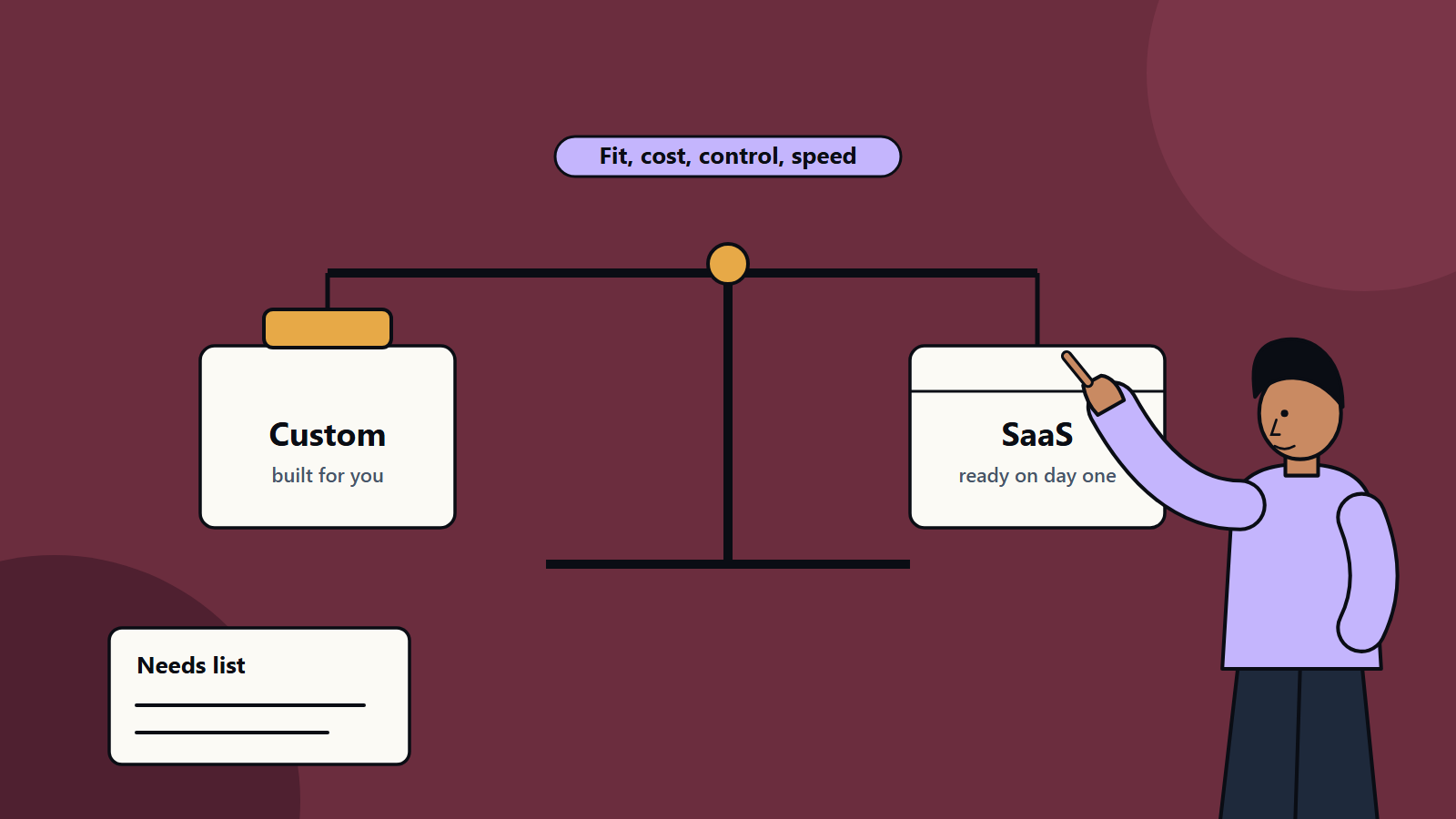
Short on time? Buy a SaaS product when the need is common and speed matters. Build custom software when the process gives you an edge, existing tools cannot fit, or integration and data control are central. Many companies do both, buying the standard parts and building the differentiating ones.
Every growing business meets this question sooner or later. A spreadsheet stops coping, or a process spans three tools, and someone asks whether to subscribe to a product or build something. Both routes can work well. Both can also go wrong when chosen for the wrong reasons.
This guide sets out a clear way to decide, with the cost and risk factors that are often missed. It applies to a start-up choosing its first tools and to an enterprise reviewing hundreds of applications.
Key takeaways
- SaaS gives speed, predictable running costs and vendor-managed upgrades. Custom software gives fit, control and the ability to differentiate.
- Count total cost over three to five years, including integration, training, licences that grow with users and maintenance.
- Check how each option handles your data, security, compliance and exit.
- A hybrid is common: SaaS for standard functions, custom software for what makes your business different.
- Decide with a scored shortlist so that preference alone does not settle it.
What each option offers
SaaS is software run by a vendor and used by subscription. You configure it but do not control the code. Examples of categories include CRM, accounting, project management and HR systems.
Custom software is built for your requirements, either by an in-house team or a development partner. You decide features, design and data model, and you own or license the code according to your contract.
Where SaaS usually wins
- The function is common across industries, so a mature product likely covers it.
- You need to start within days or weeks.
- You prefer operating costs to up-front investment.
- You have little in-house technical capacity.
- Regular updates and vendor security practices matter more than control.
Where custom software usually wins
- The process is a source of competitive advantage and should not be shared with competitors using the same product.
- Your workflow differs enough that configuring a product would mean heavy workarounds.
- You must integrate deeply with legacy systems, devices or partner platforms.
- Data location, privacy or regulation require tight control.
- Licence costs would grow steeply with users or transactions.
- You want to build a product of your own, for example a customer portal or a platform you sell.
The real cost comparison
Compare over a period of at least three years.
For SaaS, add up:
- Subscription fees at your expected user numbers, including price rises and tiers.
- Setup, configuration and data migration.
- Integrations and connector subscriptions.
- Training and change management.
- Extra modules you will need later.
For custom software, add up:
- Discovery, design and development.
- Hosting, monitoring and security.
- Ongoing maintenance, which is commonly a meaningful share of the original build cost each year.
- Product ownership inside your business.
- Future features and replatforming.
Neither list is complete without the cost of a wrong fit: time lost to workarounds, errors, and staff who stop using the tool.
Risk factors to check
- Vendor risk: pricing changes, product direction, takeovers and service outages.
- Lock-in: how easy is it to export your data in a usable form, and what does the contract say about exit?
- Security and compliance: certifications, data residency options, audit logs and access controls.
- Build risk: scope growth, delivery delays and dependence on a small number of people who know the code.
- Integration risk: how each option connects to what you run today.
A scoring approach
Write down the requirements and weight them by importance from 1 to 5. Score each option on every requirement. Typical headings include:
- Functional fit
- Speed to start
- Three-year cost
- Integration needs
- Security and compliance
- Data control
- Ability to scale
- Flexibility to change
- Internal capacity to run it
Agree the weights before you score, so the numbers support the decision and do not decorate a preference.
The hybrid route
Many organisations buy the standard platform and build around it. Examples include a SaaS CRM with a custom customer portal on top, an off-the-shelf accounting system with custom reporting, or a commerce platform with bespoke pricing logic. Good hybrids rely on stable APIs, clear ownership of data and a plan for how upgrades will affect custom parts.
Questions to ask vendors and development partners
For SaaS vendors:
- Can we export all our data, and in what format?
- What is the roadmap, and how are customer requests handled?
- What are the uptime commitments and support hours?
- How does pricing change as we grow?
For development partners:
- Who owns the code and the intellectual property?
- How will you document and hand over the system?
- How do you test, and how do you handle security?
- What does ongoing support cost?
When to revisit the decision
Review annually. A tool that fitted at ten users may strain at a hundred. A custom system may become a good candidate for replacement when a mature product catches up.
Support from SoftSapien
SoftSapien works on both sides of this decision. Our teams help businesses evaluate SaaS options, integrate them into existing systems and build custom applications where standard products fall short. Relevant services include custom software development, SaaS development and enterprise software integration.
If you are weighing options now, the contact page lets you chat with our team, send a message or schedule a free consultation call to talk it through.
Frequently asked questions
When is SaaS the better choice?
SaaS suits common functions that mature products already cover, when speed matters, when you prefer operating costs and when you have limited technical capacity.
When should a business build custom software?
Build when the process gives you an advantage, products cannot fit without heavy workarounds, deep integration or data control is required, or licence costs would grow steeply.
How do I compare costs fairly?
Compare over three to five years and include subscriptions, setup, integrations, training and migration for SaaS, and design, build, hosting, maintenance and ownership for custom software.
Can I combine both?
Yes. Many organisations buy a standard platform and build around it, such as a custom portal on top of a SaaS CRM, using stable APIs and a plan for upgrades.
Can SoftSapien help me decide?
We evaluate options, integrate SaaS products and build custom applications where needed. Contact SoftSapien through the contact page to chat with our team, send a message or schedule a free consultation call.