Short on time? Blockchain helps a supply chain when several organisations that do not fully trust each other need a shared, tamper-evident record. It rarely helps inside a single company or where a normal database will do. Start with the problem, test whether a shared ledger is needed and pilot with a small group of partners.
Blockchain generated enormous hype and then a wave of disappointment. In supply chains it still has real, if narrow, uses. Tracking provenance, proving that a product stayed cold, tracing a batch after a recall and reconciling paperwork between trading partners all involve many parties and a need for shared truth.
The same features that make blockchain useful also make it costly and complex. This guide offers a sober view for operations leaders and technology teams, from a food producer with a few partners to a global manufacturer with thousands of suppliers.
Key takeaways
- A blockchain is a shared ledger of records that is hard to alter without detection, maintained by several parties.
- It suits multi-party workflows with trust gaps. A standard database suits most single-owner needs.
- Data quality at the point of entry matters more than the ledger. Bad data on a blockchain is still bad data.
- Governance, standards and partner adoption decide success.
- Pilot with a clear question and a few committed partners.
What blockchain is
The US National Institute of Standards and Technology describes blockchains in its report Blockchain Technology Overview as tamper evident and tamper resistant digital ledgers, implemented in a distributed fashion and usually without a central authority. The report explains the building blocks: hash functions and digital signatures, consensus models for agreeing on the next record, smart contracts that run agreed rules automatically and data feeds called oracles that bring real-world information in.
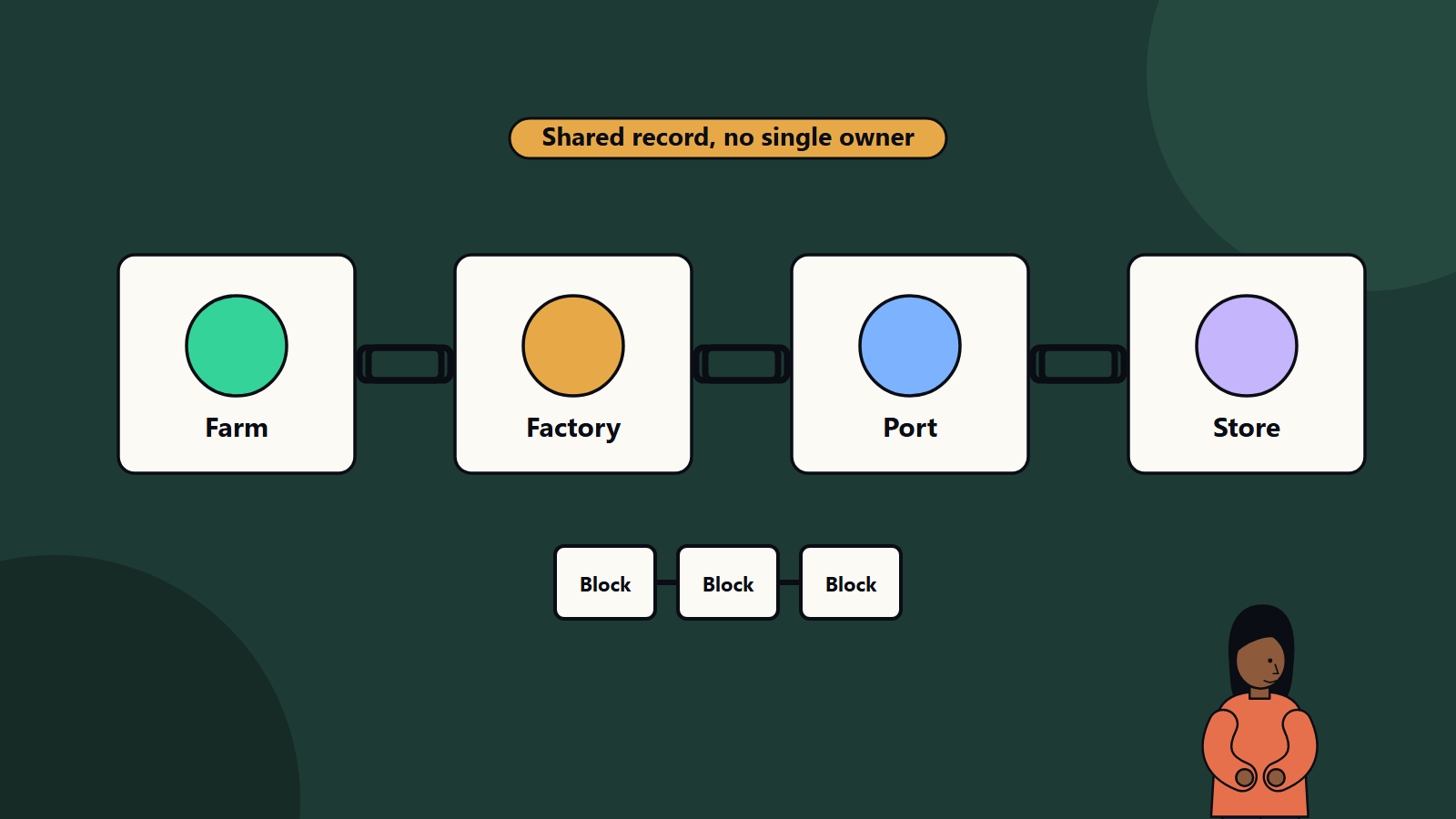
In a supply chain, each participant holds a copy of the ledger or access to it. New records, such as “batch 4471 shipped from plant A”, are added when the participants’ agreed rules are met. Past records cannot be quietly changed.
Where it can help
- Provenance and traceability. Following a product from origin to shelf: which farm, factory, shipment and store. Valuable for food safety, pharmaceuticals, luxury goods and ethically sourced materials.
- Recalls. Finding exactly which batches and locations are affected, in minutes and not days.
- Documentation. Bills of lading, certificates and customs documents shared among shippers, ports, banks and authorities, reducing delays and mismatches.
- Compliance and certification. Proof that products meet standards, with certificates that others can verify.
- Trade finance and payments. Smart contracts that release payment when delivery conditions are confirmed.
- Anti-counterfeiting. Verifying that a product is genuine.
- Sustainability reporting. Sharing verified emissions and sourcing data.
Where it usually does not help
- Single-company processes. If one organisation controls the data, a regular database is simpler, faster and cheaper.
- When parties already trust a neutral platform that everyone is willing to use.
- High-speed, high-volume transaction processing that needs very low latency.
- Situations with poor data capture. A ledger records what is entered. If a worker scans the wrong item, the error is preserved.
- When partners will not join. A network with one member has no value.
A useful test, in line with common guidance, is to ask whether multiple parties write data, whether they lack full trust in each other, whether a trusted third party is unavailable or unwanted and whether an auditable history matters. If most answers are no, use a conventional system.
The data problem
The ledger proves that a record has not changed since entry. It does not prove that the record was true when entered. Link the digital record to the physical world with care:
- Use sensors, scanners and tags such as barcodes, QR codes and RFID that reduce manual entry.
- Capture data at the source, with identity of the person or device.
- Validate against other data, such as weight, temperature and location.
- Audit and sample physical goods.
- Agree on data standards, such as product identifiers and event formats, so records from different partners fit together. Global standards bodies publish such formats.
Our article on IoT architecture describes how sensor data reaches platforms reliably.
Design choices
- Public or permissioned. Supply chain networks are usually permissioned, with known participants. Public networks offer openness and higher cost and exposure.
- What goes on the ledger. Often only hashes and key events go on the chain, while documents and bulk data sit off-chain in secure storage. This protects confidential information and reduces size.
- Consensus method. Chosen for the trust model, speed and energy use. Permissioned networks commonly use methods that are far lighter than the energy-hungry methods of some public networks.
- Smart contracts. Encode rules clearly and test them. Errors in a contract are hard to fix after deployment, so audit them. Our article on smart contract security audits covers what reviewers check.
- Integration. Connect to ERP, warehouse, transport and customs systems through APIs. The ledger should fit the workflow, with no extra data entry for users.
- Privacy. Control who sees which records. Design for data protection laws, including rights to erase data, which sit awkwardly with immutable records. Keep personal data off the chain.
Governance
Technology is the easier part. Agree:
- Who can join, and how participants are onboarded and removed.
- Who runs nodes and pays for them.
- Rules for data quality and dispute resolution.
- How the rules change over time.
- Legal status of records and smart contracts.
- Commercial model: who benefits and who pays.
Many projects failed because participants could not agree on governance and cost sharing.
Run a pilot
- Define the question, such as “trace any batch to its source within one hour”.
- Choose a narrow scope: one product line, a few partners, one or two events.
- Set measures: time to trace, error rate, cost per record, partner effort.
- Build a minimum solution using an existing platform where possible.
- Compare with a conventional alternative such as a shared database or a standard platform.
- Decide whether to scale, change or stop.
Cost and effort
Costs include platform fees or infrastructure, integration, devices, partner onboarding, governance, support and training. Benefits often appear as fewer disputes, faster recalls, lower audit costs and higher customer trust, which can be difficult to quantify. Build a business case that reflects this. Our guide to building a technology business case offers a structure.
Common mistakes
- Starting with the technology and looking for a problem.
- Underestimating partner onboarding.
- Putting sensitive or personal data on the chain.
- Ignoring data capture quality.
- Building a closed network that no one else will join.
- Neglecting smart contract testing.
How SoftSapien approaches blockchain projects
SoftSapien helps organisations test whether a ledger is the right tool, then design, build and secure pilots and production networks, with attention to integration, governance and data quality. See our blockchain development and IoT development services.
To test an idea, go to the contact page and chat with our team, send a message or schedule a free consultation call.
Frequently asked questions
When does blockchain help a supply chain?
When several organisations that do not fully trust each other need a shared, tamper-evident record, for example for provenance, recalls, shared documents or certification.
When is a normal database enough?
When one organisation controls the data, when partners already trust a neutral platform or when high-speed transaction processing is the main need.
Does blockchain guarantee data accuracy?
No. It shows a record has not changed since entry, not that it was true when entered, so data capture at the source and validation matter.
How should I start?
Define a narrow question, choose a few committed partners, build a minimum solution, compare against a conventional alternative and decide whether to scale.
Can SoftSapien help assess a blockchain idea?
Yes, from assessment to secure pilots. Contact SoftSapien through the contact page to chat with our team, send a message or schedule a free consultation call.