Short on time? Generative AI produces content when you ask for it. Agentic AI pursues a goal by planning steps, using tools and checking its own results. Pick generative AI when a person reviews every output. Pick agentic AI when a repeatable process spans several systems and you can set firm limits on what the agent may do.
Most businesses met AI through a chat window. You type a question, a model writes an answer, and you decide what to do with it. That is generative AI, and it already saves hours on drafting, summarising and research. A newer pattern, agentic AI, hands the model a goal and the tools to work towards it. The model books the meeting, updates the record, sends the reminder and tells you when it is done.
The two share the same underlying models, which is why they get confused. The difference sits in who does the acting. This guide explains where each one fits, what changes when software starts to act on its own, and how to choose for a business of any size.
Key takeaways
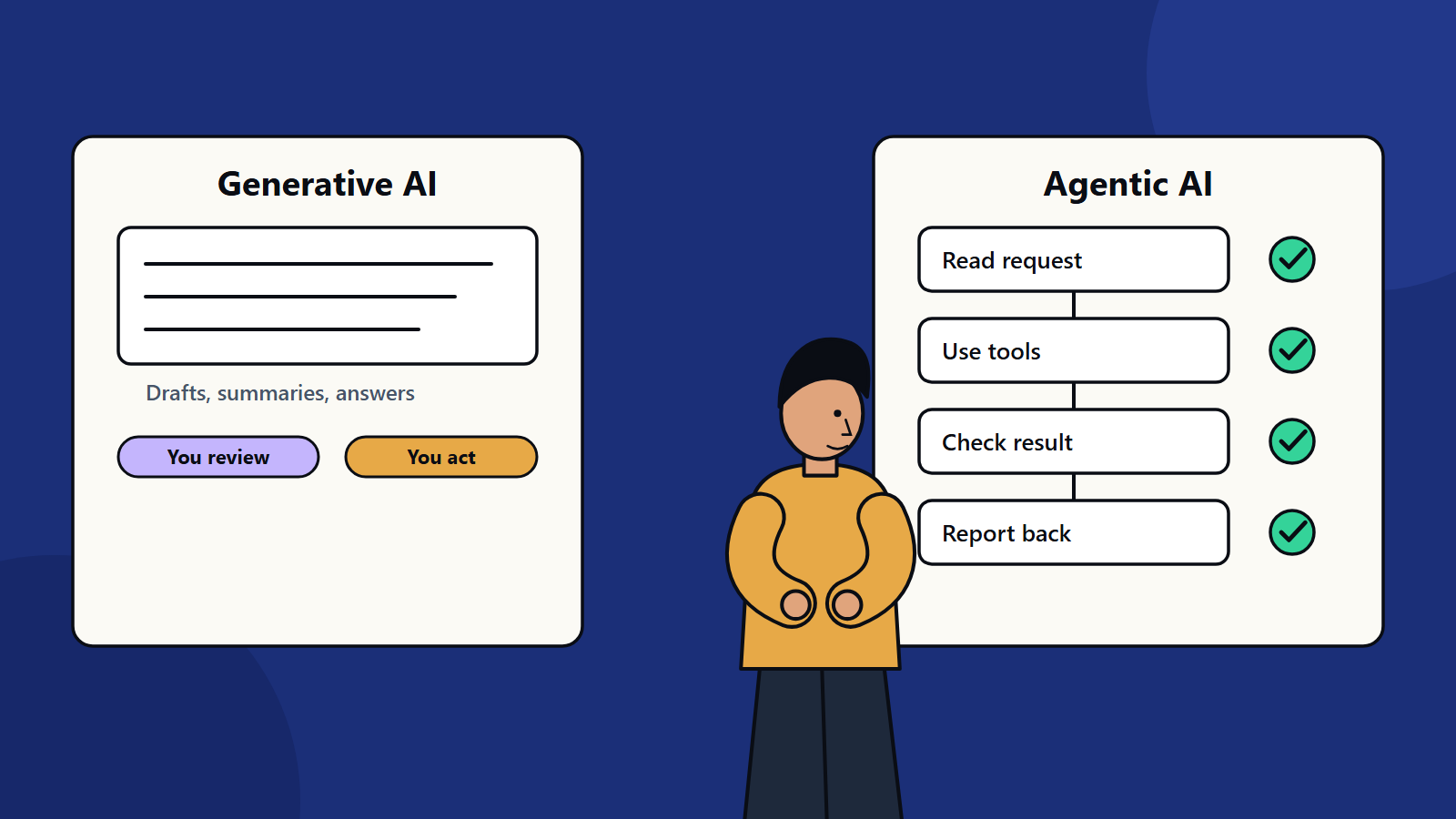
- Generative AI creates text, images, code or summaries in response to a prompt. A person decides what happens next.
- Agentic AI plans a sequence of steps, calls tools such as email, databases and APIs, and checks results before reporting back.
- Agents carry more risk because they act. They need permission limits, approvals and logs.
- Many successful projects start with generative AI, then add agent behaviour to one narrow, well-understood process.
- A short scoring checklist helps decide which approach a given task needs.
What generative AI does
A generative model predicts and produces content. You give it instructions and context, and it returns a draft. Typical uses include:
- Drafting emails, proposals, product descriptions and reports.
- Summarising long documents, meetings and support threads.
- Explaining code, suggesting fixes and writing tests.
- Answering questions over a set of company documents.
- Translating and rewriting content for different audiences.
In every case the output is a suggestion. The person asking reads it, edits it and takes the action. That human step is a built-in safety check, and it is also why generative AI is easy to adopt: no system access is needed beyond the content you paste in or connect.
What agentic AI does
An agent combines a model with a loop. It reads a goal, decides on a plan, picks a tool, runs it, looks at the result and decides what to do next. It repeats until the goal is met or it needs help.
A support agent, for example, can read a refund request, look up the order, check the policy, issue the refund within a set limit, send the customer a confirmation and write a note in the CRM. A finance agent can match invoices to purchase orders and flag the mismatches. An IT agent can reset a password after checking identity, then log the ticket.
Agents use tools through connections such as APIs. They hold credentials, which means they can change real data. The same capability that makes them useful is the reason they need careful limits.
The differences that matter
- Who acts: a person takes the action with generative AI. The software takes it with an agent.
- Scope of access: generative AI often needs only text. Agents need accounts, keys and permissions in other systems.
- Number of steps: generative AI answers in one step. Agents chain many steps, and an early mistake can carry forward.
- Speed to value: generative AI shows benefits in days. Agent projects take longer because of integration, testing and controls.
- Risk profile: a poor draft is caught by the reader. A poor agent action may already have happened by the time anyone looks.
- Cost pattern: agents make many model calls per task, so spend grows with volume and complexity.
When generative AI is the better choice
Choose a generative approach when:
- A person needs to judge quality, tone or accuracy before anything goes out.
- The task is occasional or varies each time.
- The work does not touch other systems.
- You are still learning what the model does well on your content.
- Regulation or policy requires a named human decision.
Sole proprietors and small teams can get most of their early value here. A founder who drafts customer replies with an assistant, then sends them personally, has gained time with almost no new risk.
When an agent fits
Agents make sense when:
- The process is repeated often and follows rules that can be written down.
- The work spans several tools, so a person spends their day copying data between them.
- The cost of an error is limited and reversible, or an approval step covers the higher-risk actions.
- Inputs are reasonably clean, and success can be measured.
- You can log every step and switch the agent off quickly.
Typical candidates include ticket triage, invoice matching, lead enrichment, appointment scheduling, report assembly and routine IT requests.
A five-question checklist
Ask these about any task before you choose:
- What is the worst realistic outcome if the AI gets it wrong? If the answer is serious, keep a human in the loop.
- Can the action be undone? Reversible actions suit more autonomy.
- How often does the task occur? Rare tasks rarely repay the build effort for an agent.
- How many systems does it touch? More systems mean more integration work and more permissions to manage.
- Can you test it? If you cannot build a set of realistic examples to measure quality, you are not ready for autonomy.
Controls to add as autonomy grows
Moving from generative to agentic work raises the bar for governance. The OWASP guidance on excessive agency recommends limiting the functions and permissions an agent holds and requiring human approval for high-impact actions. The NIST AI Risk Management Framework provides a wider structure for mapping and managing AI risk. In practice, that means giving each agent its own identity, granting the least access it needs, logging each step and setting up a quick way to pause it.
A staged path
Many organisations move in stages:
- Assist: staff use generative AI for drafts and summaries.
- Connect: the model gains read-only access to company knowledge.
- Propose: the agent prepares actions and a person approves them.
- Act within limits: the agent completes low-risk actions alone and escalates the rest.
Each stage produces data on accuracy and cost, which makes the next decision easier.
Common mistakes
- Calling every chatbot an agent and expecting autonomous results.
- Giving an agent broad administrator access for convenience.
- Skipping a test set and judging quality by a few demos.
- Automating a broken process, which makes the problem faster.
- Ignoring running costs until the first large invoice arrives.
Working with SoftSapien on AI
Teams that come to SoftSapien usually want a clear view of where AI will pay back and where it will not. Our AI specialists look at your processes, data and tools, then recommend a mix of generative assistants and carefully limited agents, and build and run them with security in mind. You can read more about our AI development work, or see how we support conversational AI and chatbots.
If you would like to talk through a specific use case, reach us through the contact page. You can chat with the team, send a message or schedule a free consultation call.
Frequently asked questions
What is the difference between generative AI and agentic AI?
Generative AI produces content such as text, images or code in response to a prompt, and a person decides what to do with it. Agentic AI pursues a goal by planning steps, using tools and checking results, so it can take actions in other systems.
Is agentic AI better than generative AI?
Neither is better in general. Generative AI suits tasks where a person reviews each output. Agentic AI suits repeatable processes that span several systems and have clear limits on what the agent may do.
Why does agentic AI carry more risk?
Agents hold credentials and can change real data. An early mistake can pass through several steps before anyone notices, so they need least-privilege access, approval for high-impact actions and detailed logs.
Can a small business use AI agents?
Yes, for narrow tasks such as appointment scheduling, lead follow-up or invoice matching. Start with a low-risk process, keep a person approving important actions and measure results before expanding.
How should we start with agentic AI?
Begin with generative assistants for drafts and summaries, connect them to read-only company knowledge, then let an agent propose actions for approval before it acts alone on low-risk tasks. Contact SoftSapien through the contact page to chat with our team, send a message or schedule a free consultation call.