Short on time? AI results depend on the data feeding them. Inventory your sources, agree one definition for each key term, connect and clean the data through reliable pipelines, record where it came from and who may use it, and monitor quality over time. Start with the data behind one use case.
Teams often begin an AI project by choosing a model. Then they find that customer records sit in three systems with different spellings, sales figures differ between the CRM and finance, and half the useful knowledge lives in documents no system can search. The model was never the hard part.
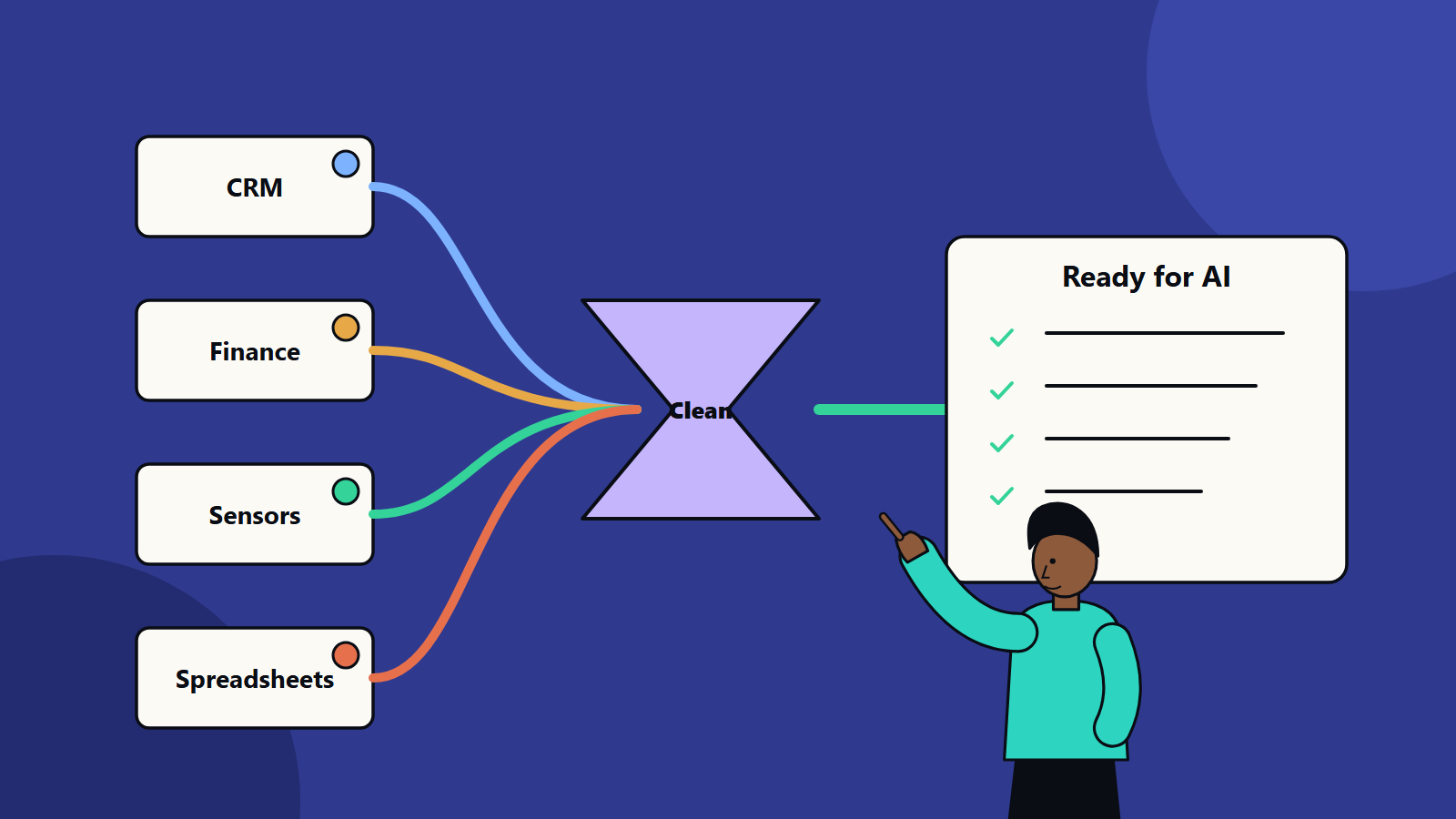
AI data integration is the work of connecting, cleaning and preparing data so models and agents can use it safely and accurately. It matters for a small business that wants an assistant to answer from its own price list as much as for a multinational building predictive models across regions.
Key takeaways
- Start with the use case, then identify the exact data it needs.
- Agree shared definitions for terms such as customer, active user and revenue before connecting anything.
- Build repeatable pipelines with checks, so data flows without manual copying.
- Unstructured data such as documents, emails and call transcripts needs its own preparation.
- Track lineage, access rights and quality. These are what make AI outputs defensible.
Why integration decides AI outcomes
A model can only work with what it sees. If sources conflict, the output reflects the conflict. If data is stale, answers are stale. If personal data is mixed in without controls, the project creates a privacy problem. Integration addresses each of these by making data consistent, current and governed.
Step 1: Pick the use case and list the data
Write the question the AI must answer or the decision it supports. For example, “predict which customers may cancel next quarter” or “answer staff questions about leave policy”. Then list the data needed: tables, files, documents, event streams and external sources. Note the owner, location, format, update frequency and sensitivity of each.
Step 2: Agree definitions
Two departments may use the same word differently. Does a customer include trial users? Is revenue booked or invoiced? Write a short glossary of the terms the project uses and get owners to sign off. A semantic layer or data catalogue can then publish these definitions for everyone. The DAMA body of knowledge provides a widely used reference for data management disciplines such as governance, quality and metadata.
Step 3: Connect the sources
Choose the integration style that suits each source:
- Batch transfer: scheduled loads, suitable for data that changes daily or less often.
- Streaming: continuous flow for events that must be fresh, such as transactions or sensor readings.
- APIs: direct access to application data in real time.
- Change data capture: copying only what changed from a database, which reduces load.
- Virtualisation: querying data where it lives, useful when copying is not allowed.
Use managed integration tools where you can. Custom scripts work for small cases but become fragile as sources grow.
Step 4: Clean and standardise
Typical tasks include:
- Removing duplicates and merging records that refer to the same person or product.
- Standardising formats for dates, currencies, units, names and addresses.
- Handling missing values with a documented rule.
- Fixing obvious errors, such as impossible dates and negative quantities.
- Resolving identifiers so the same customer has one key across systems.
Keep the raw data untouched and apply cleaning in later layers, so you can trace and repeat the steps.
Step 5: Prepare unstructured data
Much valuable knowledge sits in text. To use it with language models:
- Collect documents from approved sources only.
- Convert them to clean text, and keep headings and structure.
- Remove or mask personal and confidential details.
- Split into passages that make sense on their own.
- Add metadata such as source, owner, date, language and access level.
- Index the passages for search, using keyword and semantic methods.
- Refresh the index whenever documents change, and remove content that was withdrawn.
Step 6: Build pipelines with checks
Automate the flow from source to model. Build checks into each stage: row counts, ranges, null rates, freshness and rule tests such as “every order has a customer”. When a check fails, stop the flow and alert the owner. Silent bad data is worse than a visible delay.
Step 7: Govern access and lineage
Record where each dataset came from, what was done to it and who may use it. Enforce access rules at the data layer so a model or agent sees only what the user is allowed to see. Check where regulations affect cross-border transfers and retention, since requirements differ by country and sector.
Step 8: Monitor over time
Data drifts. Customer behaviour changes, systems are upgraded and fields are repurposed. Monitor input distributions, quality scores and model performance, and set thresholds that trigger a review. Keep a feedback route for users to flag wrong outputs, and trace them back to the data.
Quality measures to track
- Completeness: share of required fields filled.
- Accuracy: agreement with a trusted source on a sample.
- Consistency: same value across systems.
- Timeliness: delay between event and availability.
- Uniqueness: share of duplicate records.
Common mistakes
- Starting with the largest dataset instead of the one tied to a business question.
- Copying data into a new store without governance, creating a shadow system.
- Skipping definitions, which leads to dashboards nobody trusts.
- Treating preparation as a one-off project.
- Forgetting the rights and consent attached to the data.
Preparing your data with SoftSapien
SoftSapien helps organisations connect systems and prepare data for analytics and AI, from first assessment to automated pipelines and monitoring. Our teams work across data science, big data engineering and enterprise software integration.
If you have a use case in mind and want an honest view of your data readiness, use the contact page to chat with us, send a message or schedule a free consultation call.
Frequently asked questions
What is AI data integration?
It is the work of connecting, cleaning and preparing data from different sources so models and agents can use it accurately and safely.
Why does data integration matter for AI?
A model reflects the data it sees. Conflicting, stale or ungoverned data leads to wrong answers and privacy risk, while consistent and current data improves results.
How do I prepare documents for a language model?
Collect approved documents, convert to clean text, remove sensitive details, split into self-contained passages, add metadata, index them and refresh the index whenever content changes.
Which data quality measures should I track?
Track completeness, accuracy, consistency, timeliness and uniqueness, and alert owners when checks fail.
Where do I start?
Pick one use case, list the data it needs and agree definitions with the owners. Contact SoftSapien through the contact page to chat with our team, send a message or schedule a free consultation call.