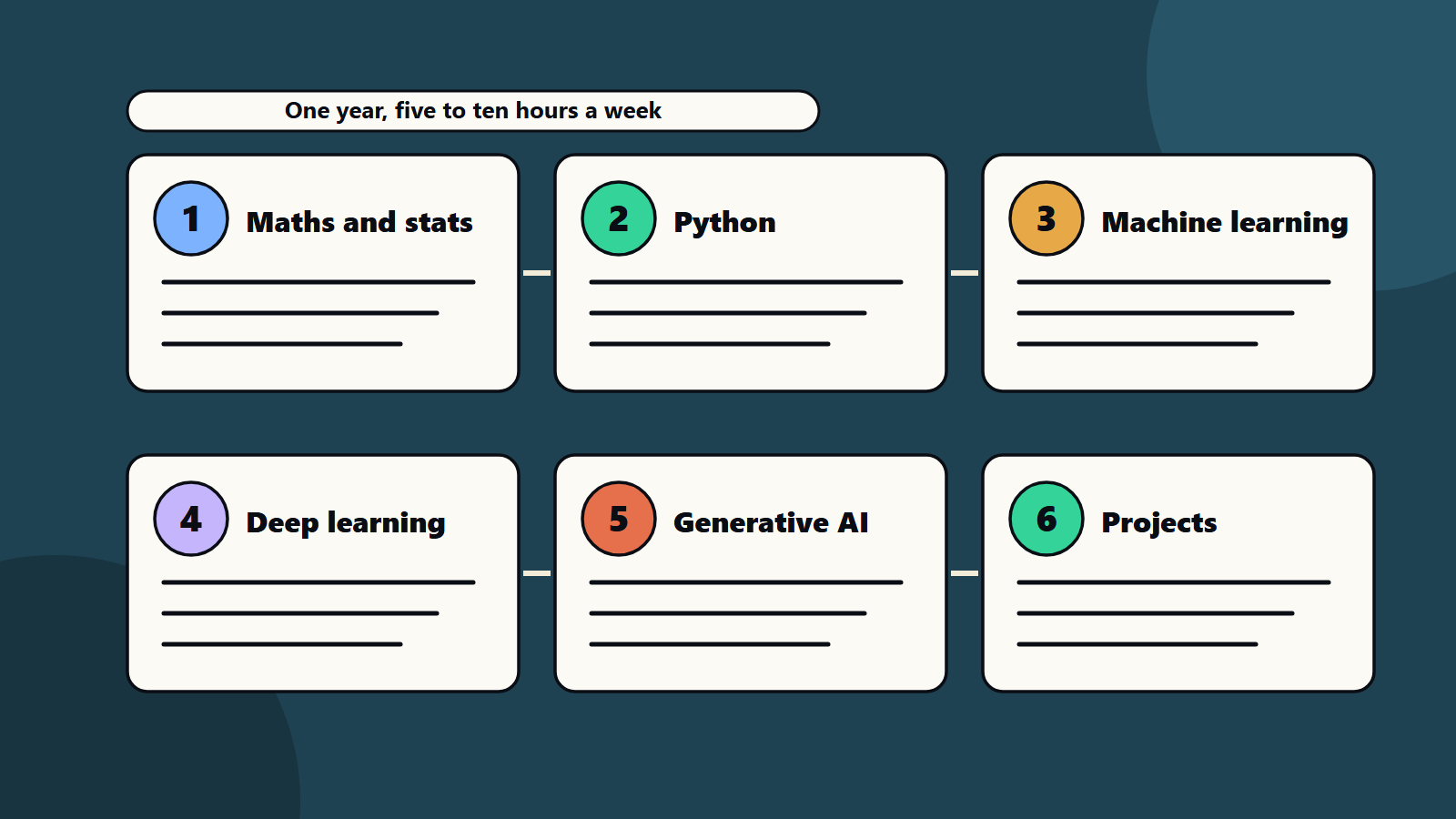
Short on time? To learn AI from scratch, follow six stages: basic maths and statistics, a programming language such as Python, machine learning fundamentals, deep learning, generative AI and a portfolio of real projects. Use free, first-party courses from Google, Microsoft and Hugging Face, study a little every day and build something at each stage. This guide gives you a 12-month plan, resources, code to try and the mistakes to avoid.
Artificial intelligence moves fast, and beginners often feel behind before they start. The good news is that the foundations change slowly. Data, maths, code and good habits help you in every wave of tools.
This guide is for adults changing careers, students, managers who want to understand their teams and developers adding AI to their skills. You do not need a degree to start. You do need patience, practice and a plan.
Key takeaways
- Learn in stages: maths and statistics, Python, machine learning, deep learning, generative AI and projects.
- Google’s Machine Learning Crash Course covers models, data, neural networks, embeddings, large language models and production systems, and suits beginners.
- Microsoft’s Azure AI Fundamentals certification covers AI workloads, machine learning, computer vision, language processing and generative AI, and expects some Python.
- Hugging Face offers free courses on large language models, agents and more, and Microsoft’s Generative AI for Beginners has 21 self-contained lessons.
- Build small projects from week one. Projects teach more than videos.
What AI is, in plain words
Artificial intelligence is software that performs tasks that normally need human judgement, such as recognising images, understanding text or choosing the next best action. Most modern AI is machine learning: you show a program many examples and it learns patterns, with no need to write every rule.
Three layers help you place the terms:
- Artificial intelligence: the broad goal.
- Machine learning: learning from data.
- Deep learning: machine learning with many-layered neural networks, which powers modern language, image and speech models.
Generative AI, such as chat assistants and image generators, is a branch of deep learning that produces new text, images, audio or code.
The six stages to learn AI from scratch
Stage 1: maths and statistics (weeks 1 to 8)
You need enough maths to understand what models do. You will not need to prove theorems.
- Algebra and functions: variables, equations, graphs.
- Linear algebra: vectors and matrices. Data and models are made of them.
- Probability and statistics: averages, spread, distributions, sampling, correlation and testing ideas.
- Calculus basics: the idea of a slope, which explains how models learn by small adjustments.
Study little and often, and connect each idea to code as soon as you can.
Stage 2: programming with Python (weeks 3 to 14)
Python is the main language for AI work. The official Python tutorial is written for programmers who are new to Python and gives a feel for the language’s style, ending with the ability to read and write modules and programs. If you are new to programming itself, start with a beginner course first, then return to it. See our Python for AI guide.
Try this tiny program to practise lists, loops and functions:
def average(numbers):
    return sum(numbers) / len(numbers)

scores = [72, 85, 90, 64, 88]
print("Average score:", average(scores))

for score in scores:
    if score > average(scores):
        print(score, "is above average")
Stage 3: machine learning fundamentals (weeks 10 to 24)
Google’s Machine Learning Crash Course is a practical introduction that uses animated videos, interactive visualisations and exercises. Its modules cover linear and logistic regression and classification, working with numerical and categorical data, datasets, generalisation and overfitting, then neural networks, embeddings and large language models, and finally production systems, automated machine learning and fairness. Beginners should follow the modules in order.
Practise with the scikit-learn library. Its getting started page shows the core pattern of fitting an estimator and predicting:
clf = RandomForestClassifier(random_state=0)
clf.fit(X, y)       # X: (n_samples, n_features), y: 1D targets
clf.predict(X)
Our machine learning for beginners guide walks through a full example.
Stage 4: deep learning (weeks 22 to 36)
Learn how neural networks work: layers, weights, activation functions, loss, back-propagation and gradient descent. Then study the main families: networks for images, networks for sequences and transformers, the design behind modern language models. Use a framework such as PyTorch or TensorFlow, and train small models before big ones. Hugging Face’s learning hub offers free courses, including one on large language models using its libraries, one on agents, one on diffusion models and one on computer vision.
Stage 5: generative AI and agents (weeks 30 to 44)
Learn prompting, embeddings, retrieval-augmented generation, fine-tuning, evaluation and safety. Microsoft’s Generative AI for Beginners has 21 self-contained lessons, so you can start anywhere, including prompt engineering, retrieval and vector databases, AI agents and fine-tuning, with code samples in Python and TypeScript. Our generative AI explained guide gives the big picture first.
Stage 6: projects and portfolio (all along, with a big push in weeks 40 to 52)
Employers and clients trust what you can show. Build three to five projects and publish them with a clear write-up.
Certifications and structured paths
Certificates are optional, and a good one gives structure. Microsoft’s Azure AI Fundamentals certification targets people at the beginning of a career in AI solution development. It measures knowledge of AI workloads, machine learning principles, computer vision, natural language processing and generative AI on Azure, and it expects knowledge of Python coding syntax and programming techniques. Check the exam page for the current code and objectives, since they are updated.
A 12-month study plan
- Months 1 to 2: maths refresh, Python basics, a command line and Git. One tiny project: a script that summarises a spreadsheet.
- Months 3 to 4: data handling with pandas and NumPy, plotting and the first half of the Machine Learning Crash Course. Project: predict house prices or similar from a public dataset.
- Months 5 to 6: finish machine learning fundamentals, learn evaluation properly and build a classification project with a clean notebook.
- Months 7 to 8: deep learning basics. Project: image classifier trained on a small public dataset.
- Months 9 to 10: language models, embeddings and retrieval. Project: a question-answering tool over your own documents. See retrieval-augmented generation.
- Months 11 to 12: agents, evaluation, deployment and safety. Project: a small agent with guardrails and a test set. See AI agent governance.
Study five to ten hours a week and the plan holds. Fewer hours simply stretch it.
Project ideas by stage
- Data summary script: read a CSV, print totals and averages.
- Price predictor: linear regression on a public dataset.
- Spam or sentiment classifier: text classification with a simple model.
- Image classifier: recognise a few types of object.
- Document search: embeddings and retrieval over your notes.
- Support triage tool: label messages by topic and urgency.
- Agent with tools: a helper that looks up facts and drafts replies, with a person approving.
How to study well
- Code along. Type examples yourself, and change them.
- Teach it back. Write a short explanation after each topic.
- Use a notebook. Record what you tried and what failed.
- Join a community. Ask questions, and share projects.
- Check your results. Always compare against a simple baseline.
- Revisit. Return to the maths when a topic confuses you.
Responsible AI from day one
Models can be wrong, biased or misused. Learn about data quality, fairness, privacy and safety early. See data quality for machine learning and responsible AI policy.
Careers and roles
- Data analyst: SQL, spreadsheets, dashboards and statistics.
- Data scientist: models, experiments and communication.
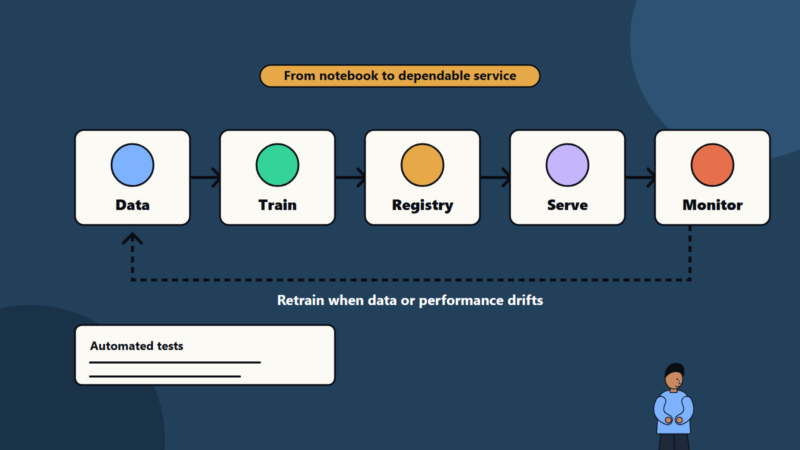
- Machine learning engineer: training, deploying and monitoring models. See MLOps basics.
- AI engineer: building products with existing models, retrieval and agents.
- Product or business roles: choosing use cases and measuring value. See choosing your first AI use case.
Learners with different backgrounds
- Business leaders: focus on concepts, use cases, risk and measurement, and do a short Python course for confidence.
- Developers: skip basic programming, and spend more time on maths, evaluation and data.
- Students: build projects early, since coursework alone rarely shows skill.
- Career changers: use your domain knowledge. A nurse, lawyer or engineer who knows AI has an edge in that field.
Regional and access notes
Many of the resources above are free and available worldwide, and some have translations. Exam availability, prices and languages vary by country. Check each provider’s page, and choose courses in a language you are comfortable with.
Common mistakes
- Watching videos without writing code.
- Skipping maths entirely, then getting stuck on basics.
- Jumping straight to the newest tool.
- Never finishing a project.
- Ignoring data quality and evaluation.
- Comparing yourself with experts when last month’s you is the fair benchmark.
A starting plan for this week
- Install Python, and write the average program above.
- Open the first module of the Machine Learning Crash Course.
- Pick a small question you care about, and find a public dataset.
- Keep a learning journal.
- Decide your next 12 weeks, and tell someone, so you stay accountable as you learn AI from scratch.
How SoftSapien supports AI learning and adoption
SoftSapien’s AI specialists run workshops, build learning paths for teams and help organisations apply what people learn to real projects, from first use cases to production systems. See our AI development and data science services.
To train your team or start an AI project, use the contact page to chat with our team, send a message or schedule a free consultation call.
Frequently asked questions
Do I need a degree to learn AI?
No. You need patience, practice, enough maths to understand what models do, Python and projects you can show.
Which language should I learn first?
Python, which is the main language for AI work. The official tutorial is written for programmers new to Python, so complete beginners should start with a beginner programming course first.
Which free courses are worth taking?
Google Machine Learning Crash Course, Microsoft Generative AI for Beginners and the Hugging Face Learn courses are good first-party starting points.
How long does it take?
About a year at five to ten hours a week to reach the stage of building small, tested AI projects.
Can SoftSapien help train our team?
Yes, with workshops and learning paths. Contact SoftSapien through the contact page to chat with our team, send a message or schedule a free consultation call.