Short on time? AI agent identity means giving every software agent its own verifiable identity, a named human owner, narrow permissions and a full activity trail. Agents will soon outnumber the people who use your systems, so treat them like employee accounts with stricter limits: short-lived credentials, approval steps for risky actions and a way to switch them off fast.
For years, access control meant people. A new employee gets an account, a manager approves access and an administrator removes it when they leave. AI agents change the picture. An agent can read email, query a database, call an interface and act on the results, all without a person watching each step.
If agents share a login, run with broad rights or have no owner, they become the weakest part of your security. This article explains how to govern AI agent identity in plain terms, using what Microsoft and IBM have said about trends in 2026. It suits a small business trying its first agent and an enterprise preparing for thousands.
Key takeaways
- Microsoft’s 2026 trends list says agents need security protections similar to humans, each with a clear identity, limits on the data and systems it can reach and managed data.
- IBM’s trends list expects non-human agent identities to far outnumber human users, which calls for new access controls.
- Give every agent a unique identity, a human owner, least privilege, short-lived credentials, logging and a kill switch.
- Separate what an agent may read, what it may propose and what it may do without approval.
- Start with a register of agents. You cannot govern what you cannot list.
What the big technology firms are saying
Microsoft’s seven AI trends for 2026 include safeguards for AI agents. In it, Vasu Jakkal, corporate vice president of Microsoft Security, says every agent should have similar security protections as humans, and warns against agents becoming “double agents” that carry unchecked risk. She lists what that means: a clear identity for each agent, limits on the information and systems it can access, and managed data. She adds that security should be built in from the start, and that trust is central.
IBM’s AI and technology trends for 2026 lists agent identity governance as a trend. It expects non-human agent identities to far outnumber human users and says that creates a need for new access controls. The same list names agent-to-agent communication, super agents and agent teams as trends, and each of those adds more identities to manage.
The NIST AI Risk Management Framework is a voluntary framework for managing AI risk across design, development, use and evaluation. Its idea of governing, mapping, measuring and managing risk gives a useful structure for agent controls.
What AI agent identity means
An agent identity is the record that answers four questions:
- Who is this agent? A unique name and credential, never shared with other agents or people.
- Who owns it? A named human or team who is accountable.
- What may it do? The data it can read and the actions it can take.
- What did it do? A trail of every request and decision.
It is the same idea as an employee account, with added care because agents act fast, at scale and sometimes in ways nobody planned.
Seven rules for governing agent identity
1. One agent, one identity
Do not let agents share an account or reuse a person’s login. Shared identities hide who did what and make removal risky. Create a service identity for each agent, in your normal identity system.
2. Name a human owner
Every agent needs an owner who understands its purpose and approves its access. When the owner leaves, the agent is reassigned or retired.
3. Least privilege
Give the agent only the rights it needs for its task. If it summarises invoices, it does not need to edit them. See our guide to zero trust security, which applies the same principle to people and systems.
4. Short-lived credentials
Use tokens that expire quickly and are issued for a task, so no secret lives for years in a configuration file. If a token leaks, the damage is short.
5. Act on behalf of a person, with limits
Many agents act for a user. Record both identities: the agent and the person it acts for. Limit the agent to the smaller of the two sets of rights.
6. Approval for risky actions
Let agents read and propose by default. Require a person to approve payments, deletions, external messages, changes to access and anything that is hard to undo. See AI agent governance.
7. Log, monitor and be ready to switch off
Record each request, tool call and result. Alert on unusual behaviour, such as a sudden rise in data reads. Keep a kill switch that disables an agent’s credentials at once. See incident response planning.
Guard against attacks on agents
Agents read text from emails, documents and web pages. Attackers hide instructions in that text to steer them. Strong identity limits the damage, since a tricked agent with narrow rights can do little. Pair it with input checks and testing. See prompt injection explained.
A worked example: a finance reconciliation agent
This example is illustrative.
A company deploys an agent that matches bank lines to ledger entries.
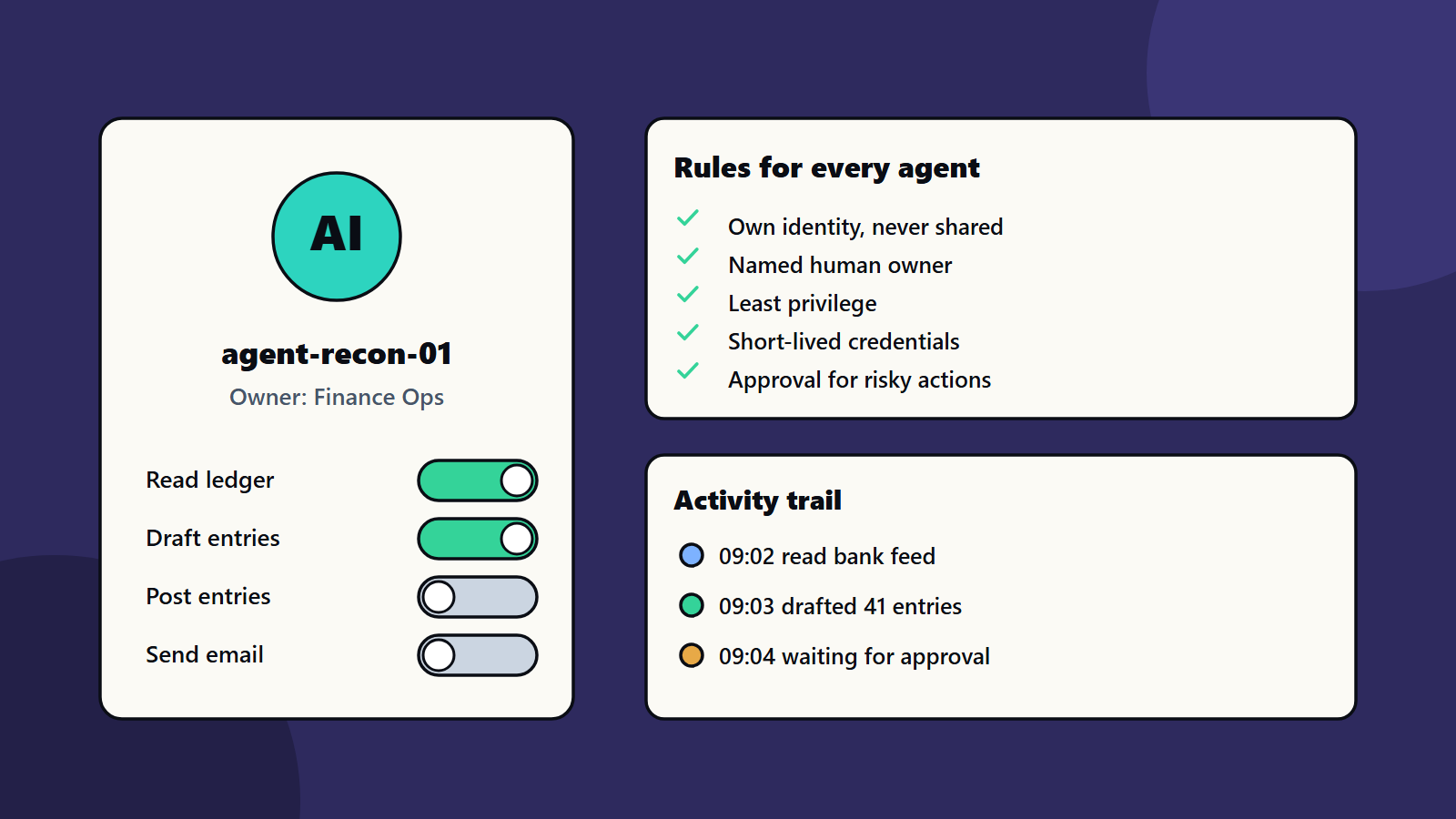
- Identity:
agent-recon-01, a service identity in the company’s identity system, with no interactive sign-in. - Owner: the finance operations manager, with a deputy.
- Rights: read access to the bank feed and ledger; permission to create draft journal entries; no permission to post them.
- Credentials: tokens that last one hour, issued by a broker when a reconciliation run starts.
- Approval: a person approves each batch of draft entries before posting.
- Logging: every read and draft is logged with the run id.
- Alerts: a warning if the agent reads more than twice its usual volume.
- Review: the owner re-certifies the agent’s access every quarter.
- Retirement: if the process changes, the owner disables the identity and records the date.
When the agent misreads a document that contains a hidden instruction, it still cannot post entries or reach other systems. The design limits the harm.
A simple agent register
Keep one list of all agents, even in a spreadsheet at first. Record:
- Name and purpose.
- Owner and deputy.
- Systems and data it can reach.
- Actions it can take, and which need approval.
- Where credentials are stored and how long they last.
- Date of the last access review.
- Date it was created and, if relevant, retired.
Metrics to track
- Number of agents, by owner and by risk level.
- Share of agents with a named owner.
- Share using short-lived credentials.
- Share with an access review in the last quarter.
- Number of high-risk actions approved and rejected.
- Time to disable an agent in a test.
Small business and enterprise views
- Sole trader or small business: use the agent features built into your main tools, give each agent its own account with minimum rights and write down who owns it. Avoid pasting passwords into prompts.
- Mid-size company: build the register, adopt service identities and short-lived tokens, and add an approval step for money and messages.
- Enterprise: extend identity governance to agents, with lifecycle automation, policy as code, central logging and regular audits. See AI agent use cases by department to plan which agents you will run.
Regional and regulatory notes
Rules on automated decisions, data access and record keeping differ by country and sector. Financial services, health and public bodies often need stronger evidence of who authorised what. Keep logs for the period your rules require, and check where identity and log data is stored. See data residency and sovereignty.
Common mistakes
- Agents running under a developer’s personal account.
- Long-lived keys stored in code.
- Broad rights granted “to make it work”.
- No owner, so nobody reviews access.
- Logs that record results but not who asked.
- No tested way to switch an agent off.
- Treating agent identity as an IT detail when it is a business control.
A starting plan
- List every agent and automation that uses an account today.
- Name an owner for each, and remove shared logins.
- Cut rights to the minimum, and move to short-lived credentials.
- Add approval for the riskiest actions.
- Test your kill switch, and review AI agent identity every quarter.
How SoftSapien supports AI agent identity
SoftSapien’s security and AI engineers help organisations design AI agent identity: registers, access models, approval flows, logging and tests, and connect them to your existing identity and monitoring systems. See our cybersecurity consulting and AI development services.
To put guardrails around your agents, use the contact page to chat with our team, send a message or schedule a free consultation call.
Frequently asked questions
What is AI agent identity?
A unique, verifiable identity for each agent, with a named human owner, defined permissions and a full activity trail, managed like an employee account with stricter limits.
Why do agents need their own identity?
Shared or borrowed logins hide who did what, make removal risky and give agents rights they do not need.
Which actions should need human approval?
Payments, deletions, external messages, changes to access and anything that is hard to undo.
How do we start?
List every agent and automation that uses an account, name an owner, cut rights to the minimum, move to short-lived credentials and test a kill switch.
Can SoftSapien help govern our agents?
Yes, from design to monitoring. Contact SoftSapien through the contact page to chat with our team, send a message or schedule a free consultation call.