Short on time? AI ROI is the gap between what a company spends on AI and the value it can prove. Capgemini calls 2026 the year of truth for AI, and Deloitte says leaders are moving from experiments to measurable business impact. To close the gap, pick use cases tied to a business metric, set a baseline before you start, count all costs, run pilots with an exit rule and report results every quarter.
Most organisations have run an AI pilot by now. Many have a demo that impressed the board. Far fewer can say what the AI saves, earns or protects, in money, time or risk.
That gap is the AI return on investment problem. This article explains how leading firms describe it, and gives a practical method to measure it. It works for a small business with one assistant and for a global company with dozens of projects.
Key takeaways
- Capgemini’s 2026 trends call this “the year of truth for AI”: investment has outpaced results, so the focus shifts to measurable impact.
- Deloitte’s Tech Trends 2026 says technology leaders are moving from AI experiments to measurable business impact, and it advises tying investment to business problems.
- Measure AI ROI against a baseline, with all costs counted: build, run, review, change and risk.
- Pick use cases with a clear metric, a clear owner and data you already have.
- Stop pilots that miss their targets, and scale the ones that pass.
What the big firms are saying
Capgemini’s top five tech trends for 2026 leads with “the year of truth for AI”. It says investment has outpaced results, so 2026 is expected to move AI from pilots to measurable business impact.
Deloitte’s Tech Trends 2026 describes technology leaders shifting from AI experiments to measurable business impact. It recommends redesigning processes before automating them, tying investments to business problems and moving quickly on small pilots. Its chapter titles include “The agentic reality check” and “The AI infrastructure reckoning”, which point at the same issue: promises meet costs and results.
IBM’s trends for 2026 names “secure ROI” as one of its themes, with enterprises moving from AI experiments to private, secure deployments that show measurable returns.
Three different firms reach one message: show the value.
Why AI returns are hard to see
- Benefits are spread out. Five minutes saved per person is real and hard to count.
- Costs hide. Licences are visible. Review time, data preparation, integration, training and monitoring often are not.
- Quality varies. A tool that is right 90 percent of the time may still create rework.
- There is no baseline. Without a “before” number, nobody can prove an “after”.
- Pilots are cheap, production is not. A demo on clean data says little about running at scale.
- Usage drifts. Adoption can fall after the novelty fades.
A method for measuring AI ROI
1. Start from a business metric
Choose a number the business already tracks: cost per ticket, days to close the books, conversion rate, hours per report, errors per thousand. See choosing your first AI use case.
2. Record the baseline
Measure the current process for a few weeks before switching anything on. Capture volume, time, cost, error rate and satisfaction.
3. Define the value formula
Write the benefit in one line. For example: hours saved multiplied by loaded hourly cost, plus error cost avoided, plus revenue gained. Agree the formula with finance before the pilot.
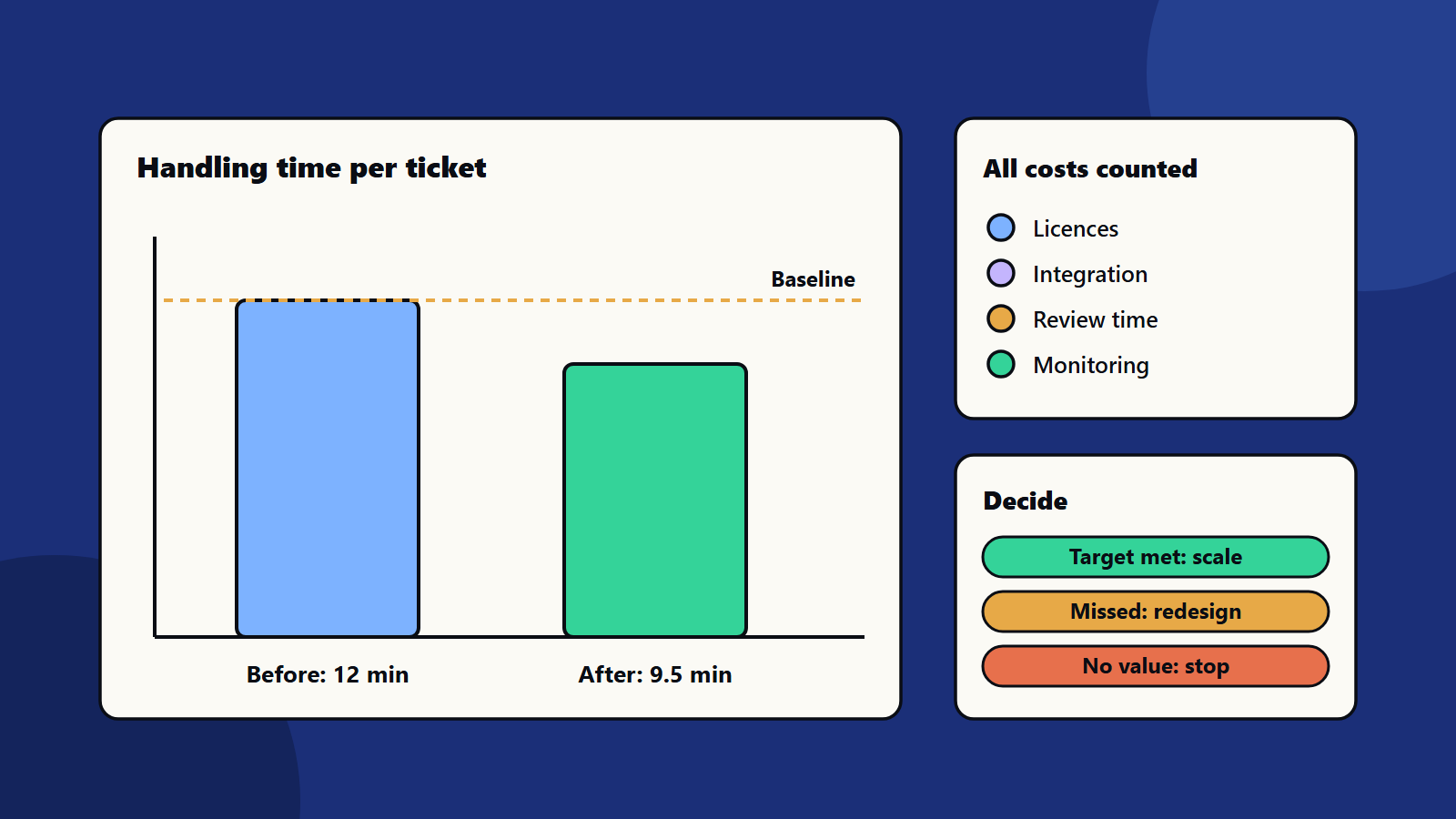
4. Count all costs
- Licences, usage fees and compute. See measuring AI cost.
- Build and integration effort.
- Data preparation and quality work.
- Human review of outputs.
- Training and change management.
- Monitoring and support. See AI model monitoring.
- Risk and compliance work.
5. Run the pilot with rules
Set the success target, the time limit and the stop rule up front. For example: “Reduce average handling time by 15 percent in ten weeks, with satisfaction unchanged. If we miss it, we stop or redesign.”
6. Compare against the baseline
Use a control group where possible: some users with the tool, some without. Report the difference as well as the end number.
7. Scale in steps
Move from pilot to production only when the value holds. Re-measure after each step, since results change at scale.
A worked example: a support assistant
This example is illustrative, with teaching numbers.
A company handles 20,000 support tickets a month. The baseline: 12 minutes of agent time per ticket, a loaded cost of 30 per hour and a satisfaction score of 4.2.
- Pilot: an assistant drafts replies for agents to edit, on one product line, for ten weeks.
- Result: average handling time falls from 12 to 9.5 minutes on that line. Satisfaction stays at 4.2.
- Gross value: 2.5 minutes saved per ticket is about 1.25 per ticket, which on 5,000 tickets for that line is about 6,250 per month.
- Costs: licences and usage of 2,000, review and monitoring of 1,200, and a one-off integration cost of 15,000.
- Net value: about 3,050 per month before the one-off cost. Payback takes around five months.
- Decision: the pilot passes its target. The team extends to two more product lines, and re-measures.
The numbers are teaching values. The lesson is the habit: baseline, formula, all costs, a stop rule and a decision.
Where AI returns often come from
- Time released in support, finance, legal review and reporting.
- Quality gains: fewer errors and rework.
- Revenue: better recommendations, faster quotes, more leads handled.
- Risk reduced: earlier detection of fraud and faults.
- Speed to market: faster drafts and tests in software and marketing. See AI in finance operations and AI in retail.
Small business and enterprise views
- Sole trader or small business: track hours saved on two or three tasks for a month, compare with the tool’s price and keep what pays. See AI for small businesses.
- Mid-size company: give each AI project an owner, a metric and a quarterly review, and keep a simple portfolio view.
- Enterprise: build a value office with common formulas, shared baselines, cost allocation and stage gates, and report results to the board. See technology investment business case.
Regional and regulatory notes
Rules on employment, consumer protection and data differ by country. If AI changes jobs or customer decisions, involve legal, risk and employee representatives early, and record how you will check fairness and quality.
Common mistakes
- Counting licence cost and ignoring review and integration cost.
- No baseline, so benefits are guesses.
- Measuring usage, such as prompts per day, while outcomes go untracked.
- Pilots with no stop rule, which drift on for months.
- Claiming savings that never leave the budget.
- Ignoring quality drops.
- Scaling before the pilot proves itself.
A starting plan
- Pick three AI projects, and write one business metric for each.
- Record baselines for four weeks.
- Agree the AI ROI formula and cost list with finance.
- Run pilots with targets and stop rules.
- Review results quarterly, stop weak projects and scale strong ones.
How SoftSapien supports AI ROI
SoftSapien’s consultants and data teams help organisations measure AI ROI: choosing use cases, setting baselines, building value formulas and dashboards, running pilots and moving winners into production. See our AI development and data analytics services.
To prove the value of your AI, use the contact page to chat with our team, send a message or schedule a free consultation call.
Frequently asked questions
What is AI ROI?
The value an AI project delivers, in money, time or risk, compared with all the costs of building, running, reviewing and governing it.
Why is AI ROI hard to see?
Benefits are spread across many small gains, costs such as review and integration hide, quality varies and there is often no baseline.
What costs should we count?
Licences and usage, build and integration, data preparation, human review, training, monitoring and compliance.
When should we stop a pilot?
When it misses the target set in advance after the agreed time. Define the target and the stop rule before the pilot starts.
Can SoftSapien help measure AI value?
Yes, from baselines to dashboards. Contact SoftSapien through the contact page to chat with our team, send a message or schedule a free consultation call.