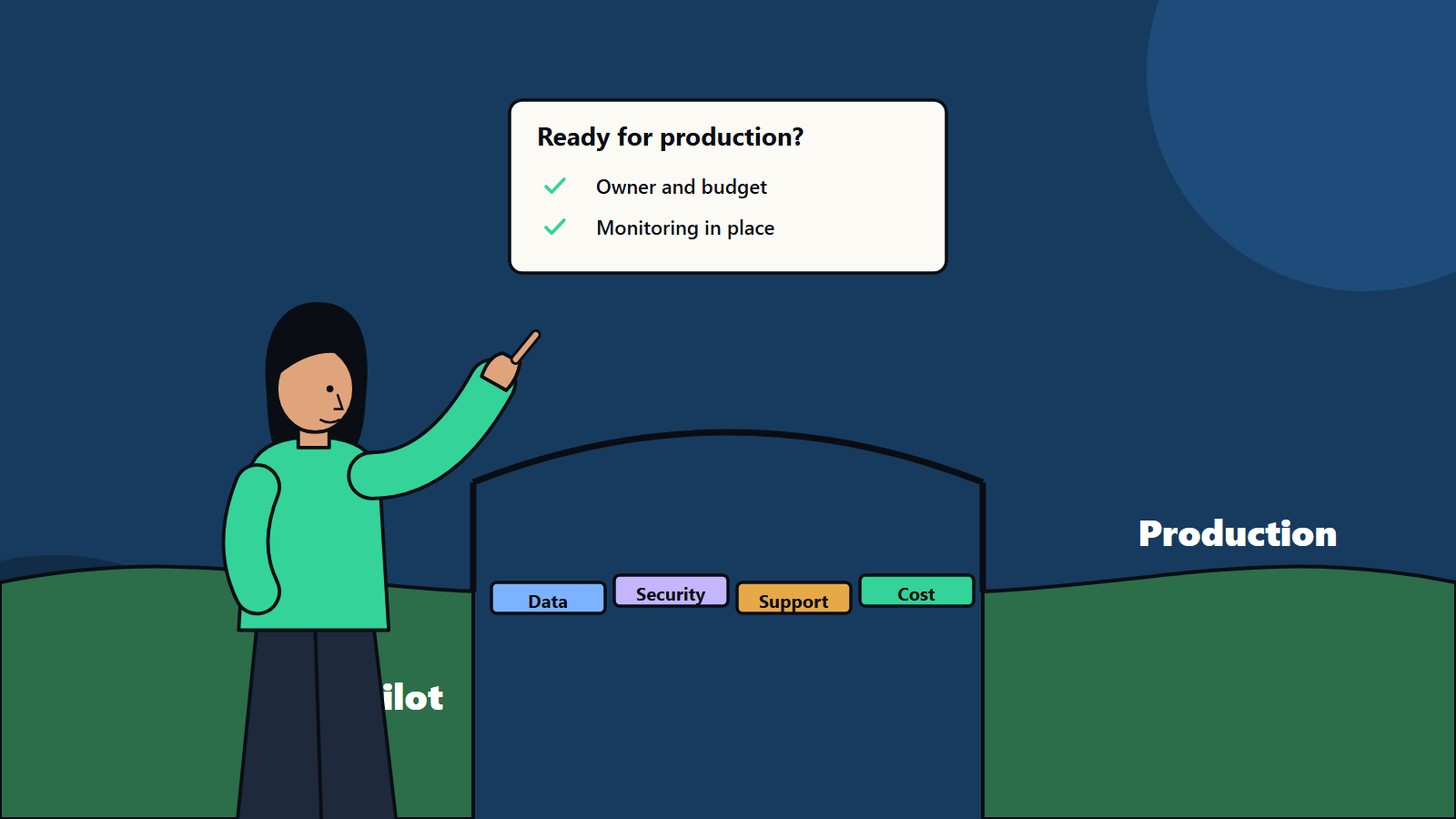
Short on time? AI pilots stall because the step from demo to daily use needs things a pilot skips: clean data feeds, security and privacy checks, monitoring, support, cost controls and an owner. Plan those from the start, set a production bar the pilot must clear, and fund the run as well as the build.
A good AI demo can be built in days. Teams show it to leaders, everyone is impressed and a pilot begins. Months later the pilot is still a pilot. It works for the original team, on curated data, with experts on hand. Nobody is sure who would support it, what it would cost at full scale or whether it is safe to let customers use it.
This pattern is common, and it is avoidable. The article explains why pilots stall and how to plan the path to production from day one. The advice suits a small company with one assistant in mind as much as a large organisation running a portfolio of AI projects.
Key takeaways
- A pilot proves that something can work. Production proves that it works reliably, safely and at an acceptable cost for real users.
- Define the production bar before the pilot starts, and test against it.
- Data pipelines, security, monitoring, support and ownership usually take more effort than the model itself.
- Budget for running costs, including model usage, infrastructure and people.
- Release in stages and keep a person in the loop until quality is proven.
Why pilots stall
- Curated data. The pilot used a clean sample. Real data is messy, late and spread across systems.
- No owner. The pilot belonged to an innovation team. The business unit that should run it never committed.
- Unclear value. There was no baseline, so benefits cannot be shown.
- Hidden costs. Usage-based pricing and infrastructure look small at pilot volumes and large at full volume.
- Security and privacy gaps. Reviews begin late and find issues that need redesign.
- Integration work. Connecting to core systems takes longer than building the model.
- Quality uncertainty. Leaders cannot tell how often the system is wrong, or how bad the errors are.
- Change resistance. Users were not involved, so adoption is weak.
- Skills gaps. Few people know how to run and monitor AI systems.
Set the production bar early
Write a short list of conditions the pilot must meet to proceed:
- Business outcome: the measure and target, such as handling time or error rate.
- Quality: accuracy on a realistic test set, and a limit on serious errors.
- Safety: results of risk and security review, including privacy impact.
- Cost: projected monthly cost at expected volume, against the value delivered.
- Operations: named owner, support process, monitoring and incident response.
- Adoption: user feedback, training plan and change support.
- Compliance: records, approvals and any regulatory checks.
If the pilot cannot meet the bar, you learn that early and can adjust or stop.
Build for production from the start
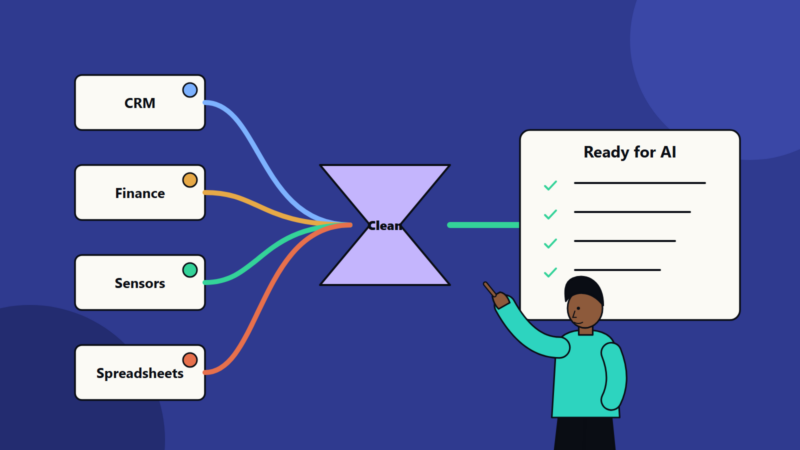
Data. Use real, representative data as early as the rules allow. Design automated pipelines in place of manual extracts. Agree who owns the data and how quality will be monitored. Our article on AI data integration covers this work.
Architecture. Choose components that can scale, with clear interfaces, so you can swap models or tools later.
Security. Apply least-privilege access, protect secrets, review third-party services and test against known AI risks such as prompt injection. The NIST AI Risk Management Framework offers a structure for mapping and managing risk across the lifecycle.
Testing. Build an evaluation set from real cases. Re-run it after every change to model, prompt, data or code.
Monitoring. Track quality, latency, cost, usage and user feedback. Set alerts, and review samples of outputs regularly.
Fallbacks. Decide what happens when the system is down or unsure: hand over to a person, use a simple rule or show a safe message.
Plan the economics
Model usage, hosting, data storage, monitoring tools and support staff all add up. Estimate the cost per task and multiply by expected volume. Include peak periods and growth. Compare with the value of time saved or revenue gained. Build cost alerts and set usage limits to avoid surprises.
Assign ownership
Production AI needs:
- A business owner accountable for outcomes.
- A technical owner responsible for the system.
- A data owner for the inputs.
- A risk or compliance contact for reviews.
- A support route for users.
Write these names down, and include them in the project plan.
Release in stages
- Shadow mode. The system runs alongside people and its output is compared, but not used.
- Assisted mode. Staff see suggestions and decide.
- Limited automation. The system acts alone on low-risk cases, with sampling for review.
- Wider automation. Scope grows as measured quality holds.
Each stage has entry and exit criteria, and a rollback plan.
Bring users with you
Involve users in design and testing, explain what the system can and cannot do, and train them in realistic scenarios. Collect feedback in the tool itself and show how it led to improvements. Early champions help others adopt.
Common mistakes
- Treating the pilot as the finish line.
- Skipping the baseline, which leaves benefits unproven.
- Leaving security and privacy review to the end.
- Underestimating integration and data work.
- Declaring success from a demo.
- Running without monitoring.
Questions to ask at each review
- What has changed since the last review in data, users or model behaviour?
- Where did the system fail, and why?
- What do users say?
- What is the cost per task now?
- Are we ready to move to the next stage, hold or stop?
How SoftSapien helps move AI into production
SoftSapien works with teams to turn promising pilots into dependable services, covering data pipelines, integration, security, testing and monitoring, and supporting the live system. Learn about our AI development work and our managed services for ongoing support.
To review a pilot that is waiting for its next step, visit the contact page and chat with us, send a message or schedule a free consultation call.
Frequently asked questions
Why do AI pilots fail to reach production?
Common reasons are curated pilot data, no business owner, unclear value, hidden running costs, late security review, integration effort, quality uncertainty and weak adoption.
What is a production bar?
A short list of conditions the pilot must meet to proceed, covering outcome, quality, safety, cost, operations, adoption and compliance.
How should AI be released in stages?
Run in shadow mode, then assisted mode with people deciding, then limited automation for low-risk cases, then wider automation as measured quality holds.
What costs are often missed?
Model usage at full volume, infrastructure, monitoring tools, data storage and support staff.
Can SoftSapien help move a pilot into production?
Yes, covering data, integration, security, testing and monitoring. Contact SoftSapien through the contact page to chat with our team, send a message or schedule a free consultation call.