Short on time? Brand positioning states who you serve, what you do for them, why you are different and why buyers should believe you. Work it out from customer interviews, competitor review and your real strengths, then test it in plain words before it reaches your website, sales deck and recruitment pages.
Many technology companies describe themselves with the same phrases: innovative, end-to-end, scalable, trusted. Readers skim past them. Positioning is the work that replaces those phrases with a clear place in the buyer’s mind. It decides which customers you chase, which problems you lead with and how you explain your value.
This guide offers a working method that suits a young software firm, a consultancy or an established technology business entering a new market.
Key takeaways
- Positioning is a choice about customers, problems and differences. It is made before any copy or design.
- Base it on evidence from customers, competitors and your own delivery record.
- A good statement is specific enough that some buyers will see it is not for them.
- Test it with customers and staff, then use it consistently across every channel.
- Review it when your market, offer or customers change.
What positioning covers
A positioning statement usually answers five questions:
- Who is the target customer? Be specific about industry, size, role and situation.
- What problem or goal do they have? Describe it in their words.
- What category are you in? The frame of reference that helps buyers understand you.
- What is your main difference? The thing you do better or differently for this customer.
- What is the proof? Results, methods, credentials and experience that make the claim believable.
A common template reads: “For [customer] who [need], [brand] is a [category] that [key benefit], because [proof].” Use it as a thinking tool, then rewrite the result in natural language.
Step 1: Gather evidence
Customer interviews. Speak with ten or more customers and a few who chose a competitor. Ask why they bought, what they compared, what almost stopped them and what changed after. Record their words.
Competitor review. Read competitors’ sites, case studies, proposals and review profiles. Note which customers they target, which claims they repeat and where they say little.
Internal view. Ask sales, delivery and support where you win, where you lose and what customers praise. Review data on win rates, retention and project margins by customer type.
Market signals. Look at search terms, analyst commentary and industry events to see how buyers frame the problem.
Step 2: Choose where to compete
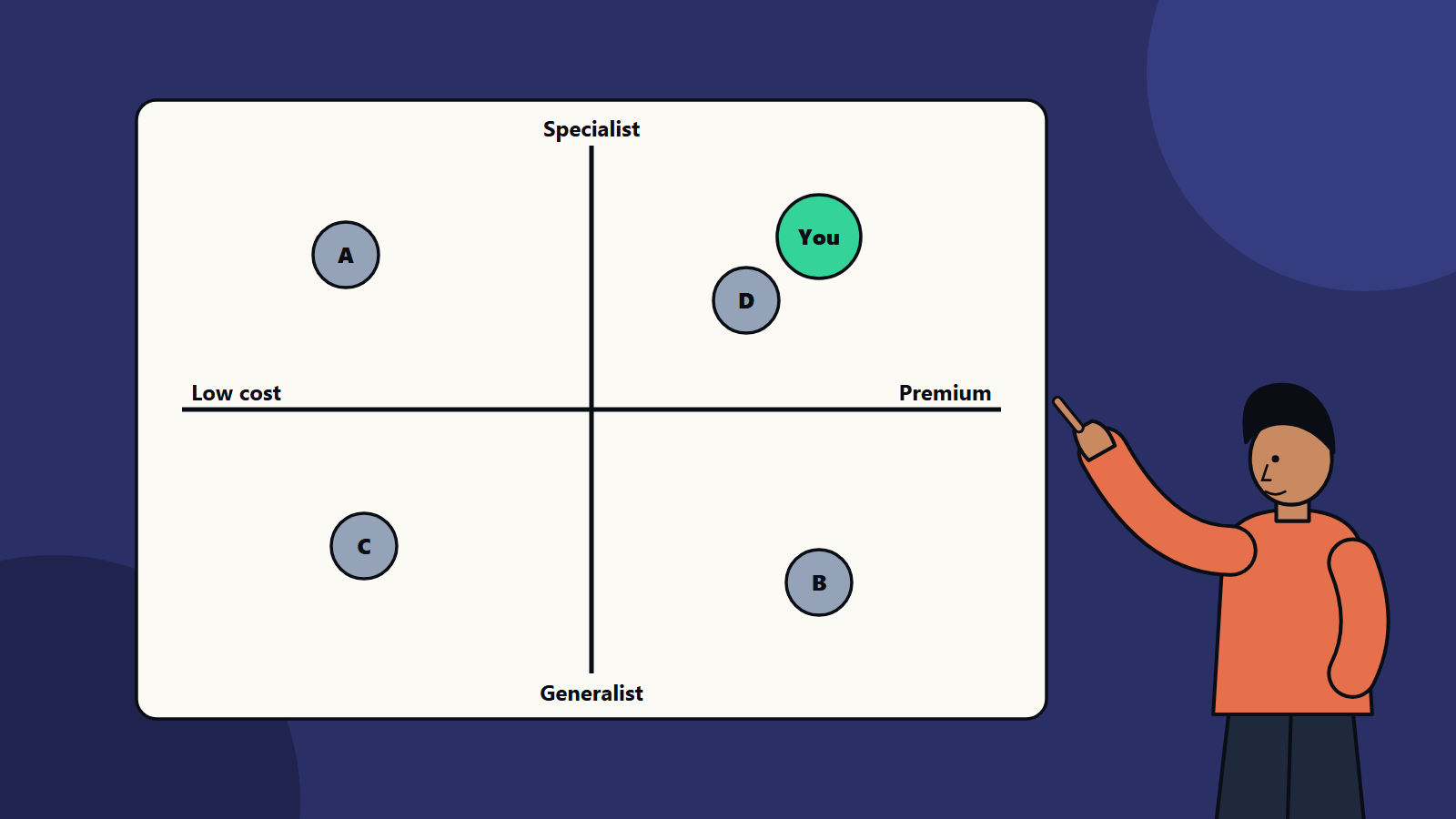
Map the market on two or three dimensions that matter to buyers, such as specialist versus generalist, premium versus economical, or product-led versus project-led. Find the position where customer needs, your strengths and competitor gaps overlap.
Test the choice with questions:
- Is the customer group big enough to sustain the business?
- Can we deliver excellent results for them repeatedly?
- Is the difference meaningful to them as well as to us?
- Can competitors copy it easily?
- Can we prove it?
Step 3: Write the message
Create a short message hierarchy:
- Headline claim: one sentence that states the main benefit for the main customer.
- Supporting points: three reasons to believe, each backed by evidence.
- Proof: case studies, numbers, certifications, partnerships and client quotes you have permission to use.
- Voice: how you sound. Plain, direct and confident usually works better than abstract and promotional.
Avoid claims you cannot support, such as superlatives with no evidence.
Step 4: Test
Show the statement to customers, prospects and staff. Ask:
- What do you think we do, and for whom?
- Is it clear what is different?
- Does it match your experience?
- What would make you doubt it?
Run it in small experiments such as a landing page, an outbound email sequence or a conference talk, and compare response with the old message.
Step 5: Put it to work
Apply the positioning consistently:
- Website: home page, service pages, case studies and about page.
- Sales: pitch deck, proposals and discovery questions.
- Content: topics and examples that reflect the chosen customer and problem.
- Recruitment: job descriptions and employer messages that attract people who fit the offer.
- Partnerships and events: choose those that reach the target audience.
Create a short brand guide covering the statement, key messages, tone and examples of good and poor wording.
Positioning for different audiences
A technology firm may serve several groups: a sole proprietor buying a first website, a growing company needing a platform and an enterprise needing a transformation partner. Keep a clear master position, then adapt the proof and language for each group, so that the core promise stays consistent.
Common mistakes
- Trying to appeal to everyone.
- Describing features and processes when buyers want to hear about outcomes.
- Copying a competitor’s wording.
- Positioning on a difference that customers do not value.
- Changing the message every quarter.
- Leaving staff out, so what is said and what is delivered drift apart.
Signs the positioning is working
- Prospects describe you in similar words to your own.
- Sales cycles shorten and the right customers contact you.
- Win rates and deal sizes rise in the target segment.
- Content attracts relevant search traffic and enquiries.
- Staff can explain what you do in one sentence.
How SoftSapien supports brand work
SoftSapien helps technology and service companies research their market, define positioning and turn it into websites, content and campaigns. Our brand strategy team works alongside digital experience and corporate communications specialists, so the message is carried through every touchpoint.
To explore your own positioning, reach out via the contact page to chat with us, send a message or schedule a free consultation call.
Frequently asked questions
What is brand positioning?
It is a deliberate choice about the customers you serve, the problem you solve, your category, your main difference and the proof that supports it.
How do I research positioning?
Interview customers and lost prospects, review competitors, ask sales and delivery teams where you win and lose, and study how buyers search and describe the problem.
What makes a positioning statement good?
It is specific enough that some buyers can see it is not for them, backed by proof and understood in the same words by customers and staff.
How do I test positioning?
Show it to customers, prospects and staff, then run small experiments such as a landing page or email sequence and compare response.
Can SoftSapien help with positioning?
Yes, from research to messaging and rollout. Contact SoftSapien through the contact page to chat with our team, send a message or schedule a free consultation call.