Short on time? Good vendor management starts before you sign: classify suppliers by criticality, assess risk and security, write clear contracts with service levels and exit terms, then manage each relationship with named owners, regular reviews and measured performance. Spend the most effort on the few suppliers whose failure would hurt most.
A typical company relies on dozens or hundreds of technology suppliers: cloud providers, software subscriptions, development partners, payment services, data providers and consultants. Each one adds capability and a dependency. When a supplier raises prices, suffers a breach, changes its product or goes out of business, you feel it.
Vendor management is the discipline of choosing, contracting, monitoring and, when needed, leaving suppliers in a structured way. This guide gives technology buyers a practical framework, whether you are a small business with ten subscriptions or an enterprise with a formal procurement function.
Key takeaways
- Not all vendors are equal. Tier them by business criticality, data access and replaceability.
- Assess risk before contracting: security, financial health, resilience, compliance and concentration.
- Contracts should define scope, service levels, security duties, data handling, change control and exit.
- Manage performance with named owners, scorecards and regular reviews.
- Plan for exit from the start, and keep alternatives in view.
Step 1: Know what you have
Build a register of suppliers with:
- What they provide and which business processes depend on them.
- Contract dates, renewal terms, notice periods and cost.
- The internal owner and the supplier’s contact.
- What data they hold or access, and where.
- Integrations and dependencies.
- Security and compliance evidence.
Many organisations find forgotten subscriptions and duplicate tools. Include software bought by departments on company cards, since it often escapes central review.
Step 2: Tier suppliers
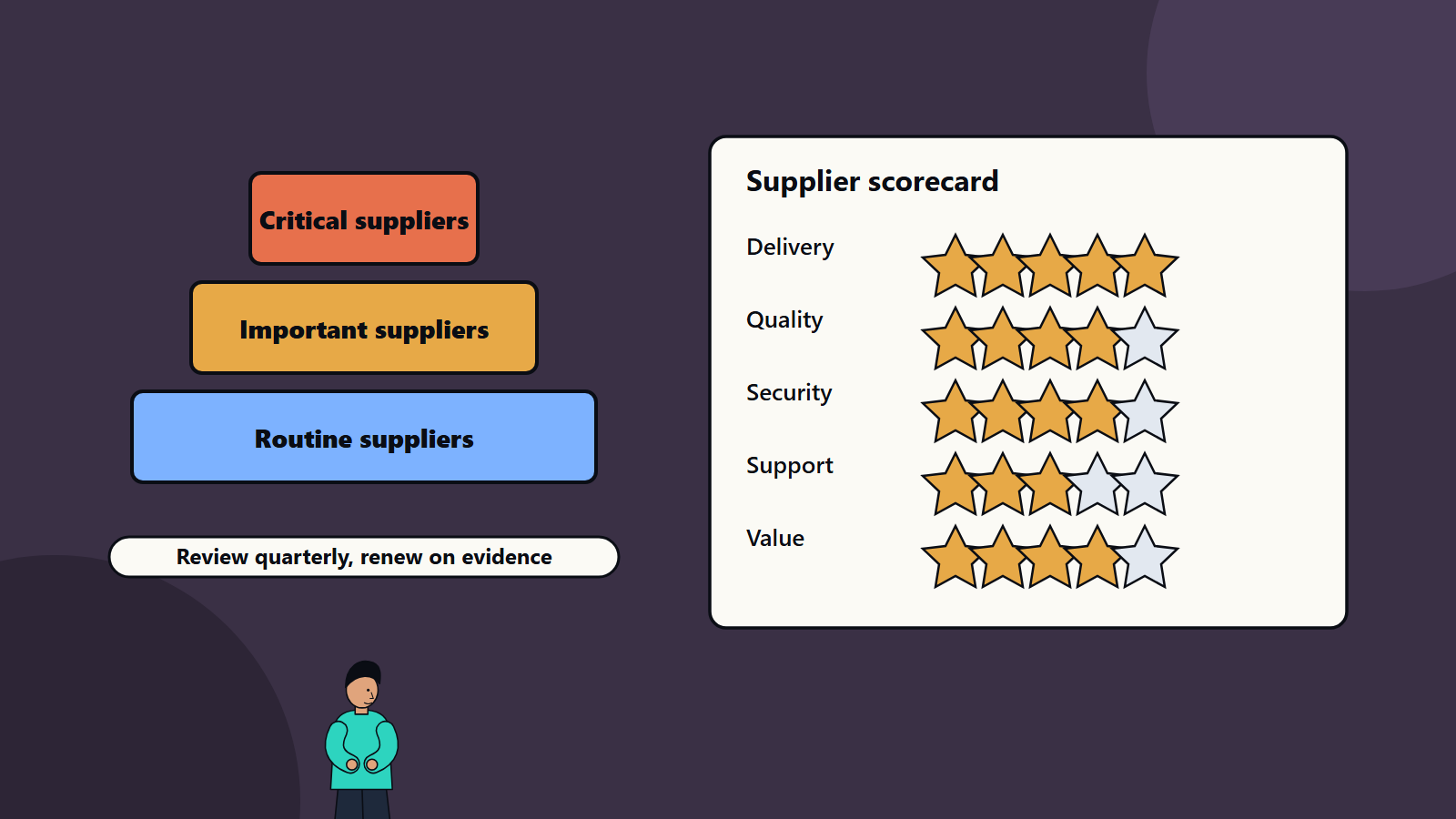
Classify by impact:
- Critical: failure stops operations or exposes sensitive data. Examples: core cloud provider, payment processor, core platform vendor.
- Important: failure disrupts significant work but has workarounds.
- Routine: low impact, easily replaced.
Apply effort in proportion. Critical suppliers deserve deep due diligence and frequent reviews. Routine ones need basic checks and a lighter touch.
Step 3: Due diligence before signing
Business and financial
- Track record, references and customer base.
- Financial stability, ownership and signs of distress.
- Capacity and key-person dependence.
Security and privacy
- Security certifications and independent audit reports, read critically for scope and exceptions.
- Security practices: access control, encryption, vulnerability management, incident response and staff screening.
- Handling of your data: location, subprocessors, retention, deletion and use for training or analytics.
- Compliance with laws and regulations relevant to you, which vary by country and sector.
- Breach history and how the vendor handled it.
For suppliers of software, ask about their own supply chain controls. Our guide to software supply chain security and the SBOM explains what to request. Government guidance such as NIST’s publications on cybersecurity supply chain risk management gives frameworks for assessing suppliers, and you should check the current version of any such document.
Resilience
- Availability history and commitments.
- Disaster recovery and business continuity plans, and evidence of testing.
- Dependence on other suppliers, such as a particular cloud.
Fit and value
- Match to requirements, roadmap and integration needs.
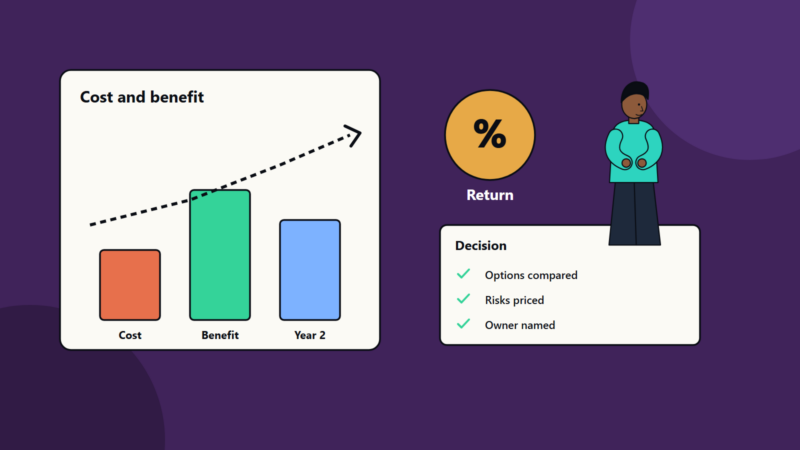
- Total cost over several years, including implementation, usage growth and exit. Our guide to building a technology business case shows how.
- Ease of use and support quality.
Use a structured scoring grid with weights agreed in advance, and involve security, legal, finance and the business owner.
Step 4: Negotiate and write the contract
Key terms:
- Scope and deliverables, described clearly.
- Pricing: fees, usage tiers, indexation, price protection for the term and charges for extras. Watch auto-renewals and minimum commitments.
- Service levels: availability, response and resolution times, with measurement methods and remedies such as service credits.
- Security and privacy: obligations, audit rights, breach notification timelines, subprocessor approval and data location. Align with your policies.
- Data ownership and access: you own your data, with the right to export it in a usable format at any time.
- Intellectual property: ownership of what is created for you, and licences for what is not.
- Change control: how scope and price changes are agreed.
- Business continuity: vendor’s duty to maintain plans, and your rights if it fails.
- Liability and indemnities: caps and carve-outs, particularly for data breaches and IP infringement.
- Termination and exit: notice periods, termination for cause and convenience, transition assistance, return and deletion of data, and continued access for a handover period. For source code of critical bespoke software, consider escrow arrangements.
- Governance: meetings, reporting and escalation.
Take legal advice, especially on cross-border terms. Do not rely on standard vendor paper without review for critical suppliers.
Step 5: Onboard
- Assign an internal owner and a backup.
- Set up access with least privilege and multi-factor authentication.
- Document integrations and configurations.
- Agree reporting, meetings and contacts.
- Train users.
- Record baseline measures to judge value later.
Step 6: Manage performance
Measure
- Service performance against agreed levels.
- Quality: defects, incidents and rework.
- Delivery: milestones and budget for projects.
- Responsiveness and communication.
- Security: audit results, vulnerabilities and incident handling.
- Value: benefits realised versus cost.
- User satisfaction.
Use a simple scorecard, reviewed monthly or quarterly depending on tier.
Review
- Hold regular reviews with the supplier for critical and important vendors: performance, issues, roadmap and risks.
- Escalate and resolve problems early, with documented actions.
- Share feedback in both directions.
Monitor risk
- Track news, financial changes, ownership changes and security incidents involving suppliers.
- Reassess critical suppliers at least yearly, and when something material changes.
- Watch concentration: too many services on one provider, or one subcontractor behind many suppliers.
- Review access rights regularly, and remove unused accounts.
Manage cost
- Track spend against budget and usage, and look for unused licences.
- Prepare early for renewals: gather usage data, check alternatives and negotiate. Many companies lose leverage by renewing at the last minute.
- Consolidate overlapping tools.
- Apply cost routines to cloud and AI services. See our guides to cloud cost optimization and measuring AI cost.
Step 7: Plan for exit
Every relationship ends sometime. Prepare:
- Exit plan for critical suppliers: how you would move, how long it takes and what it costs.
- Data portability: test exports regularly.
- Documentation of configurations and integrations.
- Alternatives: keep a shortlist of substitutes.
- Transition support in the contract.
- Knowledge retention inside your team.
When ending a relationship, manage the handover carefully: secure data return and deletion with certificates where appropriate, remove access, close accounts and capture lessons.
Governance and roles
- Executive sponsor for critical supplier relationships.
- Relationship owner in the business for each supplier.
- Procurement for commercial processes.
- Security and privacy for assessments.
- Legal for contracts.
- Finance for budgets and payments.
- A vendor management function or lead, even if part-time in a small firm.
Write a simple policy covering tiering, due diligence, contracts and review frequency.
Common mistakes
- Treating every supplier the same.
- Assessing only at selection, never again.
- Weak exit terms.
- No internal owner.
- Ignoring shadow IT.
- Renewing automatically without review.
- Accepting vague service levels.
- Overlooking subcontractors and concentration risk.
A starting plan
- Build the supplier register, and identify the top ten by criticality.
- Check contracts for renewal dates, exit terms and security clauses.
- Run a risk review of the top ten.
- Set up scorecards and a review calendar.
- Write a short policy and a due diligence checklist for new suppliers.
How SoftSapien supports technology sourcing
SoftSapien helps organisations select partners, design contracts and governance and run transition and managed services, with independent advice on risk and value. See our business services and managed services.
To review your own supplier landscape, use the contact page to chat with our team, send a message or schedule a free consultation call.
Frequently asked questions
How should I tier my technology vendors?
By business criticality, data access and replaceability: critical, important and routine, applying the most effort to the few suppliers whose failure would hurt most.
What should a technology contract include?
Scope, pricing and renewal terms, service levels with remedies, security and privacy duties, data ownership and export, change control, liability and clear exit and transition terms.
How often should vendors be reviewed?
Critical suppliers at least yearly and after material changes, with regular performance reviews. Lighter checks suit routine suppliers.
Why plan an exit from the start?
Every relationship ends sometime. Tested data exports, documentation and a shortlist of alternatives reduce disruption and keep leverage at renewal.
Can SoftSapien help with supplier selection and governance?
Yes, with independent advice. Contact SoftSapien through the contact page to chat with our team, send a message or schedule a free consultation call.