Short on time? Pick the engagement model to fit how well your scope is defined and how long the work will last: a pilot to test the relationship, fixed-scope delivery for clear requirements, a program retainer for ongoing roadmaps or managed support for run and maintain. Offshore, nearshore and onshore describe where the team sits, and each trades cost, time-zone overlap and cultural proximity differently. Agree ownership, communication and exit terms early.
Two questions shape almost every outsourced software project. How will we work together, and where will the people be? The first is the engagement model: how scope, price, risk and responsibility are shared. The second is location: onshore in your own country, nearshore in a neighbouring or similar time zone, or offshore in a distant one.
Choosing well saves money and prevents frustration. This guide compares the common models and locations in plain terms, and gives questions to ask. It helps founders buying their first development, department heads outsourcing a project and procurement teams building long-term supplier relationships.
Key takeaways
- Engagement models divide risk differently: pilot, fixed scope, program retainer and managed support.
- Match the model to the clarity of the scope, the expected change and the length of the relationship.
- Location models, onshore, nearshore and offshore, trade cost against overlap in working hours and proximity.
- A blended model is common: a core team in one place with specialists elsewhere.
- Strong governance, clear ownership of code and data and an exit plan matter more than the label.
Engagement models
Pilot
A short, defined engagement to test the fit: a discovery workshop, a proof of concept, a prototype or a few sprints. You and the partner learn how you work together and what the work really involves.
Best for: new relationships, uncertain scope, new technology or a decision about whether to proceed.
Watch for: make sure there are criteria for success and a plan for what follows. Agree whether the pilot work can be reused.
Fixed scope delivery
The partner delivers a defined set of outputs for an agreed price and timeline. Requirements are documented, with acceptance criteria. Changes are handled through change requests.
Best for: well-understood projects with stable requirements, such as a standard website, a defined integration or a migration with a clear inventory.
Watch for: the price depends on the quality of the specification. Vague requirements lead to disputes or a lower-quality compromise. Check how changes are priced and approved. Our guide to MVP development shows how to narrow scope to what can be fixed.
Time and materials
You pay for effort, usually at agreed rates, with regular reporting and often a budget cap. It suits work where the scope will evolve, such as product development with frequent learning.
Watch for: the need for active management and visibility of progress. Use short cycles, demos and budget tracking.
Program retainer
A team or a block of capacity is committed to your roadmap over a period, often renewed monthly or quarterly. The partner and your team plan work together, and capacity can shift between priorities.
Best for: long-lived products, continuous improvement and organisations that want a stable team with deep context.
Watch for: keep outcomes visible. Review value regularly, and rebalance the team as needs change.
Managed support
The partner operates and maintains a system for a monthly fee under service levels: monitoring, incident response, patching, minor enhancements and reporting.
Best for: live products and platforms where reliability matters and in-house capacity is limited.
Watch for: clear service levels, response times, scope and exclusions, reporting, security responsibilities and the cost of changes. Our guide to managed services contracts covers contract points.
Staff augmentation
Individual specialists join your team and work under your management. It adds capacity and skills quickly, and leaves you responsible for direction and quality.
Build, operate, transfer
The partner builds a team and runs a capability for a period, then hands it to you. It suits setting up a new development centre.
Hybrid and staged
Many relationships begin with a pilot, move to fixed-scope delivery of a first release, then continue with a retainer and managed support. Each stage has its own terms.
Location models
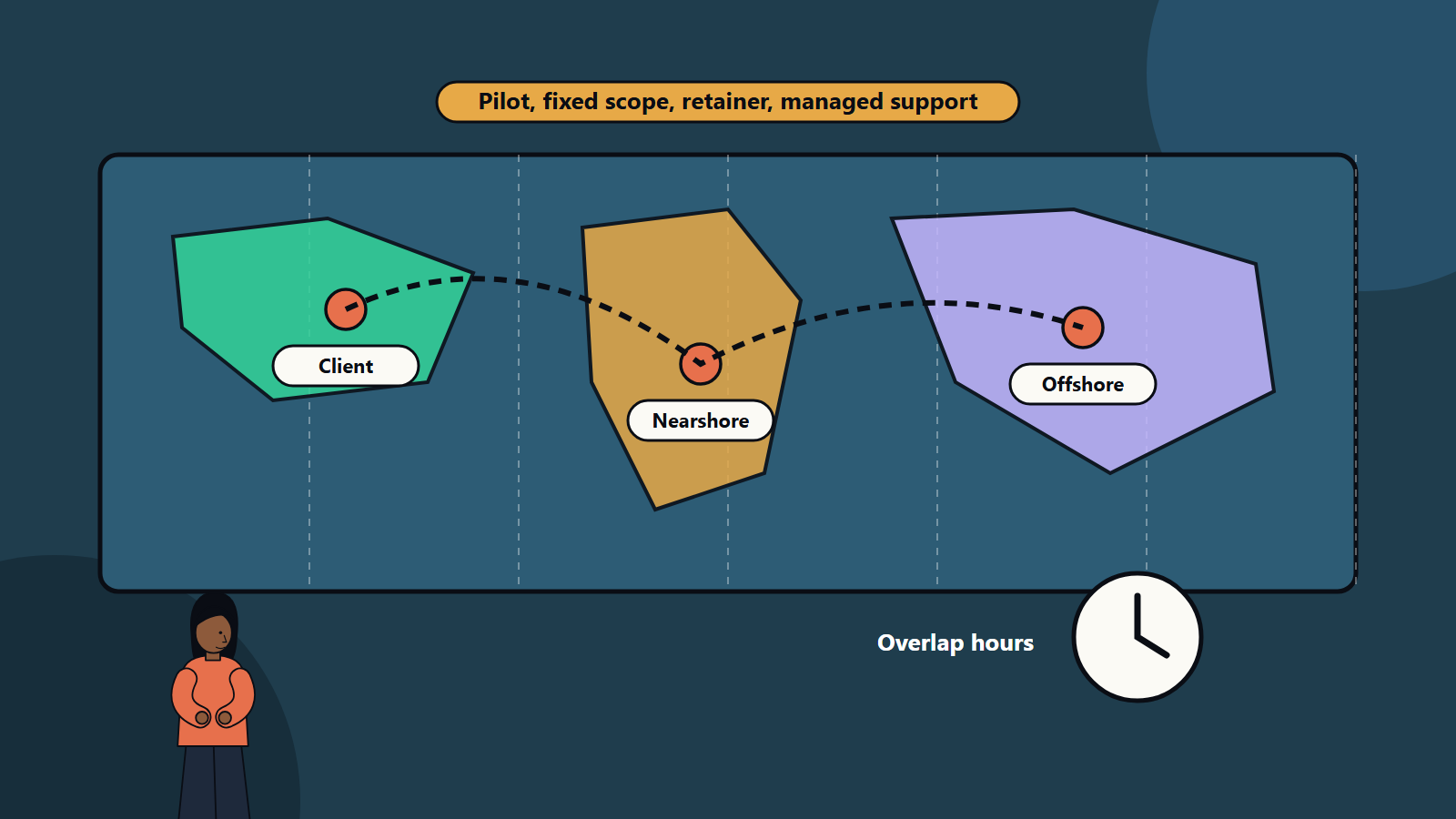
Onshore
The team is in your own country. It offers the same time zone, language, legal system and working culture. It usually costs the most.
Nearshore
The team is in a nearby country, with similar or overlapping time zones, and often cultural and language affinity. It offers good overlap for daily collaboration at lower cost than onshore.
Offshore
The team is in a distant country, often with a significant time difference. Rates can be lower and talent pools large. Collaboration takes more planning because of limited overlapping hours, and travel is longer.
Blended or follow-the-sun
A mix of locations: product and design leads close to the customer, with engineering at scale elsewhere, or teams across zones passing work along as the day moves. This can speed delivery, though it needs discipline in handovers and documentation.
Comparing options
Consider:
- Cost: rates differ by country and seniority. Total cost includes management time, rework and travel, so a lower rate does not always mean a lower total.
- Time-zone overlap: how many working hours do you share? Four or more hours of overlap helps daily decisions.
- Communication and language: fluency, clarity and documentation habits.
- Cultural fit: attitudes to feedback, hierarchy and raising problems.
- Talent and skills: availability of the technology skills you need.
- Legal and regulatory: data protection and cross-border transfers, intellectual property enforcement, tax and employment rules, and sector regulations. Take legal advice. Our guide to data residency and sovereignty explains data location issues.
- Security: physical and technical controls at the delivery location, background checks and access management.
- Stability and risk: political, economic and infrastructure factors, and business continuity plans.
- Visits and relationship building: budget for early in-person time.
Making a distributed team work
- Plan overlap: agree core hours, and use asynchronous communication for the rest.
- Write things down: requirements, decisions and designs in shared documents.
- Use shared tools: a single backlog, a shared repository and a common communication platform.
- Keep ceremonies short and regular: daily check-ins, weekly demos and monthly reviews.
- Define handovers between time zones with clear notes.
- Invest in relationships: video calls, visits and a shared sense of purpose.
- Be respectful of holidays, working patterns and cultures.
- Treat the partner’s people as part of your team, with context and feedback.
Contract essentials
- Scope, deliverables and acceptance criteria.
- Pricing model, payment milestones and change control.
- Ownership of code, designs and data, with treatment of third-party and pre-existing components.
- Access to repositories, environments and credentials held by you.
- Security, confidentiality and data protection obligations.
- Service levels and warranty.
- Key personnel and replacement rules.
- Governance: meetings, reporting and escalation.
- Exit and transition support.
- Liability, insurance and dispute resolution.
Our guide to choosing a software development partner gives a wider checklist.
Questions to ask
- Which model suits our scope today, and how would we change it later?
- What is the total cost, including management, travel and change requests?
- How many hours of overlap will the team have with ours?
- How do you handle security and access at the delivery location?
- Who owns the code, and where is it stored?
- How do you keep knowledge when people change?
- What does a smooth exit look like?
Common mistakes
- Choosing fixed scope for work that is still being discovered.
- Choosing time and materials with no budget control.
- Selecting a location on rate alone.
- No overlap in working hours.
- Treating the partner as a black box.
- Unclear ownership and access.
- No plan for the end of the relationship.
How SoftSapien works with clients
SoftSapien offers pilot, fixed-scope delivery, program retainer and managed support models, with delivery teams across North America, Europe, the Middle East and Asia Pacific, so clients can match model and location to their needs. See our custom software development and managed services.
To discuss which model suits your project, visit the contact page and chat with our team, send a message or schedule a free consultation call.
Frequently asked questions
What engagement models exist for software outsourcing?
Pilot, fixed scope delivery, time and materials, program retainer, managed support, staff augmentation and build, operate, transfer, often combined in stages.
When is fixed scope the right model?
When requirements are well understood and stable. For evolving scope, time and materials or a retainer fits better.
What is the difference between onshore, nearshore and offshore?
Onshore teams are in your country, nearshore teams are in a nearby country with similar time zones and offshore teams are far away, usually with larger time differences and lower rates.
How do I make a distributed team work?
Plan overlapping hours, write decisions down, use shared tools and a single backlog, keep regular short ceremonies and invest in relationships.
How does SoftSapien engage with clients?
Through pilot, fixed-scope delivery, program retainer and managed support, with teams across several regions. Contact SoftSapien through the contact page to chat with our team, send a message or schedule a free consultation call.