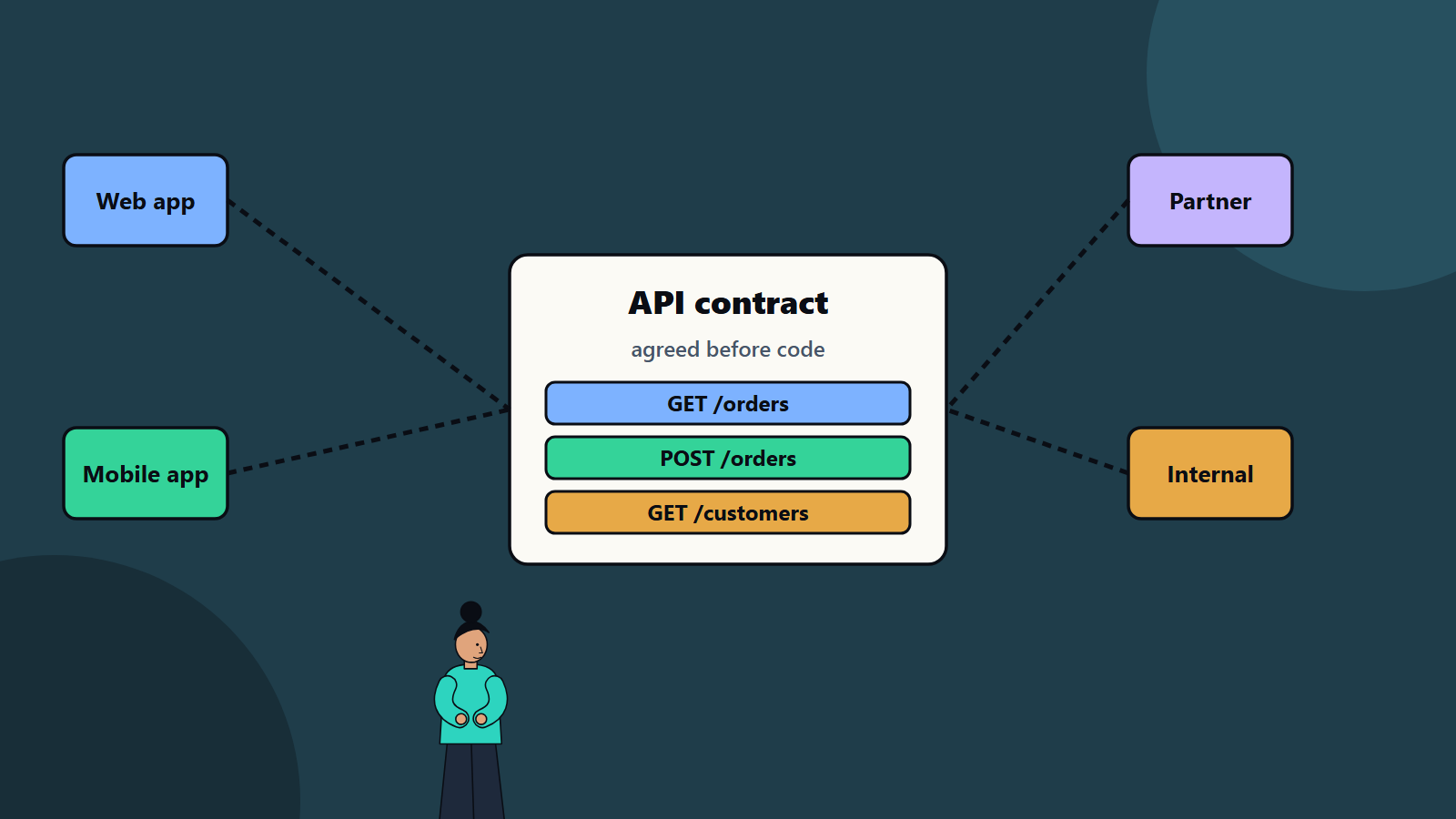
Short on time? API-first means you design and agree the interface before you build the system behind it, treat the API as a product with its own documentation and versioning and let web, mobile, partner and internal applications all use the same contract. It speeds up parallel work and makes later integration far easier, at the price of up-front design discipline.
Many systems are built first and connected later. The result is a pile of one-off integrations, each written against internal details that were never meant to be shared. Every change breaks something, and every new partner needs custom work.
An API-first approach reverses the order. You decide how others will talk to the system, write that down as a contract and build to it. This guide explains the idea, its benefits and costs and how to adopt it, for a startup building a new product and for an enterprise opening up its systems.
Key takeaways
- API-first designs the interface and its contract before implementation.
- A machine-readable specification, such as OpenAPI, supports documentation, mocks, tests and code generation.
- Good APIs are consistent, versioned, secure and documented, and they are managed like products.
- Teams can work in parallel against the contract, which shortens delivery.
- Governance and design reviews prevent a sprawl of inconsistent interfaces.
What API-first means
An application programming interface is the way one piece of software asks another to do something. In an API-first approach:
- The API is a first-class deliverable, designed with its users in mind.
- The design is agreed and written as a specification before the code.
- All clients, such as web apps, mobile apps, partner systems and internal tools, use the same interface.
- The API has an owner, a lifecycle and measures of quality.
It differs from code-first, where the API emerges as a by-product of the implementation, and from the earlier habit of building an application and later adding an API as an afterthought.
Why organisations choose it
- Parallel work. Front-end, back-end, mobile and partner teams can build against the agreed contract, using mocks until the real service is ready.
- Reuse. One set of capabilities serves many channels, which cuts duplicated logic.
- Consistency. Shared design rules give developers a predictable experience.
- Easier integration and partnerships. External parties can adopt your services without bespoke projects.
- Quality. Early design review catches problems cheaply.
- Flexibility. The contract hides the implementation, so you can change the internals, or even replace the system, without breaking clients.
- New business models. APIs can open products, data and services to partners and customers.
The specification
The OpenAPI Specification is a formal, standardised way to describe HTTP APIs. It helps people understand how APIs and chains of APIs operate, and supports tasks such as producing client code, writing tests and enforcing design standards. A specification typically lists:
- Resources and operations, such as retrieving or creating an order.
- Parameters, request and response formats and data types.
- Authentication and authorisation requirements.
- Error formats and status codes.
- Examples.
Other description formats exist for different styles, such as event-driven and query-based APIs. Choose what fits your technology and keep the description in version control.
Design principles
- Think in resources and tasks that make sense to the consumer, and keep your database layout out of the interface.
- Be consistent: naming, pagination, filtering, sorting, date formats and error structures.
- Make operations predictable: safe operations should not change data, and repeat requests for the same action should not cause duplicates. Provide idempotency keys where needed.
- Plan for change: design for additive evolution, for example adding fields without removing others, and version the API when breaking changes are unavoidable.
- Keep it simple: small, well-defined operations are easier to use and secure.
- Document with examples and explain the why.
- Handle errors helpfully: clear messages, codes and guidance for fixing problems.
- Consider performance: limits, caching and bulk operations.
Security from the start
- Use strong authentication and authorisation, for example standard protocols such as OAuth 2.0 and OpenID Connect, with least-privilege scopes.
- Validate all input, and limit sizes and rates.
- Protect sensitive data, and return only what the client needs.
- Log access, and monitor for abuse.
- Test for common weaknesses. The OWASP project publishes a list of API security risks that teams can use as a checklist.
- Review third-party access and keys regularly.
Our article on zero trust security explains authenticating every request in modern architectures.
Developer experience
APIs succeed when developers like using them:
- A clear getting-started guide that takes minutes.
- Interactive documentation generated from the specification.
- A sandbox with realistic test data.
- Client libraries or code samples in popular languages.
- A changelog and deprecation policy with notice periods.
- A support channel and a status page.
The workflow
- Discover needs: who will use the API and for what?
- Draft the contract with consumers and providers, using the specification format.
- Review against design standards and security guidelines.
- Publish mocks so clients can start.
- Implement the service, with automated checks that confirm it matches the contract.
- Test functionality, security and performance.
- Release with documentation, and monitor.
- Evolve with feedback, versioning and retirement plans.
Contract tests catch drift: they check that the implementation still honours the specification and that clients still work with it.
Governance
For organisations with many teams, add light governance:
- A design guide and a shared set of reusable components, such as common error formats and security schemes.
- An API catalogue where teams can find and reuse existing interfaces.
- Review for new and changed APIs.
- An API gateway to handle authentication, rate limits, routing and analytics.
- Metrics: usage, latency, error rates, adoption and developer satisfaction.
- Ownership: each API has a named owner and a lifecycle stage.
Our article on enterprise software integration patterns compares APIs with events, messaging and batch transfer, and describes when each fits.
Costs and trade-offs
- Up-front design time that may feel slow at first.
- Discipline to keep the contract and the implementation aligned.
- Over-design risk when teams try to predict every future need. Start with real use cases.
- Management overhead for versions, documentation and support.
- Performance and chattiness if the API is too granular.
The benefits grow with the number of consumers and the lifespan of the system.
Adopting it in an existing organisation
- Start with one new product or a high-value integration.
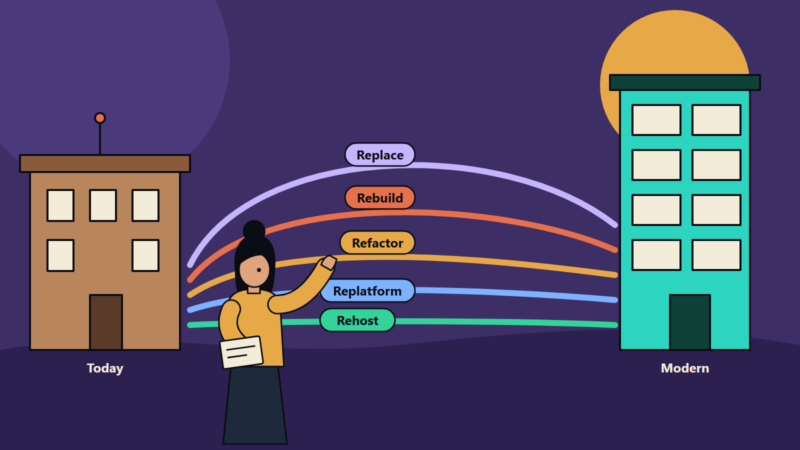
- Wrap legacy systems with well-designed APIs, so new applications do not depend on their internals. This supports step-by-step modernisation, as described in our guide to legacy application modernization.
- Create a small platform team to provide tooling and guidance.
- Train developers in API design.
- Measure and share results.
Common mistakes
- Exposing database tables as an API.
- Changing contracts without notice.
- Inconsistent styles across teams.
- Weak documentation.
- Ignoring security until the end.
- Treating the API as an add-on.
How SoftSapien delivers API-first projects
SoftSapien designs and builds API-led platforms, wraps legacy systems with modern interfaces and sets up gateways, documentation and governance. See our enterprise software engineering and enterprise software integration services.
To plan an API programme, visit the contact page and chat with our team, send a message or schedule a free consultation call.
Frequently asked questions
What does API-first mean?
It means designing and agreeing the API contract before implementation, treating the API as a product, and letting all clients use the same interface.
What is the OpenAPI Specification?
It is a standard way to describe HTTP APIs, and it supports documentation, mocks, tests and code generation.
What are the trade-offs of API-first?
It needs up-front design time and discipline to keep the contract and implementation aligned, and it adds management overhead for versions and documentation.
How do I adopt API-first in an existing organisation?
Start with one new product or integration, wrap legacy systems with well-designed APIs, create a platform team for tooling and guidance and train developers.
Can SoftSapien help with an API programme?
Yes, from design to governance. Contact SoftSapien through the contact page to chat with our team, send a message or schedule a free consultation call.