Short on time? A digital twin is a virtual model of a physical asset, process or system that is kept up to date with real data, so you can monitor it, test changes safely and predict problems. It pays off where assets are costly, complex or hard to experiment on, and where good data already exists. Start with one asset and one decision it should improve.
Engineers have always built models of the things they design. A digital twin goes further: the model stays connected to the real thing, receives data from sensors and systems and changes as the real thing changes. That connection lets teams ask practical questions. Will this pump fail next month? What happens to throughput if we change the production sequence? Could we cut energy use without hurting comfort?
The idea is useful and heavily marketed, so many projects stall on unclear goals or poor data. This guide explains what digital twins are, where they pay back, what they need and how to start. It suits a manufacturer, a building operator, a utility or a logistics company, and the technology partners who support them.
Key takeaways
- A digital twin combines a model, live or regular data and a purpose.
- Common types include asset twins, process or system twins and, at larger scale, twins of facilities, networks and cities.
- Value comes from decisions: predictive maintenance, optimisation, simulation and training.
- Data quality, integration and ownership are the hard parts.
- Start small, prove value, then scale with common standards and platforms.
What a digital twin is
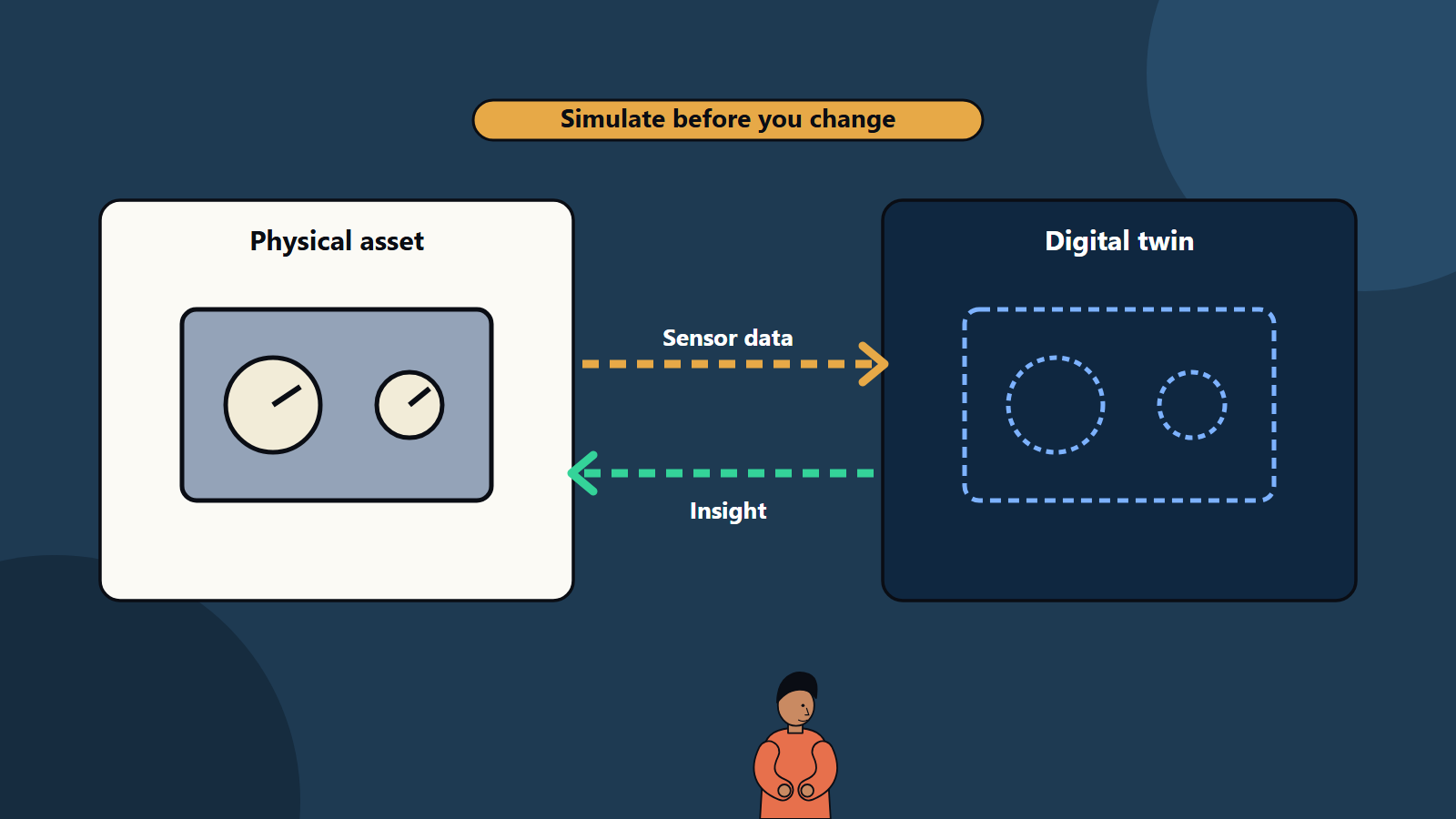
A digital twin is a virtual representation of a physical object, process or system, linked to it by data. The link may update in real time or at regular intervals, and may run in one direction, from the physical to the virtual, or in both, so that decisions in the twin can adjust the physical system.
Three elements matter:
- A model: geometry, physics, behaviour rules or statistical and machine learning models that represent how the asset works.
- Data: sensor readings, operational records, maintenance history, design data and external factors such as weather.
- A purpose: a decision or outcome the twin supports.
Without a purpose, a twin is an expensive animation. Standards bodies and industry groups have published frameworks, including the ISO 23247 series for manufacturing, and different vendors use the term differently, so define what you mean in your own project.
Kinds of twins
- Component or asset twin: one pump, motor, turbine, vehicle or machine.
- System or process twin: a production line, a plant, a supply chain or a building’s heating and cooling.
- Facility or infrastructure twin: a factory, hospital, port, rail network or power grid.
- City or region twin: traffic, energy and utilities for planning.
- Product twin: a model of a product across its life, from design to field performance.
- Organisation or process twin: a model of workflows and capacity, sometimes called a digital twin of the organisation.
Maturity ranges from a descriptive twin that shows current state, through diagnostic and predictive twins to prescriptive twins that recommend or trigger actions.
Where digital twins pay off
Predictive maintenance
Sensors on motors, pumps and compressors feed models that estimate remaining useful life. Maintenance moves from fixed schedules or breakdowns to planned work when needed. Benefits include fewer unplanned stoppages and better use of spare parts.
Process optimisation
A twin of a production line or plant lets engineers test changes to schedules, speeds or layouts without risking output. Teams can find bottlenecks and tune settings to improve throughput, quality or energy use.
Design and testing
Engineers simulate how products behave under stress, heat or vibration before building prototypes, then compare field data against the model to improve the next design.
Energy and building management
Twins of buildings combine floor plans, equipment and occupancy data to optimise heating, cooling and lighting, and to plan retrofits.
Operations and logistics
Warehouses, ports and fleets use twins to simulate flows and plan capacity, and to react to disruptions.
Training and safety
Operators train on a virtual copy of a plant or machine. Hazardous procedures can be rehearsed safely, sometimes with extended reality tools. Our article on XR in training covers when immersive tools justify their cost.
Infrastructure and utilities
Operators model networks to forecast demand, spot leaks or faults and plan investment.
What you need
Data
- Sensors and connectivity: the right measures at the right frequency. Our guide to IoT architecture explains devices, gateways and platforms.
- Operational and enterprise data: maintenance logs, production plans, quality records and energy data from existing systems.
- Engineering data: drawings, bills of materials and specifications. Our article on product lifecycle management covers how this information is managed.
- Context: environment, operating conditions and events.
- Quality and governance: definitions, ownership, access control and retention. Poor data gives a confident but wrong twin. See our guide to data quality for machine learning.
Models
- Physics-based models capture known behaviour, such as thermal or structural response.
- Data-driven models learn patterns from history, such as failure signatures.
- Hybrid models combine both.
- Simulation engines run what-if scenarios.
- Calibrate and validate against real behaviour, and track accuracy over time.
Platform and architecture
- A platform for ingestion, storage, model execution, visualisation and APIs.
- Edge processing for fast local decisions, with cloud for heavy analysis and fleet-wide learning.
- Integration with enterprise systems, such as asset management, ERP and quality systems.
- Interoperability through standards and open interfaces, to avoid dead-end silos.
- Security for devices, data and control paths.
People and process
- A business owner with a clear decision to improve.
- Engineers who understand the asset, data specialists and operations staff.
- Change management so that insights lead to action.
Business case
Benefits are specific to the use case: reduced downtime, lower maintenance cost, energy savings, higher yield, faster design cycles and fewer prototypes. Costs include sensors, connectivity, data engineering, modelling, platform, integration and maintenance of the twin itself. Build the case around one decision and a measurable result, and use a staged approach. Our guide to building a technology business case offers a structure.
How to start
- Pick a high-value asset or process with known pain, such as costly downtime.
- Define the decision and the measure: for example, reduce unplanned stoppages on a line by a set percentage.
- Audit the data: what exists, how good is it and what is missing?
- Build a minimum twin: a model with a limited set of data, aimed at the decision.
- Validate against history and in live conditions, with domain experts.
- Pilot with users, integrate with workflows and measure outcomes.
- Scale to more assets, with shared data models and platform services.
Challenges
- Unclear purpose and scope creep.
- Data gaps and silos, including old equipment with no sensors.
- Model accuracy and drift as equipment ages and conditions change.
- Integration with old operational technology and enterprise systems.
- Security risks from connecting operational systems.
- Skills across engineering, data and software.
- Vendor lock-in with proprietary formats.
- Overpromising, such as claims that a twin can run everything.
Common mistakes
- Starting with a 3D visual before choosing a decision to improve.
- Trying to twin an entire plant at once.
- Ignoring data ownership and quality.
- Building models nobody validates.
- No plan to maintain the twin.
- Forgetting the people who must act on its output.
How SoftSapien supports digital twin projects
SoftSapien works with industrial and infrastructure organisations on data platforms, IoT integration, analytics and applications that bring twins into daily operations. See our IoT development and product lifecycle management services.
To explore a use case, go to the contact page and chat with our team, send a message or schedule a free consultation call.
Frequently asked questions
What is a digital twin?
It is a virtual representation of a physical object, process or system, linked to it by data, with a model and a purpose such as monitoring, prediction or simulation.
Where do digital twins pay off?
Predictive maintenance, process optimisation, design and testing, energy management, logistics planning, training and infrastructure operations, especially for costly or complex assets.
What do I need to build one?
Sensors and connectivity, operational and engineering data, validated models, a platform and architecture, and a business owner with a clear decision to improve.
How should I start?
Pick one high-value asset, define the decision and measure, audit the data, build a minimum twin, validate it with experts and pilot with users before scaling.
Can SoftSapien help with a twin project?
Yes, across data, IoT and analytics. Contact SoftSapien through the contact page to chat with our team, send a message or schedule a free consultation call.