Short on time? A thought leadership programme earns trust by sharing original, useful ideas about problems your buyers care about. Pick two or three topics where you have real experience, back them with evidence, put named experts in front of them, publish in several formats, promote steadily and measure influence on conversations and pipeline. Commit for at least a year.
Buyers of complex services rarely choose the cheapest supplier. They choose the one they trust to understand their problem. Trust is built before the first sales call, when a prospective buyer reads an article, hears a talk, watches a webinar or sees an expert answer a hard question in public.
Thought leadership is the practice of creating that trusted body of ideas. It sounds grand, yet at its best it is simple: share what your people know in ways that help others. This guide explains how business-to-business firms build a programme that lasts, from a small consultancy with two experts to a global company with many. Claims in this field are often inflated, so the focus here is on practical steps.
Key takeaways
- Real thought leadership starts with real expertise and a point of view that helps buyers decide or act.
- Choose a few topics, tie them to your positioning and the questions buyers ask.
- Use original evidence: experience from projects, data, research and clear methods.
- Named people persuade more than brand voices. Support them with editors and a clear process.
- Measure long-term influence beyond clicks, and keep going long enough to compound.
What counts, and what does not
Genuine thought leadership offers:
- A perspective based on experience, such as “here is what we learned moving forty applications to the cloud”.
- Evidence: data, examples, research or a transparent method.
- Usefulness: readers can act on it.
- Candour: it names trade-offs and says when something does not work.
Content that merely repeats common knowledge, rebrands a product pitch as insight or follows every trend without experience behind it adds noise. Buyers spot it quickly.
Step 1: Connect it to strategy
Start with business goals: which markets, which customers, which services do you want to be known for? Link topics to your positioning. Our guide to brand positioning for technology companies explains how to define that. Then choose two or three themes where you can credibly say something. A theme could be a problem (“moving legacy systems without stopping the business”), a method or a view on where the market is heading.
Step 2: Understand the audience
- Interview customers and prospects: what keeps them awake, which decisions are hard, what do they read and who do they trust?
- Review sales calls and support questions for recurring themes.
- Map buyer roles. A chief financial officer, a chief technology officer and an operations lead need different angles on the same topic.
- Check search and social conversations to see which questions people ask. Our guide to B2B content strategy describes how to turn those questions into a plan.
Step 3: Find your experts and your evidence
- Experts: identify people who do the work and can explain it clearly. They may not be senior executives. Engineers, consultants and project leads often have the best material.
- Evidence: gather project learnings, benchmarks, survey results, anonymised data from your own operations, pilots and experiments. With client work, get permission and protect confidentiality.
- Original research: a small, well-designed survey or analysis of your own data can anchor a programme. Be clear about method and limits.
- Third-party sources: cite standards bodies, regulators and published research accurately, and link to them.
Do not claim another company’s technology, results or ideas as your own.
Step 4: Choose formats
Mix formats to fit audience habits and the depth of the idea:
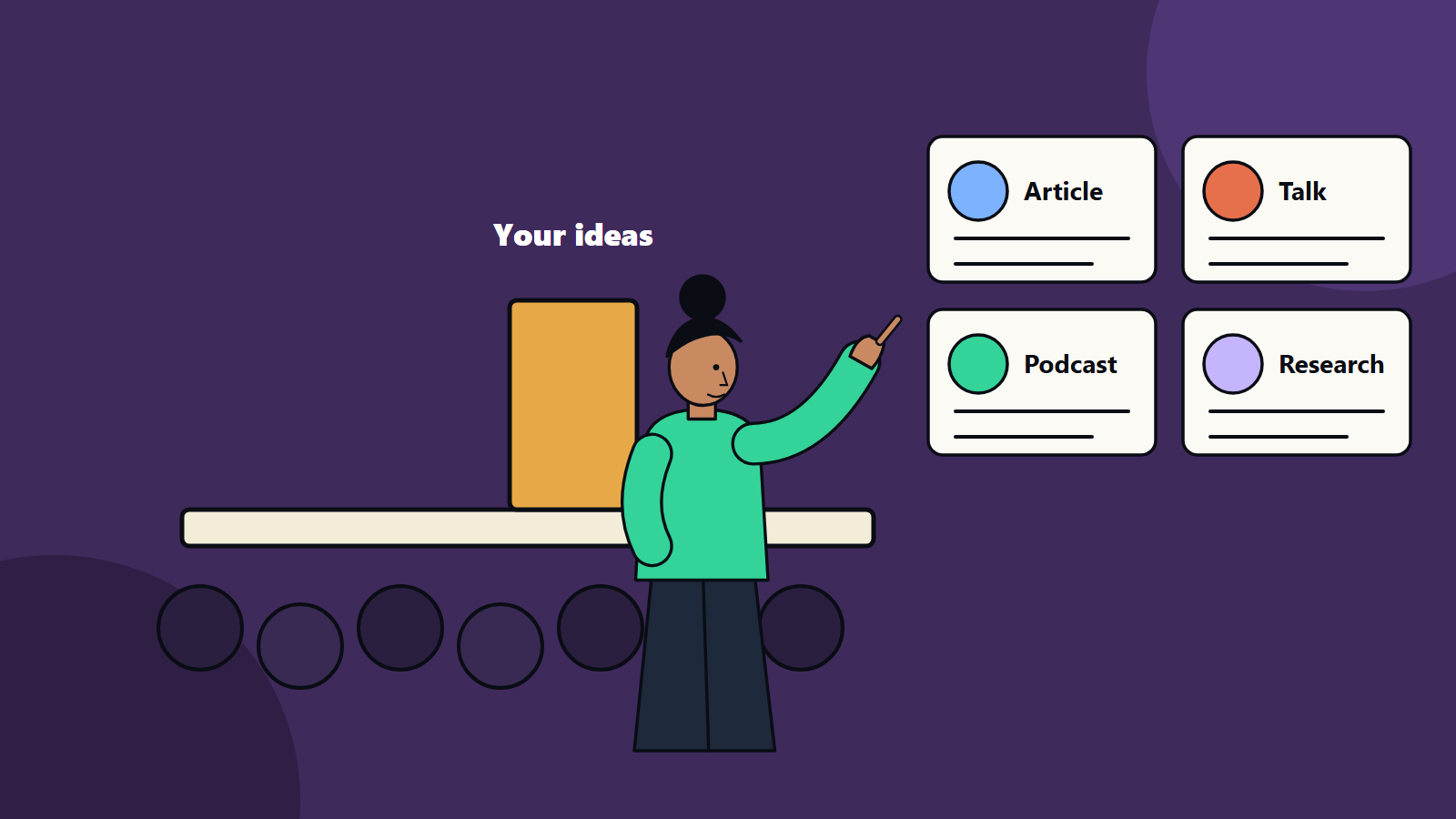
- Articles and guides for search visibility and depth.
- Reports and research for credibility and press interest.
- Webinars and talks for live interaction.
- Podcasts and interviews for personality and reach among busy professionals.
- Video for demonstrations and short explainers.
- Newsletters for a steady relationship.
- Social posts from experts, as described in our article on B2B social media.
- Conference sessions and panels.
- Workshops and roundtables with customers.
- Contributions to industry bodies, standards groups and open source projects.
Repurpose: one research report can yield a keynote, ten articles, a webinar, social posts and a sales deck.
Step 5: Create a process
- Editorial calendar: themes, formats, owners and dates, planned a quarter ahead.
- Interview-led drafting: many experts prefer to talk. Capture an interview, and let an editor shape the text, with the expert’s review.
- Quality standards: accuracy checks, source links, plain language and a consistent voice.
- Approvals: legal and client confidentiality review where needed, with a short turnaround.
- Roles: an editor-in-chief, writers, designers, a promotion lead and the experts.
- Time protection: agree how much time experts give, and respect it.
Step 6: Promote
Great content does not promote itself:
- Share through expert and company channels, newsletters and communities.
- Pitch research and commentary to trade media and analysts, with data they can use.
- Offer speakers to events and podcasts.
- Brief sales and customer success teams so they can use content in conversations.
- Use paid promotion for key pieces, aimed at target accounts.
- Optimise for search and for AI answers, with clear structure and sources. Our guide to generative engine optimization covers this.
- Build relationships with peers and partners who may share your work.
Step 7: Measure
Link measurement to goals and time horizons.
- Reach and visibility: share of voice for your topics, search impressions, speaking invitations and media mentions.
- Engagement quality: time on page, shares by relevant people, replies and newsletter growth.
- Pipeline influence: how many opportunities involved thought leadership content, asked in sales discovery and tracked in the CRM.
- Sales feedback: do prospects mention your ideas? Does content shorten explanations?
- Brand measures: unprompted awareness among target accounts, and perception on key attributes.
- Talent and partners: applications and partnership enquiries.
Expect results over months and years. Review quarterly, and adjust topics and formats.
Ethics and risk
- Be accurate. Wrong claims damage credibility for a long time.
- Respect confidentiality and intellectual property.
- Disclose sponsorships and relationships.
- Be careful with opinions on sensitive topics outside your expertise.
- Use AI tools to assist drafting only with human expertise and review, and follow your own AI policy. Our guide to a responsible AI policy offers a starting point.
- Prepare for criticism and challenge, and respond with evidence and courtesy.
Common mistakes
- Launching with no topic focus.
- Publishing only product news.
- Relying on ghost-written text with no real expert behind it.
- Inconsistent output: a burst of activity, then silence.
- Ignoring distribution.
- Measuring only traffic.
- Giving up after three months.
A twelve-month outline
- Months 1 to 2: define themes, audience, experts and process. Interview customers.
- Months 3 to 4: publish the first cornerstone piece, such as a guide or research report, and a steady flow of supporting articles and posts.
- Months 5 to 8: add webinars, podcast guesting and conference proposals. Pitch commentary to media.
- Months 9 to 12: refresh the strongest pieces, repeat the research with new data and review results with sales.
How SoftSapien supports thought leadership
SoftSapien helps firms plan programmes, interview experts, produce research and content and promote them through search, social and digital PR, with measurement tied to pipeline. See our digital PR and corporate communications services.
To plan your programme, visit the contact page to chat with our team, send a message or schedule a free consultation call.
Frequently asked questions
What is thought leadership in B2B?
It is sharing original, useful ideas based on real experience and evidence about problems buyers care about, so that prospects trust your expertise before the first sales call.
How many topics should a programme cover?
Two or three themes tied to your positioning, where you can credibly say something, rather than chasing every trend.
Who should be the face of thought leadership?
Named experts, who often come from delivery teams as well as the executive suite. Support them with editors and a clear process.
How long before results appear?
Expect months to years. Review quarterly on influence, pipeline conversations and brand measures, and commit for at least twelve months.
Can SoftSapien help build a programme?
Yes, from planning to promotion. Contact SoftSapien through the contact page to chat with our team, send a message or schedule a free consultation call.