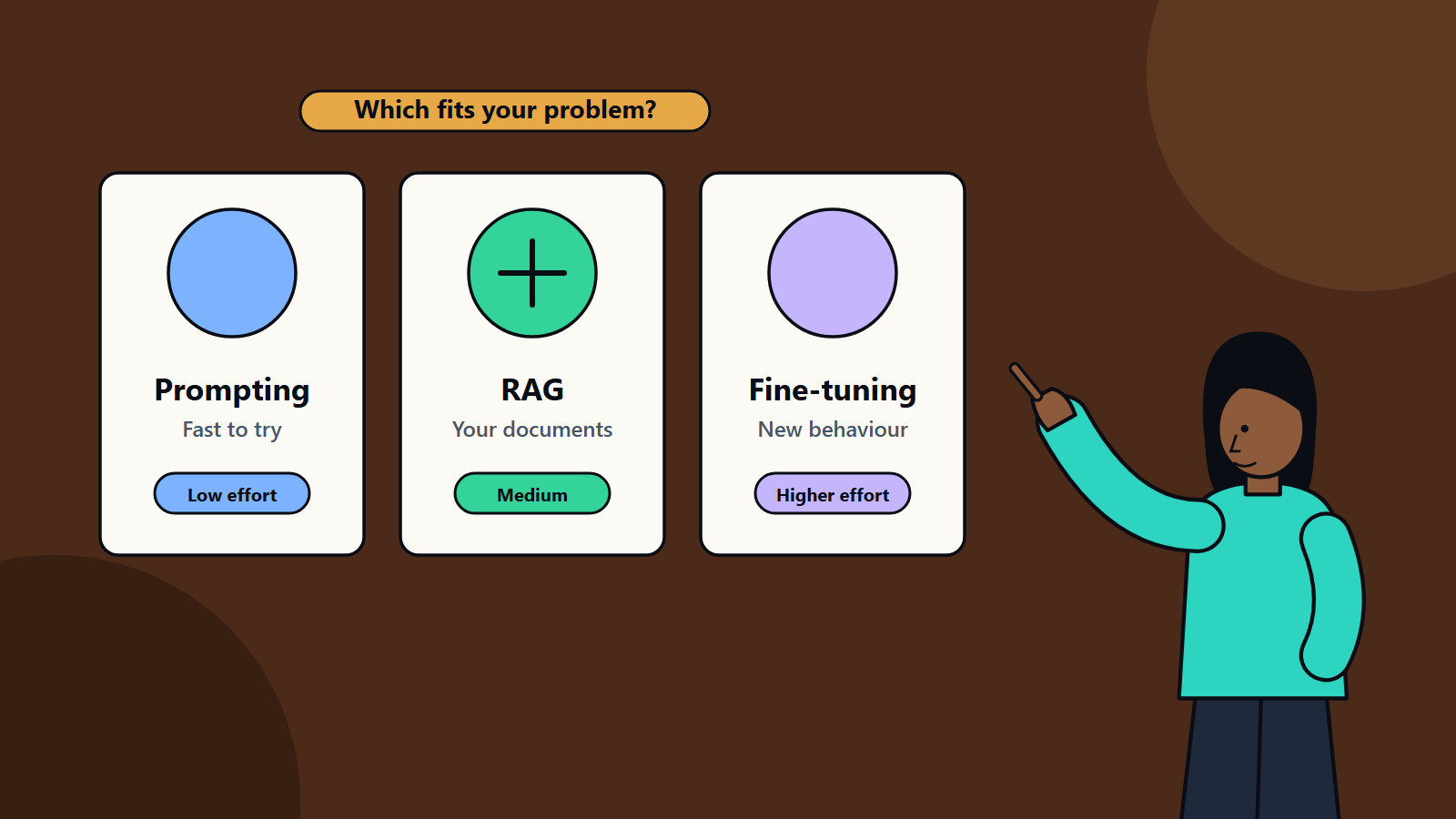
Short on time? Try better prompting first. Add RAG when the model needs your private or changing information. Consider fine-tuning when you need consistent style, format or specialised behaviour that prompts cannot achieve. Many production systems combine two or three of these.
A general language model knows a great deal and nothing about your company. To make it useful for your products, policies and customers you have three main levers: write better instructions, give it your documents at question time or train it further on examples. Each has a different cost, speed and purpose.
This guide explains how to choose, with simple tests you can apply to a real use case. It suits a small team adding an assistant to a website as well as an enterprise planning a portfolio of AI applications.
Key takeaways
- Prompting changes what you ask and how. It is the fastest and cheapest to try.
- RAG retrieves your documents and gives them to the model with the question. It suits facts that are private, specialised or frequently updated.
- Fine-tuning adjusts the model with examples. It suits consistent style, structure or narrow tasks.
- Start simple, measure with a test set and add complexity only when results demand it.
- The options combine well.
The three options in brief
Prompting
You write instructions, examples and context into the request. Good prompts state the role, the task, the format, the tone, constraints and a few examples of what good looks like. You can add rules such as “answer in three sentences” or “ask a question if information is missing”.
Strengths: quick, cheap, easy to change, no training.
Limits: the model still lacks your private facts. Long prompts cost more and can become hard to manage. Behaviour can vary between runs.
Retrieval-augmented generation
The system searches your approved content and supplies the best passages to the model with the question, so the answer reflects your sources and can cite them. Our guide to retrieval-augmented generation covers the steps in detail.
Strengths: current, private knowledge without retraining. Traceable sources. Updates by changing documents.
Limits: needs clean content, a search index and good retrieval. It adds components to run and secure. It does not change how the model behaves.
Fine-tuning
You train an existing model further on examples of inputs and desired outputs. The result is a customised model that has absorbed patterns from your data.
Strengths: consistent tone and structure, better performance on a narrow task, shorter prompts, sometimes lower cost per call with a smaller tuned model.
Limits: needs a quality dataset, expertise and time. Facts inside the tuned model go stale and cannot be easily updated or traced. Not every model or provider supports it.
A decision path
Ask these questions in order:
- Can a clear prompt with examples do the job well enough? If yes, stop there.
- Does the answer depend on information the model does not have, such as your policies, product data or recent events? Add RAG.
- Do you need consistent style, a fixed output format or specialist behaviour that prompts cannot achieve reliably? Consider fine-tuning.
- Do you need both current facts and consistent behaviour? Combine RAG with tuning or with a carefully designed prompt.
Examples
- Support assistant for a product catalogue that changes weekly: prompting for tone and format, with RAG for catalogue and policy content.
- Tool that classifies incoming emails into twenty categories: a few examples in the prompt may work, and fine-tuning a small model may improve accuracy and cost at high volume.
- Contract review helper: RAG over contract templates and clause libraries, prompts that set review rules, and human sign-off.
- Brand-voice writer: prompting with style guidelines and examples, with fine-tuning if the voice must be reproduced reliably at scale.
- Internal policy bot: RAG with access control. Fine-tuning adds little.
Cost and effort
- Prompting: hours to days. Costs are mostly model usage.
- RAG: days to weeks to prepare content, build the index and test. Ongoing costs include storage, search, content upkeep and model usage.
- Fine-tuning: weeks, including data collection and cleaning, training runs, evaluation and maintenance whenever the base model changes.
Costs differ by provider and model, so check current pricing before you commit.
Testing and evaluation
Whatever you choose, build a test set of real questions or tasks with approved answers. Measure accuracy, completeness, format compliance, safety and cost. Compare options on the same set. Re-run the tests after any change to prompts, content, models or settings. Our article on AI cost forecasting can help you estimate the running cost of each option.
Risks to manage
- Data protection: know what data goes to a provider and under which terms, and respect privacy law where your users live.
- Access control: apply user permissions in retrieval.
- Prompt injection: treat external and retrieved text as untrusted.
- Bias and fairness: test outputs across groups relevant to your use.
- Model changes: providers update models, so retest regularly.
Common mistakes
- Jumping to fine-tuning to teach the model facts that change.
- Indexing messy documents and expecting good answers.
- Judging by a few impressive examples.
- Ignoring maintenance after launch.
- Choosing the most complex method to look advanced.
Working through the choice with SoftSapien
SoftSapien helps teams test these approaches on their own data, compare cost and quality, and build the chosen solution with proper security and monitoring. Learn more about our AI development and data science services.
If you have a use case in mind, open the contact page to chat with us, send a message or schedule a free consultation call.
Frequently asked questions
When should I use RAG instead of fine-tuning?
Use RAG when the model needs private, specialised or frequently changing facts. Fine-tuning suits consistent style, format or narrow tasks, and is a poor way to store facts that change.
Should I start with prompting?
Yes. It is the fastest and cheapest option. Move to RAG or fine-tuning only when a test set shows prompts cannot reach the quality you need.
Can I combine the approaches?
Yes. Many systems use prompting for tone and format, RAG for knowledge and light fine-tuning for specialised behaviour.
How do I compare the options?
Build a test set of real tasks with approved answers and compare accuracy, format compliance, safety and cost for each option.
Can SoftSapien test these options for me?
Yes, on your own data. Contact SoftSapien through the contact page to chat with our team, send a message or schedule a free consultation call.