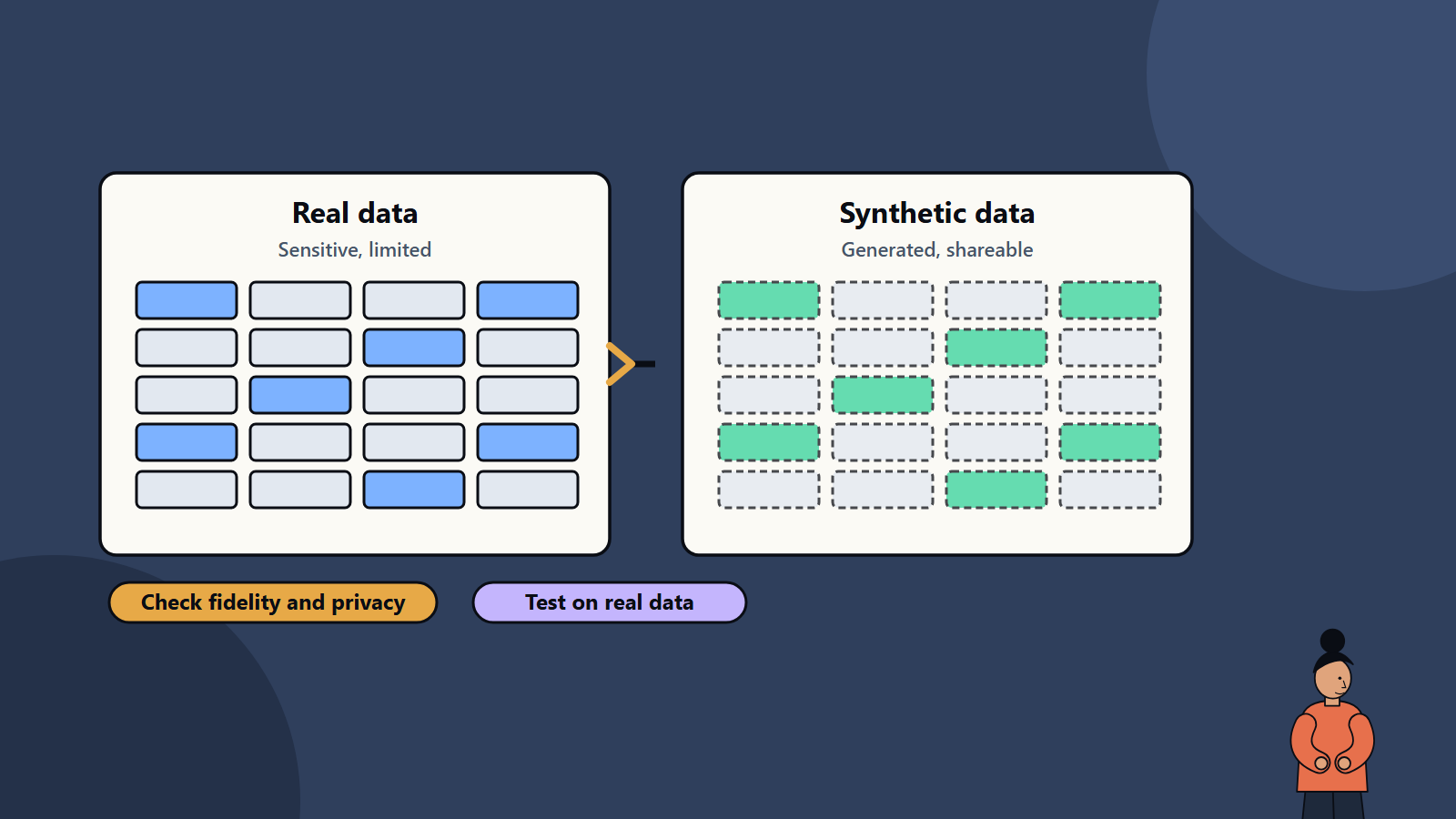
Short on time? Synthetic data is artificially generated data that imitates the statistical patterns of real data. It can help with testing, sharing, balancing rare cases and training models when real data is scarce or sensitive. It is never automatically private or accurate, so check how closely it matches reality, test for leakage of real records, validate models on real data and document how it was made.
Real data is often hard to use. Customer records are protected by privacy law. Medical images are scarce. Fraud cases are rare. Engineers need realistic data to test a system and cannot copy production into a test environment. Synthetic data offers a way round: generate data that looks and behaves like the real thing without being the real thing.
The idea is attractive and easy to oversell. Done well, it speeds up projects and widens access. Done badly, it produces data that misleads models or quietly reveals the records it was built from. This guide explains how synthetic data is made, where it helps, where it fails and which checks to run. It suits a small team needing test data and a data science group working with sensitive information.
Key takeaways
- Synthetic data is generated by rules, simulation or models, and it mimics properties of real data.
- Good uses: software testing, privacy-aware sharing, rare event augmentation, simulation of scenarios and bootstrapping when real data is limited.
- Risks: poor fidelity, bias that is copied or amplified, leakage of real records and false confidence.
- Always evaluate utility, privacy and fairness, and test models on real held-out data.
- Document the method, source data and limits, and keep humans accountable for decisions.
What it is
Synthetic data is information generated artificially, as opposed to collected from real events. It comes in several kinds:
- Rule-based or random data: values created by formulas and distributions, often used for software testing, such as fake names and addresses.
- Simulation-based data: produced by a model of a physical or business process, such as sensor readings from a simulated machine, or images from a three-dimensional scene.
- Statistical synthesis: data sampled from models fitted to real data, preserving relationships between columns.
- Machine learning generators: neural networks that learn from real data and produce new samples, including images, text and tables.
- Augmented data: real data altered in controlled ways, such as rotating images or adding noise, to enlarge a training set. Strictly this is derived data, and it carries the privacy properties of the original.
Where it helps
Software testing and development
Teams need realistic data volumes and formats to test systems, but must not copy personal data to test environments. Generated data with the right structure, edge cases and distributions solves much of this. Our guide to performance testing discusses realistic data for load tests.
Privacy-aware sharing
Organisations may share synthetic versions of datasets with partners, researchers and vendors to collaborate with less exposure. Privacy depends on method and testing, as discussed below.
Rare events and imbalance
Fraud, equipment failure and rare diseases appear seldom in real data, so models see few examples. Synthetic examples can balance classes, but only if they represent real behaviour. Copies of the few existing cases add little.
Simulation and scenario testing
Autonomous systems, robots and industrial processes benefit from simulated worlds where dangerous or unusual situations can be created safely. Vision systems for inspection can be trained on rendered defects, combined with real images. Our article on computer vision for quality inspection shows where this arises.
Bootstrapping and prototyping
When a new product has no data yet, synthetic data lets teams build pipelines, dashboards and prototypes before real data arrives.
Training and education
Realistic but fictional datasets for teaching, demonstrations and sales demonstrations.
Language and content
Generated text can augment training data, test chat systems and create varied examples. Quality and diversity need careful review.
Limits and risks
Fidelity
Synthetic data is only as good as the model or rules behind it. Generators may miss rare patterns, subtle correlations or real-world messiness. A model trained on poor synthetic data learns the generator’s mistakes.
Bias
If the source data is biased, a generator can copy or amplify the bias. Synthetic data can also introduce new bias when assumptions in a simulation do not reflect reality. Fairness needs testing on both.
Privacy leakage
Synthetic does not mean anonymous. Generators can memorise and reproduce real records, particularly for small datasets and unusual individuals. Even without exact copies, combinations of attributes may allow someone to be re-identified or inferred. Treat privacy as something to measure.
False confidence
Strong results on synthetic test data may not carry over to real use. Teams may stop collecting real data because synthetic data seems enough.
Model collapse and feedback
Training models on data generated by other models, repeatedly, can degrade quality and reduce diversity. Keep a base of real, verified data.
Regulatory uncertainty
Whether synthetic data counts as personal data depends on how it was made and whether individuals can be identified. Rules differ by country, so take legal advice for sensitive uses.
Generating it well
- Define the purpose: what will the data be used for, and what properties matter?
- Understand the source data: quality, coverage and sensitivity. Poor source data gives poor synthetic data. See our guide to data quality for machine learning.
- Choose the method: rules and simulation for well-understood processes, statistical or learned generators for complex real-world patterns.
- Preserve structure: keep relationships between tables, valid keys, realistic ranges and business rules.
- Include edge cases deliberately, such as nulls, extreme values and unusual formats, particularly for testing.
- Apply privacy protections: limit what the generator can memorise, consider techniques such as differential privacy where the mathematical guarantees fit, and restrict access to the source data and the generator.
- Generate at the scale you need, and no more.
- Version and document the generator, parameters and source data snapshot.
Evaluate: utility, privacy and fairness
Utility checks
- Statistical similarity: compare distributions, correlations and summary statistics between real and synthetic data.
- Task performance: train a model on synthetic data and test on real held-out data. Compare to a model trained on real data. The gap shows how useful the synthetic data is.
- Domain expert review: do records look plausible? Do rules hold?
- Coverage: are rare but important cases represented?
Privacy checks
- Nearest-neighbour tests: check how close synthetic records are to real ones, and look for exact or near copies.
- Membership inference tests: see whether an attacker can tell whether a record was in the training data.
- Attribute inference: test whether sensitive attributes can be guessed.
- Uniqueness: examine rare combinations that could identify people.
- Formal guarantees: where used, understand their assumptions and limits.
- Independent review for high-risk data.
Fairness checks
- Compare outcomes across relevant groups, in both real and synthetic data.
- Look for under-represented groups and distorted relationships.
- Document findings and mitigation.
Using it in machine learning
- Mix with real data and give real data priority.
- Always test on real data, kept separate from anything used in generation.
- Monitor in production: performance may differ from lab results. See our guide to MLOps basics and our article on evaluating LLM output.
- Label clearly which data is synthetic, to avoid confusion later.
- Avoid training generators on their own output repeatedly.
Governance
- Assign an owner for each synthetic dataset.
- Define approved uses, and access rules.
- Keep records of generation methods, evaluation results and approvals.
- Include synthetic data in your data inventory and privacy impact assessments. Our guide to a responsible AI policy can host these rules.
- Review regularly, since generators and risks evolve.
Common mistakes
- Assuming synthetic means private.
- Never validating against real data.
- Generating data that is too clean, which hides real-world messiness.
- Ignoring bias in the source.
- Using one generator for everything.
- Stopping real data collection.
- No documentation.
A starting plan
- Pick a clear use case, such as test data for a customer system.
- Start with rule-based generation for testing, and add learned generators when needed.
- Define utility and privacy checks, and run them every time.
- Compare model results on synthetic and real data.
- Document and review.
How SoftSapien supports synthetic data work
SoftSapien helps organisations create realistic test data, build and evaluate synthetic datasets and design checks for utility, privacy and fairness. See our data science and QA and testing services.
To explore your use case, visit the contact page and chat with our team, send a message or schedule a free consultation call.
Frequently asked questions
What is synthetic data?
Artificially generated data that imitates the statistical patterns of real data, produced by rules, simulation, statistical models or machine learning generators.
Is synthetic data automatically private?
No. Generators can memorise real records, and combinations of attributes may allow re-identification, so privacy should be tested with checks such as nearest-neighbour and membership inference tests.
Where does synthetic data help most?
Software testing, privacy-aware sharing, balancing rare events, scenario simulation and bootstrapping prototypes when real data is limited.
How do I check synthetic data quality?
Compare distributions and correlations, train on synthetic and test on real held-out data, have domain experts review records and check fairness across groups.
Can SoftSapien help generate and evaluate synthetic data?
Yes, with utility, privacy and fairness checks. Contact SoftSapien through the contact page to chat with our team, send a message or schedule a free consultation call.