Short on time? A strategic roadmap links a clear vision to a small set of outcomes, shows what will be worked on now, next and later, and is reviewed every quarter. Start from goals and evidence, state outcomes rather than lists of features, be firm on this quarter and flexible beyond it, name owners, expose dependencies and trade-offs and keep the document short enough to read.
Leaders often have a clear vision and a long list of projects, with little in between. Teams then pursue everything at once, deadlines slip and nobody can say which work matters most. A strategic roadmap bridges the gap: it turns direction into priorities that people can plan around.
Roadmaps apply to a whole company, a product, a technology platform or a department. This guide explains how to build one that survives contact with reality, with simple formats and review habits. It suits a founder planning the next year and an executive team coordinating several business units.
Key takeaways
- A roadmap communicates direction, priorities and trade-offs. It is not a promise of dates for every feature.
- Start from vision, goals and evidence, and express work as outcomes.
- Use time horizons: committed for this quarter, planned for next, directional beyond.
- Make capacity, dependencies and risks visible.
- Review quarterly, communicate changes openly and measure results.
What a roadmap is
A roadmap is a visual or written plan showing what an organisation intends to achieve and in what order. It sits between the vision, which describes the destination, and the plan or backlog, which lists detailed tasks. Good roadmaps:
- Connect work to goals.
- Show sequence and relative priority.
- Reveal dependencies and resource limits.
- Support decisions about what to do and what to leave out.
- Help different audiences share the same picture.
Bad roadmaps are wish lists, or rigid schedules that break at the first surprise.
Start with the foundation
Vision and strategy
State where you want to be in three to five years, in plain words. Link it to your market position and strengths. If the vision is vague, a roadmap cannot fix it. Our guide to brand positioning for technology companies can help sharpen direction.
Goals and measures
Translate the vision into a few goals for the next twelve months, each with measures: revenue, retention, cost, quality, risk reduction or capability. Three to five goals are enough. Our article on OKRs for technology teams explains one way to set and track goals.
Evidence
Gather inputs:
- Customer research and feedback.
- Market and competitor trends.
- Financial and operating data.
- Technical constraints and debt.
- Risks and compliance duties.
- Staff and partner views.
Look for patterns across requests.
Build the roadmap
1. List candidate initiatives
Collect ideas from all sources: new products, features, platform work, process changes, hires, partnerships and risk reduction. Write each as the outcome sought and the problem addressed, such as “reduce onboarding time for new customers from fourteen days to five”.
2. Evaluate and prioritise
Score each against criteria such as:
- Contribution to goals: how much does it move a key measure?
- Customer or stakeholder value.
- Strategic fit.
- Effort and cost: with ranges and uncertainty acknowledged.
- Risk and dependencies.
- Urgency: deadlines, regulations and competitive pressure.
- Confidence: how strong is the evidence?
Frameworks such as value versus effort, weighted scoring or simple rankings can help. The numbers support judgement and leave the final call to people. Be willing to say no, and record why.
3. Check capacity
Compare the list with available people and budget. Account for run and maintenance work, leave, hiring lead times and unplanned demand. A roadmap that fills one hundred percent of capacity will fail. Many teams plan around seventy to eighty percent, leaving room for the unexpected.
4. Sequence and group
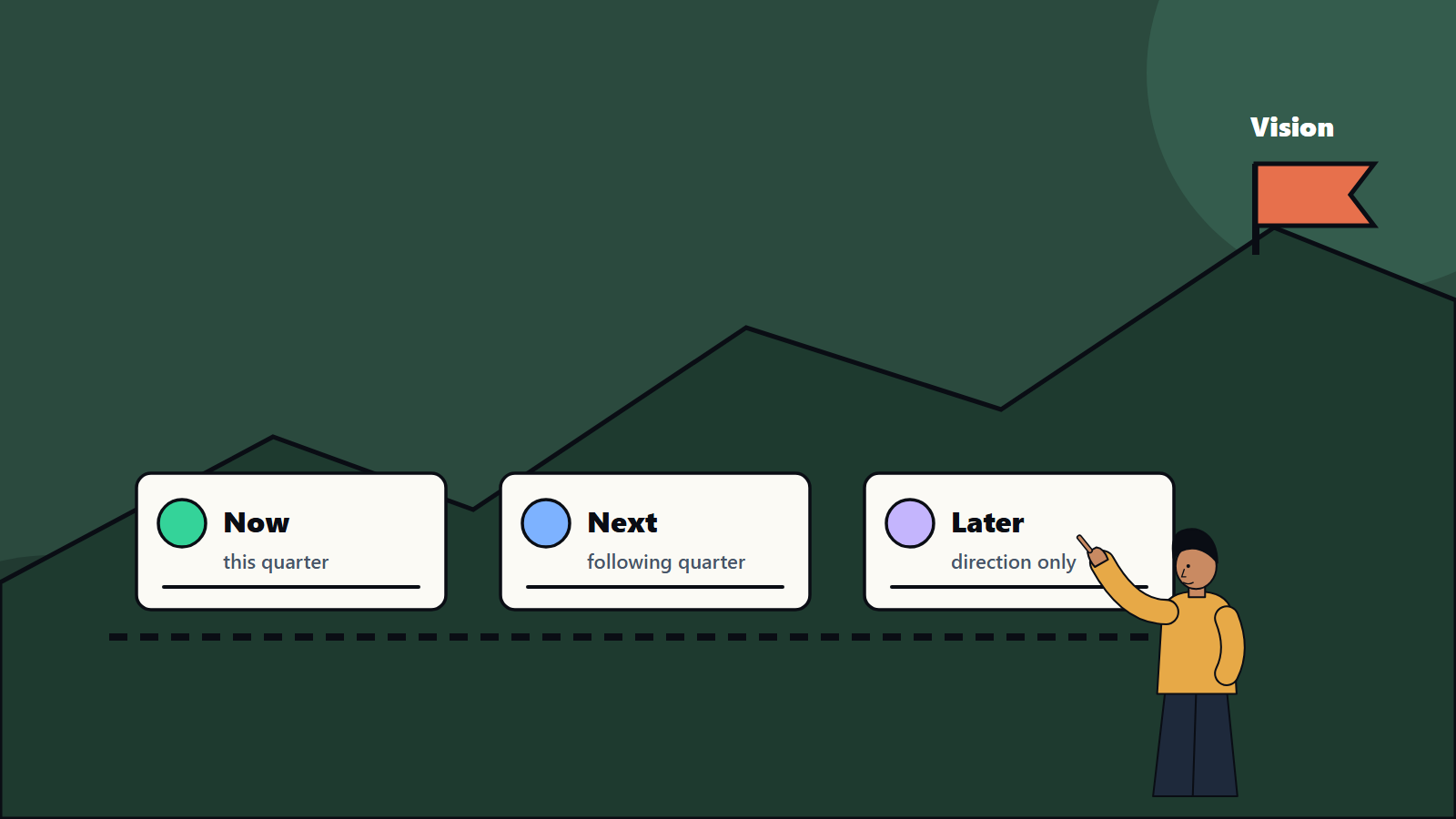
- Place the work in time horizons: now (this quarter, committed), next (following quarter, planned with some flexibility) and later (beyond, directional themes).
- Respect dependencies: enabling work such as data foundations, security and platform capabilities must come before the features that rely on them. Our guide to API-first strategy shows how enabling decisions shape what follows.
- Group initiatives under goals or themes, so the logic is visible.
- Balance types of work: growth, improvement, risk and technical health.
5. Add owners and measures
Name an accountable owner for each initiative, and the measure that will show success. Define what “done” means.
6. Show assumptions and risks
State key assumptions, such as “regulatory approval arrives by month three”, and the main risks with responses.
Formats
- Now-next-later: three columns, simple and honest about uncertainty. Good for product and technology roadmaps.
- Timeline or Gantt style: shows dates and dependencies, better for projects with fixed deadlines. Avoid false precision beyond the near term.
- Outcome-based roadmap: organised by goals and outcomes, with initiatives as bets under each.
- Theme-based roadmap: high-level themes by quarter.
- Swimlanes: rows for teams, products or workstreams.
- One-page summary for executives, with detail behind it.
Pick the simplest format that your audience understands.
Roadmaps for different audiences
- Board and executives: goals, major bets, investment and risk.
- Teams: detailed priorities, dependencies and owners.
- Customers and partners: direction and themes without committing to dates or features. Be careful with promises.
- Sales and support: what is coming and how to talk about it.
Maintain one source of truth, and create views for each audience.
Technology and platform roadmaps
For technology functions, include:
- Business-driven initiatives such as new products and integrations.
- Platform and architecture modernisation. See our guide to legacy application modernization.
- Security and resilience work.
- Cloud and infrastructure changes, with cost.
- Data and AI capabilities.
- Skills and organisation.
- End-of-life dates for technologies and contracts.
Make technical debt visible, with a clear link to business risk, so it competes fairly for capacity.
Governance and cadence
- Quarterly review: assess results, update priorities and plan the next quarter in detail.
- Monthly check-in: progress, risks and changes.
- Triggers for earlier change: major market events, funding changes, failed assumptions or serious incidents.
- Decision rights: who can change the roadmap, and how changes are communicated.
- Change log: record what moved and why.
Our guide to why digital transformation programmes stall describes how weak governance undermines plans.
Communicate
- Explain the reasoning behind choices, as well as the choices.
- Present trade-offs: what we are not doing, and why.
- Use plain language and visuals.
- Invite questions and challenge.
- Share results as well as plans, so credibility grows.
Measure progress
- Delivery against committed priorities.
- Movement in goal measures.
- Benefits realised from completed initiatives.
- Changes made and the reasons.
- Stakeholder confidence, from short surveys or conversations.
Common mistakes
- A long list with no prioritisation.
- Dates for items two years away.
- Feature lists with no outcomes.
- Ignoring capacity and run work.
- Never saying no.
- Hiding dependencies and risks.
- Treating the roadmap as fixed.
- Not reviewing, so it goes stale.
A first roadmap in two weeks
- Days 1 to 3: confirm vision and three to five goals.
- Days 4 to 6: gather evidence and candidate initiatives.
- Days 7 to 9: score, check capacity and draft now, next and later.
- Days 10 to 12: review with leaders, adjust and name owners.
- Days 13 to 14: publish a one-page version, and set the review dates.
How SoftSapien supports roadmapping
SoftSapien’s advisers facilitate roadmap sessions, bring evidence and technical depth and help turn priorities into delivery plans, for business and technology leaders. See our business advisory consulting and business transformation services.
To shape your roadmap, use the contact page to chat with our team, send a message or schedule a free consultation call.
Frequently asked questions
What is a strategic roadmap?
A plan showing what an organisation intends to achieve and in what order, linking vision and goals to prioritised initiatives, with dependencies and trade-offs visible.
What is a now-next-later roadmap?
A simple format with three horizons: committed work this quarter, planned work next quarter and directional themes beyond, honest about uncertainty.
How full should a roadmap be?
Plan around seventy to eighty percent of capacity, leaving room for run work, leave, hiring lead times and unplanned demand.
How often should a roadmap be reviewed?
Quarterly for priorities, with monthly check-ins and earlier changes when assumptions fail or major events occur.
Can SoftSapien facilitate roadmap planning?
Yes, with evidence and technical depth. Contact SoftSapien through the contact page to chat with our team, send a message or schedule a free consultation call.