Short on time? Agent-to-agent protocols are shared rules that let AI agents built by different teams and vendors find each other, hand over tasks and exchange results. The Agent2Agent (A2A) protocol, which Google created and donated to the Linux Foundation, connects agents to agents, and the Model Context Protocol (MCP) connects an agent to its tools and data. Use them to avoid one-off links, and secure each connection with identity, limits and logs.
One agent that books a meeting is easy. Ten agents from different vendors, each owning a part of a business process, are harder. They need a common way to ask each other for work, share results and stay within limits.
That is the job of agent-to-agent protocols. IBM’s 2026 trends list agent-to-agent communication as a sign that multi-agent systems are moving into production as protocols mature. This article explains the main protocols, when to use them and how to run them safely. It suits teams planning their first connected agents and enterprises with many.
Key takeaways
- A2A is an open protocol for communication between AI agents, letting agents on different frameworks interoperate and delegate sub-tasks without exposing their internal memory, tools or logic.
- MCP is an open-source standard for connecting AI applications to external data, tools and workflows, compared by its documentation to a USB-C port for AI.
- The two are complementary: MCP links an agent to tools, and A2A links agents to each other.
- Protocols do not make agents safe. Add identity, least privilege, approval and logging.
- Start with a simple workflow, and add agents only when tests show a need.
What the sources say
The A2A project describes A2A as an open protocol for communication between AI agents. It lets agents built on different frameworks interoperate, delegate sub-tasks and coordinate actions without exposing their internal memory, tools or logic, and it treats agents as opaque applications. Google originally developed A2A and donated it to the Linux Foundation. A Technical Steering Committee oversees it, with representatives from AWS, Cisco, Google, IBM Research, Microsoft, Salesforce, SAP and ServiceNow, and the project uses the Apache 2.0 licence. The A2A site says it complements MCP.
The Model Context Protocol documentation calls MCP an open-source standard for connecting AI applications to external systems: data sources such as files and databases, tools such as search engines and calculators, and workflows such as specialised prompts. It compares MCP to a USB-C port for AI applications and notes that assistants and development tools already support it.
IBM’s 2026 trends names agent-to-agent communication as multi-agent systems moving into production, supported by maturing protocols, and also lists super agents and agent teams.
Anthropic’s guidance on building effective agents adds a cautionary note: find the simplest solution possible, and increase complexity only when it demonstrably improves outcomes. It distinguishes workflows, where code paths are predefined, from agents, where the model directs its own process.
The problem agent-to-agent protocols solve
Without a shared protocol, every pair of agents needs a custom link. With ten agents, that is up to 45 links to build, secure and maintain. Protocols reduce that to one standard per side.
They also protect independence. Agents can keep their inner workings private and still cooperate, which matters when agents belong to different teams or companies.
A2A and MCP in plain words
- MCP, agent to tools: an agent asks a server for a tool, such as “search this database” or “read this file”. The server describes what it offers, and the agent uses it.
- A2A, agent to agent: one agent hands a task to another agent and receives the result, without seeing how the second agent works.
Think of MCP as the agent’s hands, and A2A as the agent’s phone line to colleagues.
A message example
Real protocols define their own message formats. This simplified, illustrative message shows what a delegated task usually contains:
{
  "task_id": "T-5521",
  "from_agent": "procurement-agent",
  "to_agent": "supplier-risk-agent",
  "request": "Assess supplier ACME Ltd for contract renewal.",
  "inputs": {"supplier_id": "S-1042", "contract_value": 120000},
  "constraints": {"max_cost": 5, "deadline": "2026-12-10"},
  "on_behalf_of": "buyer-jane",
  "requires_human_approval": false
}
Notice the fields that matter for safety: who is asking, on whose behalf, with what limits and whether a person must approve.
Design rules for connected agents
1. Use the simplest structure that passes tests
Many tasks need one agent with good tools. Use several agents when roles differ, permissions differ or work can run in parallel. See multi-agent systems explained.
2. Give every agent an identity
Each agent needs its own identity, an owner and narrow rights, and calls between agents should carry the identity of the caller and the person it acts for. See AI agent identity.
3. Limit what crosses the boundary
Pass only the data the other agent needs. Strip personal and confidential details where possible.
4. Set time, cost and depth limits
Prevent loops, where agents keep calling each other. Cap the number of hops, the cost and the time for each task.
5. Keep humans in the loop for risky steps
Require approval for payments, external messages and irreversible actions, wherever in the chain they occur.
6. Trace across agents
Use one trace id through the whole chain, so you can follow a request from the first agent to the last. See observability and AI model monitoring.
7. Version and test the contracts
Treat each agent’s inputs and outputs like an interface. Test them, version them and announce changes. See contract testing for APIs.
Security risks to plan for
- Prompt injection across agents. A malicious instruction in one agent’s input can travel to the next. See prompt injection explained.
- Excessive agency. An agent with broad tools can do harm if tricked.
- Impersonation. A fake agent claims to be a trusted one. Authenticate callers.
- Data leakage. Context passed along may contain secrets.
- Cascading errors. One wrong answer feeds the next agent.
- Supply chain. Third-party agents and tool servers need vetting. See software supply chain security.
A worked example: contract renewal
This example is illustrative.
A company wants to speed up contract renewals.
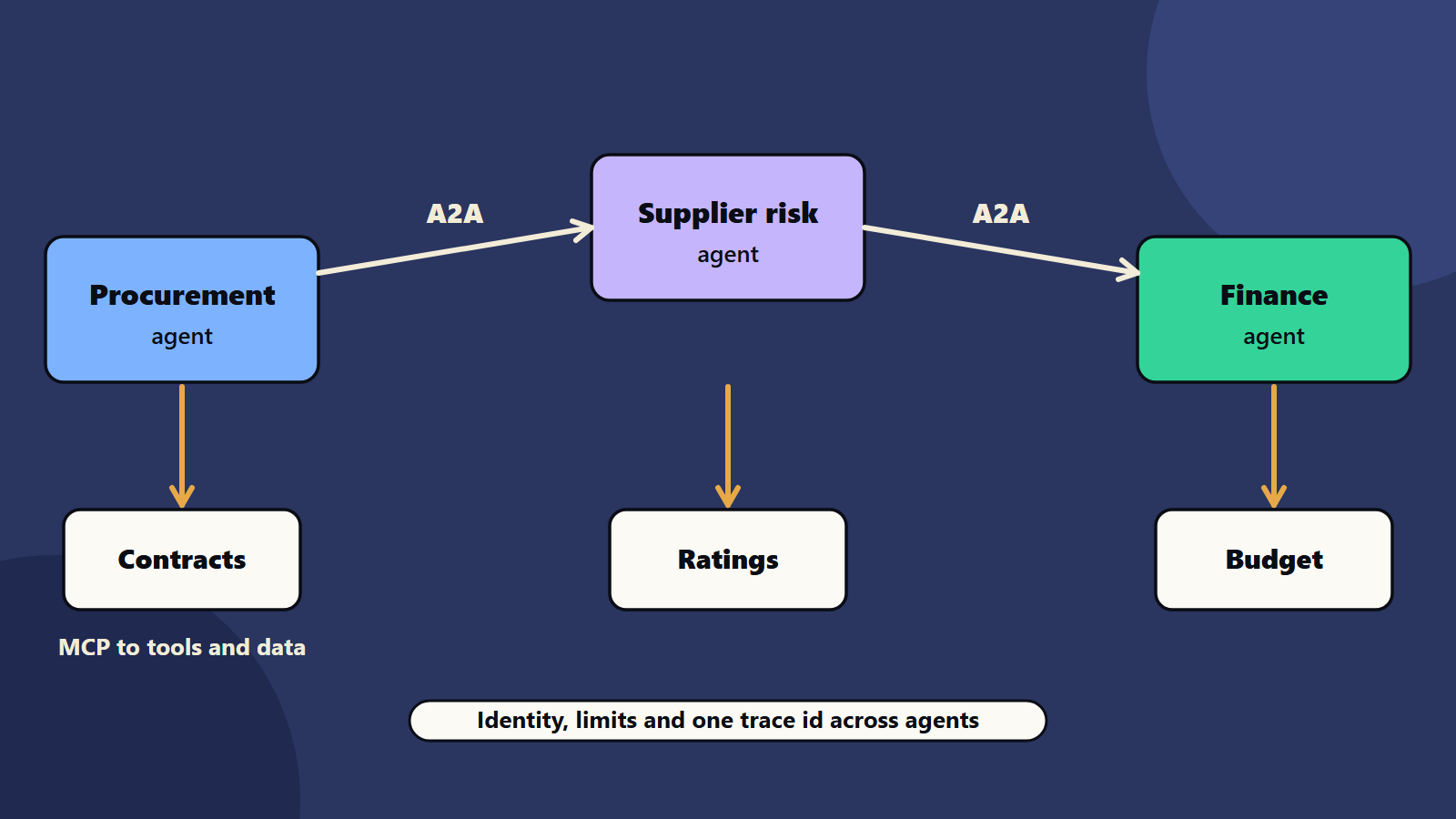
- A procurement agent collects renewal notices and checks contract terms through MCP connections to the contract store and the supplier database.
- It delegates a risk check to a supplier-risk agent run by another team, using an agent-to-agent protocol. The task states the supplier, the limits and the deadline.
- The risk agent uses its own tools, which the procurement agent never sees, and returns a score and evidence.
- A finance agent checks budget availability, again by delegation.
- The procurement agent assembles a recommendation and sends it to a human buyer for approval.
- Logs hold a single trace of all steps. The buyer approves, edits or rejects.
Each agent stays simple, and the cross-team links use a standard rather than custom code.
Small business and enterprise views
- Sole trader or small business: one assistant with a few connected tools is enough. Use tool connections from trusted providers, and avoid giving them broad access.
- Mid-size company: adopt a standard for tool access, choose a framework that supports agent protocols and start with two or three connected agents.
- Enterprise: build a registry of agents and tool servers, with owners, versions, security reviews, identity and monitoring, and standard contracts between teams.
Regional and regulatory notes
When agents from different companies or regions exchange data, rules on personal data, cross-border transfer and automated decisions may apply. Record what data crosses each boundary, and keep logs for the period your rules require. See data residency and sovereignty.
Common mistakes
- Building many agents when one would do.
- Trusting any agent that claims an identity.
- Passing full context to every agent.
- No limits, so agents loop and costs spike.
- No trace across the chain.
- Treating a protocol as a security guarantee.
- Not versioning agent interfaces.
A starting plan
- Pick one workflow that crosses two teams.
- Build each agent with narrow tools, and test it alone.
- Connect them with an agreed protocol and clear limits.
- Add identity, approval and tracing.
- Review agent-to-agent protocols in your stack each quarter, since standards keep moving.
How SoftSapien supports multi-agent systems
SoftSapien’s AI engineers design and build connected agents, tool servers and protocol integrations, and add identity, approval flows, tracing and testing. See our AI development and enterprise software integration services.
To connect your agents safely, use the contact page to chat with our team, send a message or schedule a free consultation call.
Frequently asked questions
What is the A2A protocol?
An open protocol for communication between AI agents, which lets agents built on different frameworks delegate tasks without exposing their internal memory, tools or logic.
How is MCP different from A2A?
MCP connects an AI application to tools and data, and A2A connects agents to each other. The A2A project describes them as complementary.
Do protocols make agents safe?
No. Add identity, least privilege, approval for risky actions, limits and tracing across the whole chain.
When should we use several agents?
When roles or permissions differ or work can run in parallel. Many tasks need only one agent with good tools.
Can SoftSapien help connect our agents?
Yes, from design to monitoring. Contact SoftSapien through the contact page to chat with our team, send a message or schedule a free consultation call.