Short on time? A multi-agent system uses several AI agents with different roles that pass work to each other, often with a lead agent that plans and delegates. It can help with tasks that split naturally into parts or need independent checks. A single agent or a fixed workflow is simpler, cheaper and easier to control, so add agents only when a test shows they improve results.
A single AI assistant that answers questions is one thing. A set of AI agents that research, draft, check and act, handing results to one another, is another. This pattern, called a multi-agent system, is receiving attention as businesses move from chat to automation.
It also adds cost, complexity and new ways to fail. This guide explains what multi-agent systems are, the common designs, when they make sense and how to keep them safe. It suits a team exploring its first agent project and an enterprise planning an agent platform.
Key takeaways
- A multi-agent system coordinates several agents, each with its own instructions, tools and role.
- Common patterns include an orchestrator with workers, pipelines, review pairs and debate between agents.
- Start with the simplest design that works. Anthropic’s engineering guidance on building agents advises adding complexity only when it demonstrably improves outcomes.
- Costs, delays and errors compound across agents, so set limits, logging and human approval.
- Governance matters more as agents act on real systems.
Agents and workflows
An influential engineering article, Building effective agents from Anthropic, draws a distinction. In workflows, language models and tools follow predefined code paths. In agents, the model directs its own process and tool use, staying in control of how it reaches the goal. Agents suit open-ended problems where the number of steps cannot be predicted. Workflows suit well-defined tasks where predictability matters more.
A multi-agent system uses more than one such agent. Each may have different instructions, tools, permissions and sometimes a different model.
Common patterns
Orchestrator and workers
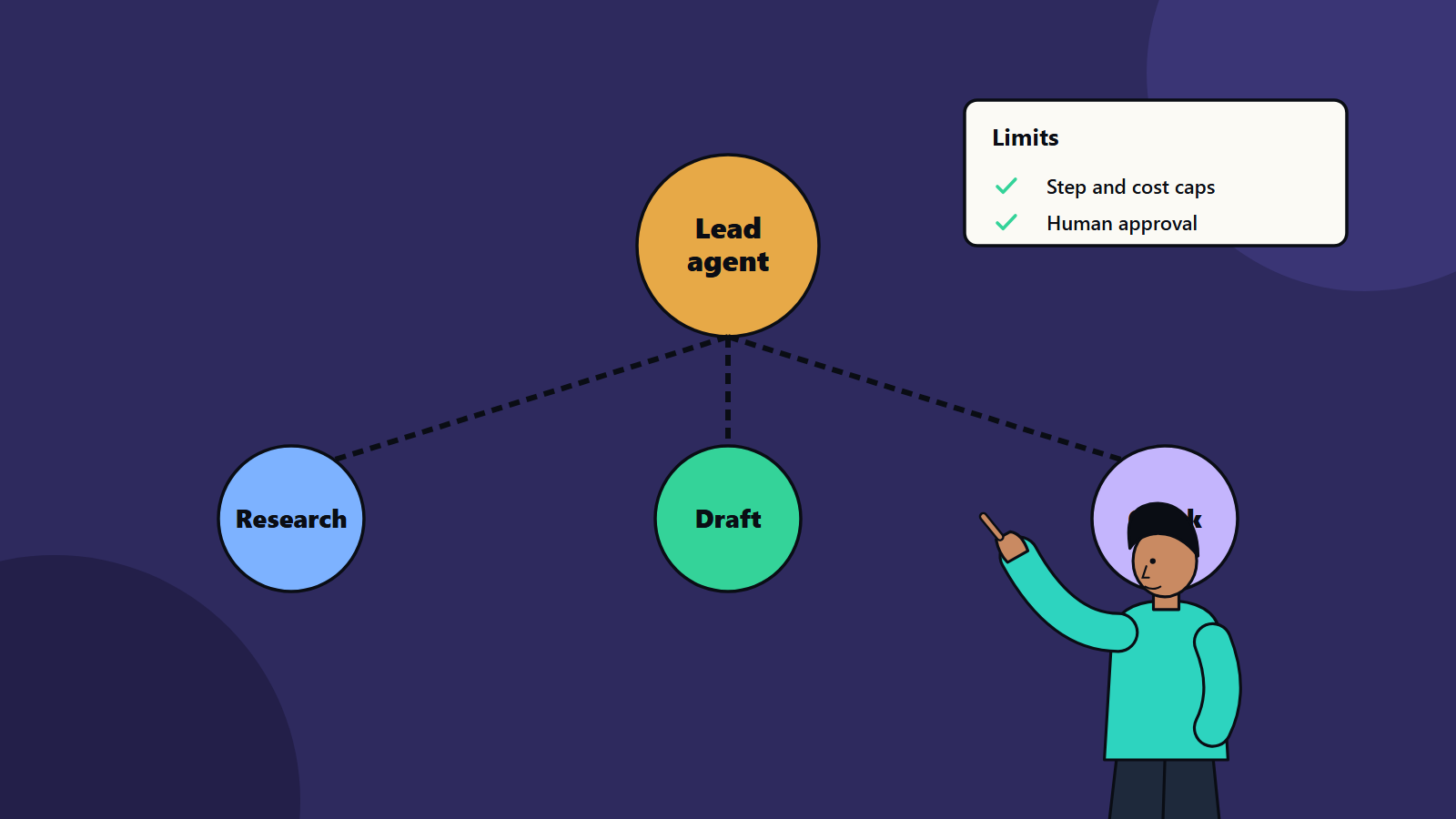
A lead agent receives a goal, breaks it into subtasks, delegates them to worker agents and combines their results. The subtasks are decided from the specific input, so the plan can change from one request to the next. This suits research, analysis and coding tasks where the parts are not known in advance.
Pipeline or assembly line
Agents work in a fixed order: one gathers information, another drafts, another edits and another formats. The path is predictable, so this is closer to a workflow, with agents as stages.
Specialists with a router
A routing agent reads a request and sends it to the right specialist, such as billing, technical support or sales. Each specialist has focused instructions and tools. This simplifies prompts and permissions.
Reviewer and critic
One agent produces work and another checks it against rules, facts or policy. The reviewer can be a different model or run with different instructions. This can catch mistakes, though two agents can share blind spots, so do not treat it as a guarantee.
Debate and voting
Several agents propose answers independently, and a judge or a vote picks the best. This can improve accuracy on reasoning tasks at higher cost.
Parallel workers
Many agents handle independent items at the same time, such as checking a hundred documents, then results are merged. This improves speed when tasks do not depend on each other.
When multi-agent makes sense
- The task has distinct parts that benefit from different instructions, tools or permissions.
- Work can run in parallel to save time.
- Context is too large for one agent, so splitting keeps each focused.
- You want separation of duties, for example a drafting agent that cannot send email and a sending agent that can only send approved drafts.
- Independent review is valuable.
When to keep it simple
- A single model call with good prompts and retrieved context handles the task.
- A fixed workflow covers the steps.
- Reliability and predictability matter most.
- You cannot yet measure quality, so extra agents would add noise.
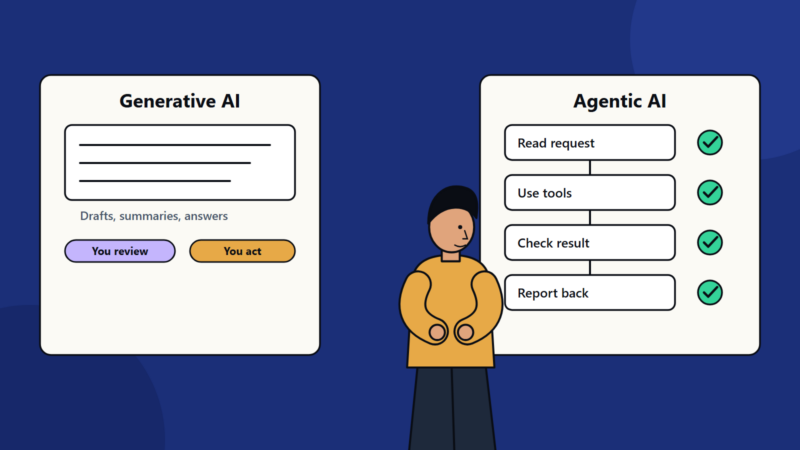
Our guide to generative AI versus agentic AI helps decide how much autonomy a task needs.
Costs and risks
- Cost. Each agent makes model calls, and coordination adds more. Costs can multiply quickly. See our guide to measuring AI cost.
- Latency. Chains of calls take time.
- Error compounding. A mistake early in the chain can mislead every later step.
- Loops and runaway behaviour. Agents can call each other repeatedly.
- Debugging difficulty. Behaviour emerges from interactions, so tracing is essential.
- Security. More agents and tools mean more access to protect. Text passed between agents can carry injected instructions.
- Accountability. When several agents contribute, it can be unclear who or what decided.
Design guidance
- Define the goal and the measure of success before building.
- Start with one agent, and add others only when tests show gains.
- Give each agent one clear role, concise instructions and only the tools it needs.
- Specify the hand-off format. Structured messages with named fields reduce misunderstandings.
- Limit steps, time and spend per task, and stop gracefully when limits are hit.
- Keep a person in the loop for high-impact actions.
- Log every message and tool call with identifiers that link them to the original request.
- Test with realistic cases, including failures and hostile inputs. Our article on evaluating LLM output explains how to build a test set.
- Compare against a simpler baseline on quality, cost and speed.
Safety and governance
Apply the controls described in our guide to AI agent governance: an inventory with named owners, separate identities, least privilege enforced outside the model, approval tiers, logging, testing and a kill switch. The OWASP guidance on excessive agency warns against giving models more functionality, permissions or autonomy than the task needs, which is especially relevant when many agents share tools.
Specific points for multi-agent setups:
- Treat messages from one agent to another as untrusted input to be validated.
- Do not let an agent expand its own permissions or create new agents without control.
- Keep a global budget and an overall stop control.
- Make sure there is one place to see the whole run.
Example use cases
- Research assistant: a lead agent splits a question into topics, workers search and summarise sources and a reviewer checks citations.
- Customer support: a router sends cases to specialist agents, which draft replies that a person approves for complex cases.
- Software maintenance: agents analyse a bug, propose a fix, write tests and review the change, with a developer approving.
- Back-office processing: agents extract data from documents, validate it against rules and flag exceptions to staff.
Measuring results
- Task success rate and quality scores.
- Cost per completed task.
- Time to complete.
- Number of steps and retries.
- Human intervention rate.
- Incidents and near misses.
Review these regularly, and simplify designs that do not earn their complexity.
Common mistakes
- Building a crowd of agents for a task one prompt could do.
- Vague roles and overlapping tools.
- No limits, leading to runaway costs.
- Skipping evaluation.
- Giving agents broad access for convenience.
- Hiding the process from users and owners.
How SoftSapien builds agent solutions
SoftSapien designs and builds agent and workflow solutions with evaluation, security and monitoring built in, starting simple and adding agents where they earn their place. See our AI development and cybersecurity consulting services.
To explore a use case, use the contact page to chat with our team, send a message or schedule a free consultation call.
Frequently asked questions
What is a multi-agent system?
It is a system in which several AI agents, each with its own role, instructions and tools, coordinate to complete a task, often with a lead agent that plans and delegates.
When should I use multiple agents?
When a task splits into distinct parts, can run in parallel, needs different permissions or benefits from independent review. Start with the simplest design that works.
What are the main risks?
Higher cost and latency, compounding errors, runaway loops, hard debugging, injected instructions passed between agents and unclear accountability.
How do I keep multi-agent systems safe?
Limit steps and spend, give each agent least privilege, validate messages between agents, log everything and keep a person approving high-impact actions.
Can SoftSapien build agent solutions?
Yes, with evaluation and monitoring. Contact SoftSapien through the contact page to chat with our team, send a message or schedule a free consultation call.