Short on time? Small language models are compact AI models built or tuned for a narrower job. IBM’s 2026 trends say smaller, tunable open models are gaining ground over giant general-purpose ones, and that efficiency matters as compute stays scarce. Choose a small model when the task is narrow, speed, cost or privacy matters and you can test it well. Keep a larger model for open-ended, hard tasks.
For a while, bigger meant better. Each new model had more parameters, more data and more cost. Today the picture is more mixed. Many everyday tasks, such as classifying a ticket, extracting fields from an invoice or answering questions about one product, do not need the largest model available.
This article explains when small language models win, when they do not and how to decide. It suits a small team watching its budget and an enterprise running AI at scale.
Key takeaways
- IBM’s 2026 trends list “efficiency over scale” and “domain-specific reasoning models”: smaller, tunable open models gaining ground over giant general-purpose models.
- Microsoft’s 2026 trends highlight efficient AI infrastructure that reduces waste and cost.
- Small models can be cheaper, faster and easier to run privately or on devices.
- They need clear tasks, good data and careful testing, and they can be weaker on broad, open-ended work.
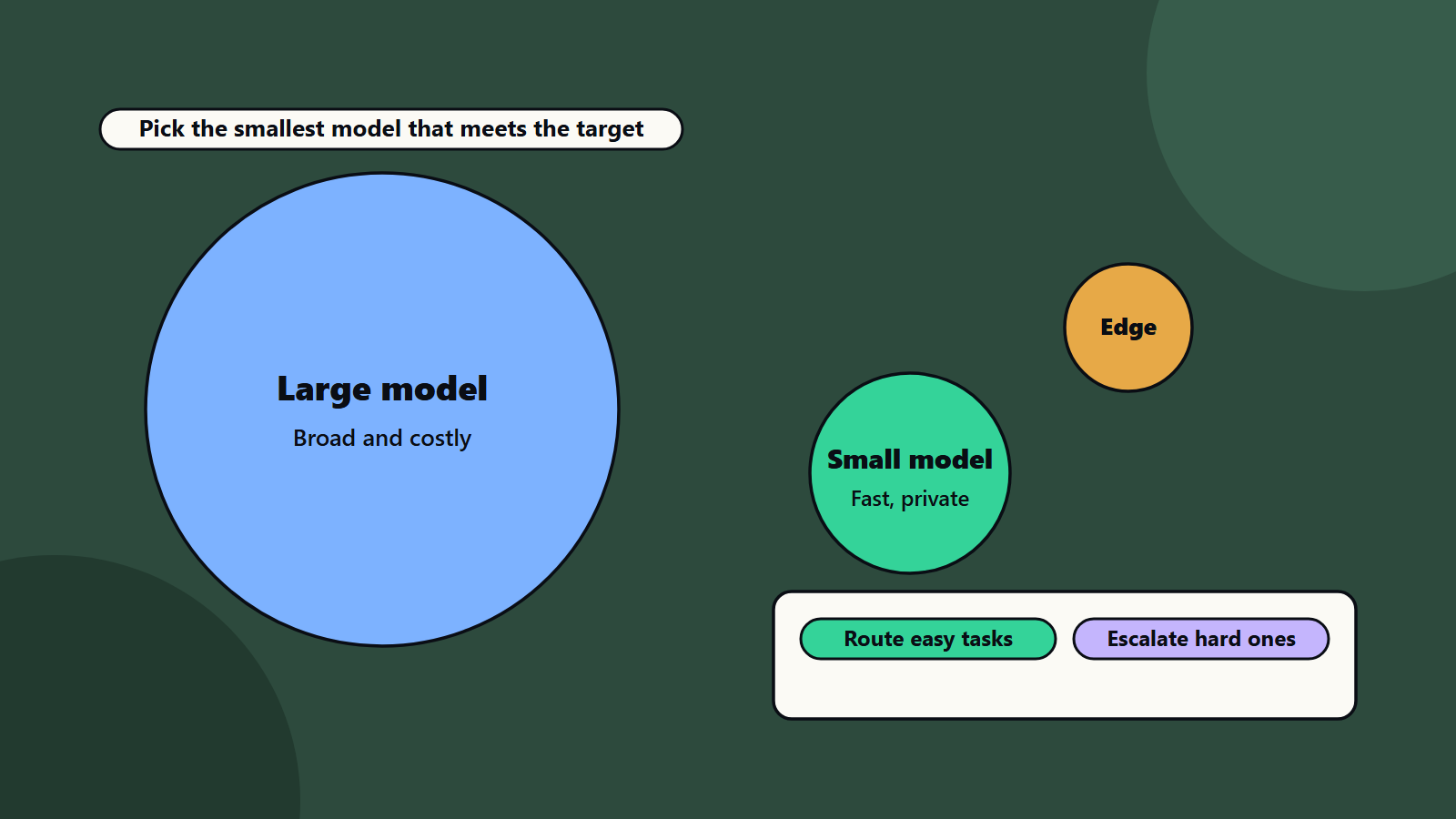
- Many systems use both: small models for routine steps, larger ones for hard cases.
What the big firms are saying
IBM’s trends for 2026 includes “efficiency over scale”, saying compute stays scarce, so efficient, hardware-aware models and new chips grow in importance. It also lists “domain-specific reasoning models”, noting that smaller, tunable open models gain ground over giant general-purpose models. A related trend is open-source diversification, with open AI expanding across model sizes and countries.
Microsoft’s AI trends for 2026 include efficient AI infrastructure. Mark Russinovich, Azure’s chief technology officer, describes densely packed, dynamically routed, linked datacenters that reduce waste and cost, which fits the same theme: get more from each unit of compute.
Hugging Face’s learning hub includes a course on post-training AI models, called the smol course, among its offerings. It shows how common it has become to adapt small open models to specific tasks.
What counts as small language models
There is no single line. People usually mean models small enough to run on one or a few processors, on a laptop or on a device, and well short of a large cluster. Smaller models can be general, or tuned to a domain such as legal text, medical notes or code. The label matters less than the fit: does the model do your task well, at your speed and cost, in the place you need it to run?
When smaller wins
- Narrow, repeated tasks. Classification, extraction, routing, summarising short texts and answering from a fixed set of documents.
- Latency. Smaller models respond faster, which matters in live chat, voice and games.
- Cost at volume. Millions of small calls add up. A cheaper model can change the economics. See measuring AI cost.
- Privacy and control. A model you run yourself keeps data in your environment. See open-weight versus hosted AI models.
- Edge and offline use. Devices, factories and vehicles may have limited or no connection. See edge computing.
- Predictability. A tuned model on a narrow task can be more consistent.
When bigger still wins
- Open-ended reasoning across many topics.
- Rare or unusual requests that a narrow model has not seen.
- Long, complex documents and multi-step planning.
- Low volume. If you make few calls, the cost gap may not matter, and a larger model saves tuning effort.
- Speed of development. A strong general model is quick to try.
How teams adapt small models
- Prompting with examples: often enough for simple tasks.
- Retrieval: give the model the facts it needs. See retrieval-augmented generation.
- Fine-tuning: train on your examples so the model learns your format and vocabulary. See RAG, fine-tuning or prompting.
- Distillation: train a small model to imitate a larger one on your task.
- Quantisation: store numbers with fewer bits so the model uses less memory and runs faster, at some cost in precision.
Each option needs data, testing and upkeep. Start with the lightest option that meets your target.
A decision method
- Define the task and metric. For example: classify tickets into twelve categories with at least 95 percent accuracy.
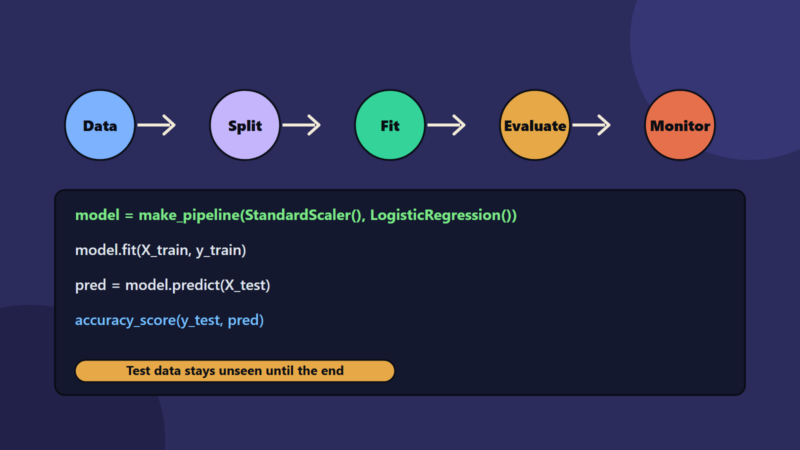
- Build a test set. Use real, varied examples, including hard ones. See evaluating model output.
- Try a strong general model first to see the ceiling.
- Try a small model with prompts and retrieval.
- Tune if needed, and compare accuracy, speed and cost.
- Pick the smallest model that meets the target, with a fallback to a larger one for hard cases.
- Monitor in production. See AI model monitoring.
A worked example: support ticket triage
This example is illustrative, with teaching numbers.
A company receives 50,000 tickets a month and wants to label each by product, urgency and topic.
- Baseline: a large hosted model labels tickets at 97 percent accuracy, with an average response time of two seconds and a monthly bill that the team finds high.
- Trial: a small open model, tuned on 8,000 labelled tickets, reaches 95 percent accuracy at 0.3 seconds per ticket on a single server.
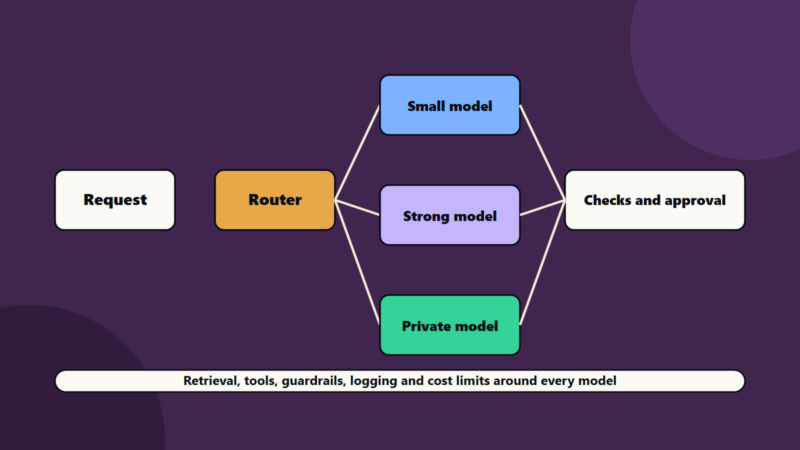
- Design: the small model handles all tickets. When its confidence is low, or the ticket mentions legal action or safety, the ticket goes to the larger model and then to a person.
- Result: most tickets use the cheap path, accuracy on the hard cases stays high thanks to the fallback and the monthly cost falls. The team keeps a weekly test run to catch drift.
The company did not replace its large model. It used it where it matters.
Small business and enterprise views
- Sole trader or small business: use hosted models through your tools, and look for features that pick a lighter model for simple tasks. Local models can suit privacy-sensitive jobs.
- Mid-size company: test a small model for your highest-volume task, and keep a routing rule to a stronger model.
- Enterprise: build a model catalogue with approved small and large models, a routing layer, shared evaluation, monitoring and cost allocation. See AI orchestration.
Regional and licence notes
Open models come with licences that differ in what they allow, including commercial use and redistribution. Check each licence before you build on a model. Rules on data and AI also vary by country, so keep records of where models run and what data they see.
Common mistakes
- Choosing by size or hype and skipping a test.
- Tuning with too little or poor data.
- Ignoring licence terms.
- No fallback for hard cases.
- Forgetting upkeep: models drift and tasks change.
- Comparing only the price per call and ignoring engineering time.
A starting plan
- Pick one high-volume, narrow task.
- Build a test set of 200 real cases.
- Compare a large model and a small model on accuracy, speed and cost.
- Add routing and a fallback.
- Monitor, and review your small language models choices every quarter.
How SoftSapien supports small and domain-specific models
SoftSapien’s AI engineers help teams choose between small language models and larger ones: test sets, prompting, retrieval, tuning, deployment on your cloud or devices, routing and monitoring. See our AI development and data science services.
To right-size your AI, use the contact page to chat with our team, send a message or schedule a free consultation call.
Frequently asked questions
What are small language models?
Compact models, general or tuned to a domain, small enough to run on a few processors, a laptop or a device.
When do small models win?
On narrow, repeated tasks where speed, cost at volume, privacy, edge use or predictability matter.
When should we use a larger model?
For open-ended reasoning, rare requests, long complex documents and low-volume work where tuning effort outweighs savings.
How do we decide?
Define the task and metric, build a test set, try a strong model for the ceiling, test a small model and pick the smallest that meets the target.
Can SoftSapien help right-size our models?
Yes, with testing and deployment. Contact SoftSapien through the contact page to chat with our team, send a message or schedule a free consultation call.