Short on time? AI suits finance operations where work is high volume and rule-driven: reading invoices, matching documents, reconciling accounts, flagging unusual items and drafting summaries. Keep people in charge of approvals, record every decision, test on your own documents, protect financial data and expand step by step. Start with one process and measure accuracy.
Finance teams spend large parts of the month on repetitive work: typing invoice details, chasing missing purchase orders, matching bank lines to ledger entries and explaining variances. Much of it follows patterns, which makes it a natural fit for modern AI tools.
This guide explains where AI helps in finance operations, how to deploy it safely and what to measure. It suits a small business with a part-time bookkeeper and a large finance function with shared service centres. It is general information and not accounting or legal advice.
Key takeaways
- Strong use cases include document capture, matching, reconciliation, anomaly detection, query handling and drafting commentary.
- Keep humans responsible for approvals, exceptions and anything with money moving.
- Test on your own documents and edge cases, and track accuracy by field and by supplier.
- Control access, logging and data handling, since finance data is sensitive.
- Start with one process, prove the benefit and extend.
Where AI helps
Invoice capture and coding
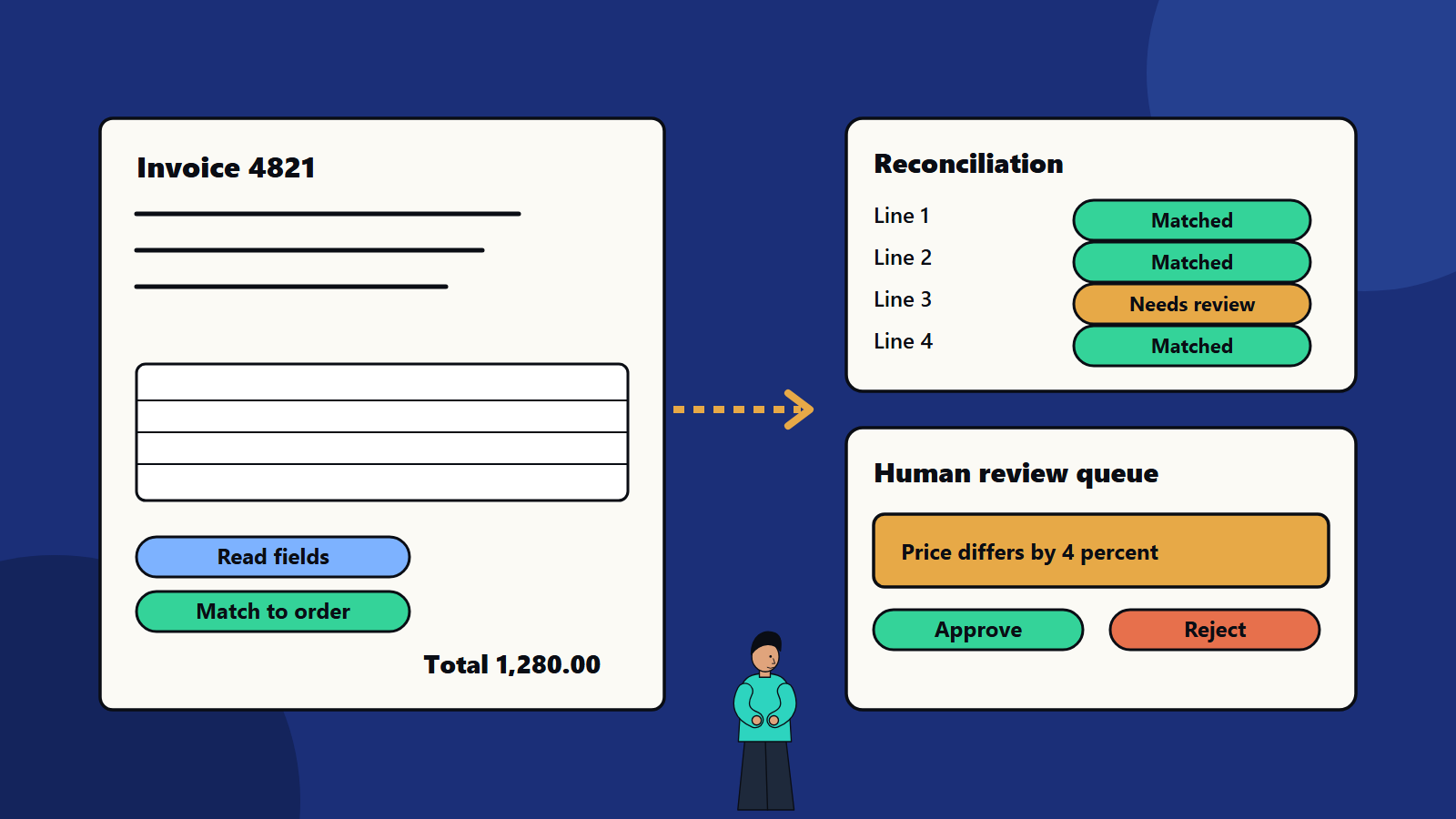
AI reads invoices in many layouts, extracts supplier, dates, amounts, tax and line items and suggests general ledger coding based on past behaviour. Traditional rules handle clean, repeating formats, and newer models cope better with varied layouts. Output includes a confidence score so low-confidence items go to a person.
Three-way matching
Matching an invoice to the purchase order and goods receipt is a classic task. AI handles imperfect matches, such as different descriptions, partial deliveries and rounding differences, and flags real mismatches for review.
Bank and account reconciliation
Matching bank lines to ledger entries, intercompany balances and subledgers can use rules plus learned patterns. AI can propose matches for fuzzy cases, group many-to-one items and explain unmatched items.
Anomaly and fraud detection
Models can flag duplicate invoices, unusual amounts, changed bank details, split payments just under approval limits and unusual timing. Analysts review the alerts. Tune thresholds carefully, since too many false alerts get ignored.
Collections and cash forecasting
Predict which invoices will pay late, prioritise follow-up and improve cash forecasts. See our guide to demand forecasting and predictive analytics for the methods behind such predictions.
Query handling
Assistants can answer supplier and employee questions such as payment status or expense policy, drawing on approved sources. See retrieval-augmented generation.
Close and reporting support
Draft variance commentary, summarise journal entries for review and highlight unusual movements. People must check numbers and wording before anything goes to management or auditors.
Keep people in control
- Approvals stay human for payments, journal postings above a threshold, vendor changes and policy exceptions.
- Segregation of duties: the person or system that proposes should differ from the one that approves.
- Exception queues: low-confidence and unusual items go to reviewers, with the AI’s reasoning and source documents shown.
- Explainability: record why the system suggested a code or match.
- Override and feedback: reviewers correct mistakes, and corrections improve the process.
- Limits on actions: an AI agent should have narrow permissions, such as reading and proposing, with a person releasing payments. See AI agent governance and multi-agent systems explained.
Data, security and compliance
- Treat financial data as sensitive: encrypt, restrict access and log use.
- Decide where data is processed and stored, and check contracts with AI providers on retention and training use. See open-weight versus hosted AI models and data residency and sovereignty.
- Guard against manipulation of document-reading systems. Invoices can contain hidden instructions or altered details. See prompt injection explained.
- Meet accounting standards, tax rules and audit expectations in your jurisdictions, and keep an audit trail of every change.
- Involve internal audit, risk and external auditors early.
- Use a written policy. See responsible AI policy.
Test before you trust
- Collect a test set: several hundred real documents, including poor scans, unusual formats, multiple languages and known tricky suppliers.
- Define correct answers with experienced reviewers, checked twice.
- Measure by field: accuracy for supplier, date, amount, tax and coding as well as overall.
- Measure by outcome: how many items pass untouched, how many need review and how many errors slip through.
- Stress test: duplicates, altered bank details and edge cases.
- Run in shadow mode: the system proposes while people work as usual, then compare.
- Re-test regularly, since formats and suppliers change.
Our guide to evaluating model output with a test set explains the method.
Implementation steps
- Pick one process with high volume and clear rules, such as invoice capture for the top fifty suppliers.
- Map the current flow, timings, error rates and costs.
- Choose the approach: packaged finance automation, a general AI platform or a custom build. Compare fit, integration, security, cost and exit options. See choosing a software development partner.
- Integrate with the accounting or ERP system, using supported interfaces. See ERP implementation and enterprise software integration patterns.
- Pilot, measure and refine.
- Train the team and change roles from keying to reviewing. See change management in technology programmes.
- Scale to more suppliers and processes.
Measure value
- Touchless rate: items processed with no human touch.
- Cycle time: invoice receipt to approval, and days to close.
- Accuracy and error cost.
- Cost per invoice.
- Early payment discounts captured, and late fees avoided.
- Fraud and duplicate payment prevented.
- Team time moved to analysis and supplier conversations.
- Auditor findings.
See our guide to measuring AI cost to keep running costs in view.
Common mistakes
- Automating a broken process.
- Trusting vendor accuracy claims without testing on your documents.
- No exception handling.
- Letting an AI agent release payments.
- Ignoring audit and tax requirements.
- Using finance data with a provider before checking contract terms.
- No monitoring after launch.
A starting plan
- Choose one process, and measure its current volume, time and errors.
- Build a test set from real documents.
- Run a shadow pilot for a month.
- Switch to review mode with exception queues and clear approvals.
- Report results to the finance leadership and auditors, then extend.
How SoftSapien supports AI in finance operations
SoftSapien’s AI engineers and finance process consultants assess processes, build and test document and matching automation, integrate with accounting and ERP systems and set up governance and monitoring. See our AI development and data analytics services.
To explore automation for your finance team, use the contact page to chat with our team, send a message or schedule a free consultation call.
Frequently asked questions
Which finance tasks suit AI?
High-volume, rule-driven work such as invoice capture, matching documents, reconciliation, anomaly detection, collections prediction and drafting variance commentary.
Should AI approve payments?
No. Keep people responsible for approvals, exceptions and payment release, with segregation of duties and an audit trail.
How do we test an invoice automation tool?
Build a test set from real documents, measure accuracy by field and outcome, stress test edge cases and run in shadow mode before relying on it.
What are the data risks?
Finance data is sensitive. Check provider terms on retention and training, control access, log use and guard against manipulated documents.
Can SoftSapien help automate finance processes?
Yes, with build, test and governance. Contact SoftSapien through the contact page to chat with our team, send a message or schedule a free consultation call.