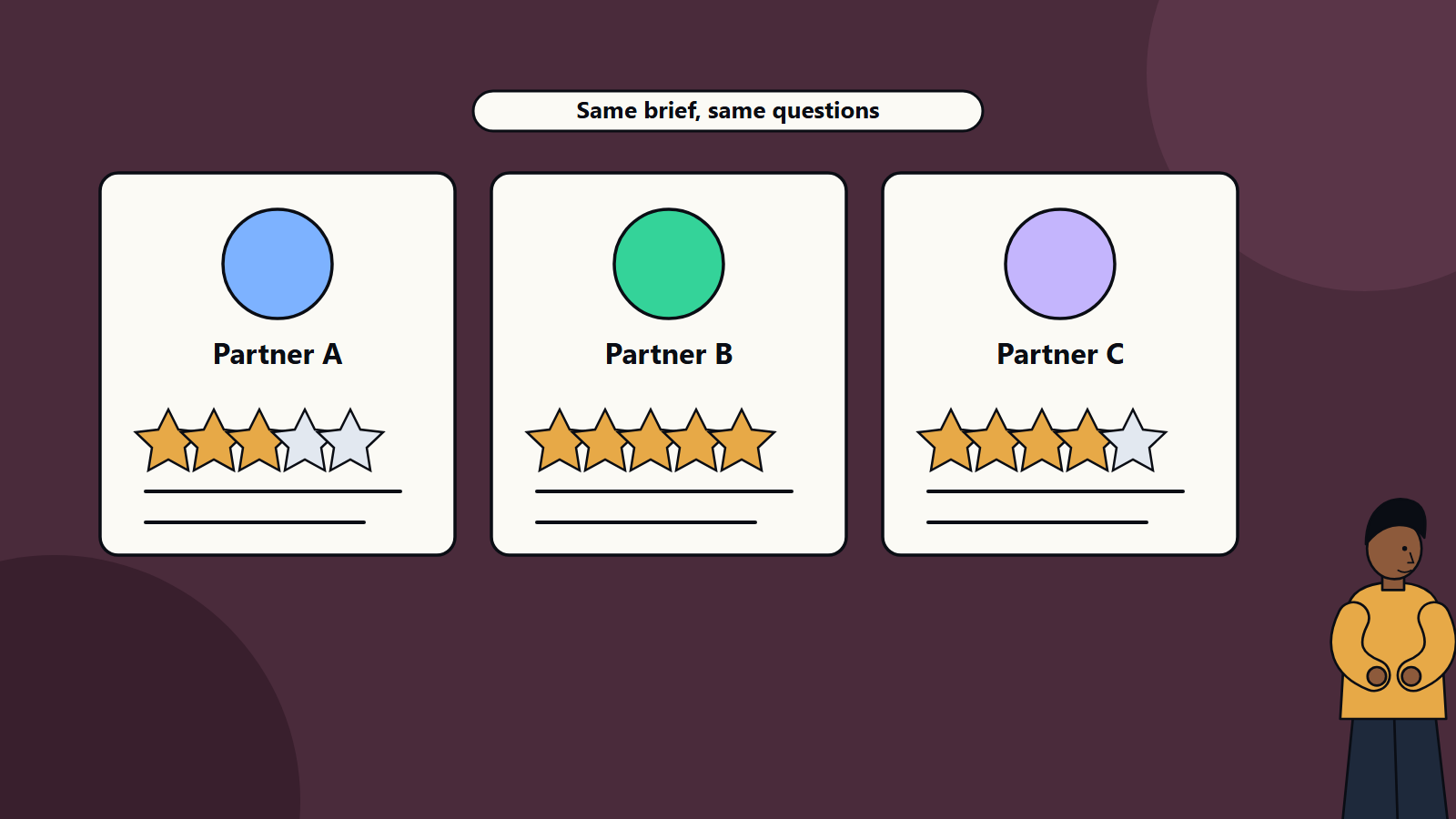
Short on time? Write a clear brief, shortlist three to five partners, ask each the same questions, check relevant experience and references, review how they work and communicate, agree who owns the code and data, run a small paid pilot if you can and choose the commercial model that matches how certain your scope is.
Choosing a software development partner is one of the most consequential buying decisions a company makes. The right partner delivers a product that works, on time and within budget, and leaves you in control of what was built. The wrong one leaves you with delays, rework and code you cannot maintain.
Proposals and websites all sound similar, so a structured process matters. This guide gives a practical checklist for buyers, whether you are a founder hiring a first agency, a department head outsourcing a project or a procurement team selecting a long-term supplier across regions.
Key takeaways
- Start with a written brief covering goals, users, scope, constraints and budget range.
- Judge partners on relevant experience, process, people and communication, with size and price as two factors among several.
- Always check references, and speak to clients with similar projects.
- Agree code and intellectual property ownership, security terms and exit arrangements before work starts.
- Match the engagement model to how well the scope is defined.
Step 1: Prepare a brief
Share a short document that lets partners respond properly:
- Business goals and what success looks like.
- Users and the problem to solve.
- Scope: main features, platforms, integrations and any existing systems.
- Constraints: timeline, budget range, technology preferences, compliance needs and data location rules.
- Team and governance: who decides, who is available and how often you want updates.
- Selection process and dates.
Be open about uncertainty. Partners who see a clear brief give better estimates and more honest advice. Our guide to MVP development helps define a first release.
Step 2: Build a shortlist
Sources include referrals from peers, industry directories and review sites, case studies, conference speakers, open source contributions and search. Look for partners with:
- Relevant domain or technology experience, such as similar industries, platforms and scale.
- A team size that fits: a very large firm may treat a small project as low priority, and a very small one may lack capacity.
- Location and time zone overlap that suits your communication needs. Many successful engagements span regions, and overlap in working hours helps.
- Financial stability and a track record.
Choose three to five for detailed conversations.
Step 3: Ask good questions
About experience
- Which projects have you delivered that resemble ours? What went well and what went wrong?
- What is your experience with our industry, integrations and compliance needs?
- How many people with the right skills do you have, and who would work on our project?
About process
- How do you plan, estimate and track progress?
- How do you handle changes in scope?
- How do you test, and what is your approach to automation and security? Our guide to test automation strategy lists what good looks like.
- How do you set up delivery pipelines and environments?
- How do you document and hand over?
About people
- Who is the day-to-day lead, and what is their seniority?
- What is your staff turnover? How do you handle team changes?
- Who does the design and quality assurance?
- Will subcontractors be involved, and how are they managed?
About communication
- How often will we meet and receive reports?
- What tools do you use, and how can we see progress at any time?
- How do you escalate problems?
About commercial terms
- How do you price: fixed, time-based or mixed?
- What is included and excluded?
- What does support after launch cost?
Step 4: Check evidence
- Case studies: ask for detail on goals, role and results. Treat unsupported superlatives with caution.
- References: speak with at least two or three clients, ideally on projects similar to yours. Ask about quality, honesty when problems arose, responsiveness and whether they would hire the partner again.
- Work samples: review live products, code samples under confidentiality and design portfolios.
- Reviews and ratings on independent sites, read critically.
- Certifications and partnerships, such as security standards and cloud provider programmes, as supporting evidence.
- Technical conversation: let your technical lead or an independent adviser talk with the proposed team.
Step 5: Compare proposals
Use a scoring grid with weights agreed beforehand. Typical criteria:
- Understanding of your problem.
- Relevant experience.
- Proposed approach and team.
- Quality of estimates and assumptions.
- Security and compliance approach.
- Communication and governance.
- Cost over the life of the project, including maintenance.
- References and cultural fit.
Be wary of a quote far below the others, which may leave out essentials or rely on later change requests. Be equally cautious of vague proposals with no assumptions.
Step 6: Pilot
A small paid pilot, such as a discovery workshop, a prototype or two sprints, shows how the partner works before you commit to a larger contract. Judge the quality of questions they ask, the clarity of their communication and the quality of what they deliver.
Step 7: Agree the contract
Key points to cover:
- Scope and deliverables, with acceptance criteria.
- Intellectual property and code ownership: the contract should state that you own the code and designs created for you, with clear treatment of any pre-existing or third-party components and their licences.
- Data protection and security: roles, safeguards, breach notification, location of data and subprocessors. Rules vary by country.
- Confidentiality.
- Payment terms linked to milestones.
- Change control process.
- Service levels and warranty: defect fixing period after launch and support terms.
- Key personnel and replacement.
- Access: you should hold the repositories, cloud accounts and credentials, or have full access.
- Exit and transition: documentation, handover support and what happens if the relationship ends.
- Liability and insurance.
- Dispute resolution and governing law.
Involve legal counsel, especially for cross-border contracts.
Engagement models
Choose by how well defined the work is.
- Fixed scope: a set deliverable for a set price. Suits clear, stable requirements. Changes are handled through change requests.
- Time and materials: pay for effort. Suits evolving scope, with a cap and regular reviews to manage cost.
- Dedicated team or retainer: a team works on your roadmap over time. Suits long-term products.
- Pilot first, then scale: start small and extend.
- Managed support: ongoing operation and maintenance for a monthly fee.
Our article on offshore and nearshore engagement models compares options in more detail.
Manage the relationship
- Appoint a product owner on your side with time and authority.
- Hold regular demos of working software.
- Share business context along with requirements.
- Keep documentation and repositories under your control.
- Review progress against goals and budget monthly.
- Treat the partner as part of the team, give honest feedback early and expect the same.
Red flags
- Promises of fixed price and date with no analysis.
- No questions about your business.
- Reluctance to provide references.
- Team changes between sales and delivery.
- Vague ownership terms.
- Pressure to sign quickly.
- No clear approach to testing and security.
Common mistakes
- Choosing on price alone.
- Skipping the brief.
- Leaving ownership and access unclear.
- No internal owner.
- Expecting the partner to read your mind about priorities.
How SoftSapien works with clients
SoftSapien works with clients through pilot, fixed-scope delivery, program retainer and managed support models, with clear ownership of code and data. Learn about our custom software development and managed services.
To compare notes on your own selection, use the contact page to chat with our team, send a message or schedule a free consultation call.
Frequently asked questions
How do I shortlist a software development partner?
Use referrals, directories, case studies and reviews, then pick three to five with relevant experience, a suitable team size, workable time zone overlap and a solid track record.
What should I ask references?
About quality, honesty when problems arose, responsiveness, handling of changes and whether they would hire the partner again, ideally on projects similar to yours.
Who should own the code?
You should, with the contract stating ownership of code and designs created for you and clear treatment of third-party components and licences.
Which engagement model should I choose?
Fixed scope for clear, stable requirements, time and materials for evolving scope, a dedicated team for long-term products and a pilot first to test the relationship.
Can SoftSapien go through this process with me?
Yes, we welcome the questions. Contact SoftSapien through the contact page to chat with our team, send a message or schedule a free consultation call.