Short on time? The best early wins in healthcare digital transformation sit in operations: scheduling, patient communication, referrals, billing, supply and records exchange. Start with one pain point, involve clinical and administrative staff, protect patient data under the rules that apply in your country and use standards such as HL7 FHIR for data exchange. This article covers operations and administration. Clinical decision tools are outside its scope.
Health services face rising demand, staff shortages and tight budgets. Patients wait on hold to book appointments, staff retype data between systems and managers lack a current view of capacity. Digital tools can lift much of this administrative load and give clinicians more time with patients.
The sector also has strict duties around safety and privacy, complex legacy systems and busy teams who cannot pause care for an IT project. This guide covers practical areas for operational transformation, the foundations they need and ways to deliver safely. It suits a small clinic, a hospital group and a health insurer’s operations team alike. It gives no medical advice, and clinical decision tools carry additional regulatory requirements that it leaves aside.
Key takeaways
- Start with operational pain points that affect patients and staff daily: access, waiting, paperwork and information gaps.
- Interoperability is a foundation. Standards such as HL7 FHIR support data exchange between systems.
- Privacy, security and consent rules differ by country and must shape the design.
- Involve clinicians and administrators from the start, and design for their workflows.
- Deliver in small steps, measure outcomes and keep patient safety first.
High-value operational areas
Access and scheduling
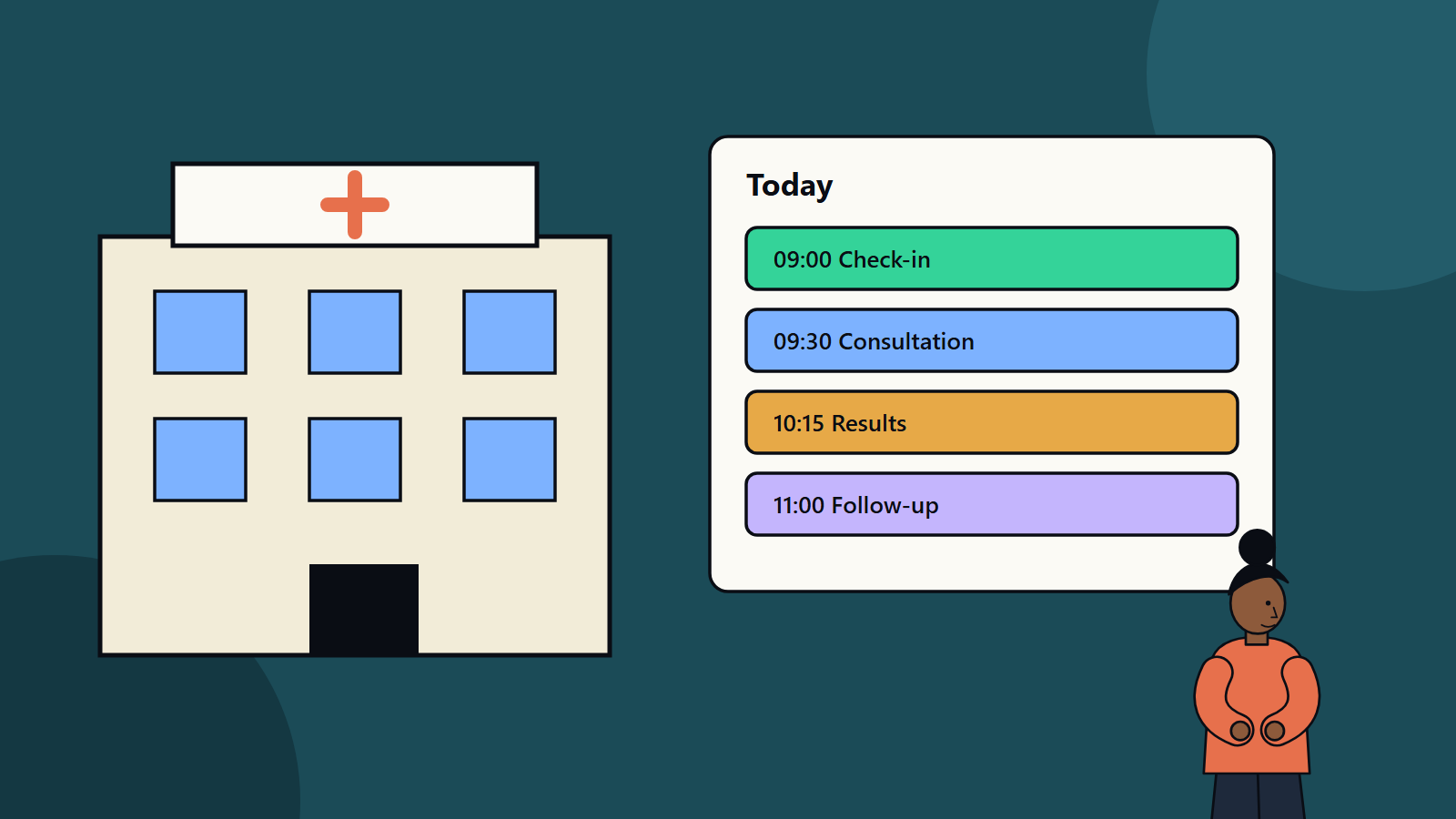
- Online booking, rescheduling and reminders that reduce no-shows.
- Waiting list management and cancellation filling.
- Triage questionnaires that route patients to the right service, designed with clinical oversight.
- Capacity planning for clinics, theatres and diagnostics.
Patient communication and engagement
- Secure messaging and notifications.
- Pre-visit forms and digital check-in.
- Portals with appointment details, letters and test result releases, as policy permits.
- Multilingual and accessible content for diverse communities.
- Contact centre tools and, where suitable, assistants for common non-clinical questions such as opening hours and directions.
Referrals and care coordination
- Electronic referrals with tracking, so nothing is lost.
- Shared care plans and task lists.
- Discharge communication to primary care and community services.
Revenue cycle and administration
- Eligibility checks, coding support, claims submission and denial tracking.
- Automated document handling, such as reading forms and matching them to records, with human review.
- Procurement and inventory management for medicines and supplies.
- Workforce scheduling and credential tracking.
Records and information
- Digitising paper records.
- Better search and summaries of documents for staff, with attention to accuracy and access rights.
- Data platforms for operational reporting and quality improvement.
Remote and home services
- Video consultations and remote monitoring programmes, under clinical governance.
- Logistics for home delivery of tests and medicines.
Interoperability foundation
Information trapped in separate systems is a major source of inefficiency. HL7 FHIR is a standard published by HL7 for exchanging healthcare data, covering areas such as clinical records, diagnostics, medications, workflow and financial information. Many electronic record systems and regulators support it. Using standard interfaces reduces custom work and makes it easier to connect new tools. Plan for:
- A clear map of systems and data flows.
- Standard identifiers and terminologies.
- An integration layer or platform with API management.
- Master data for patients, providers and locations, with careful matching to avoid mismatched records. Our article on enterprise software integration patterns can guide the technical choices.
Privacy, security and compliance
Health data is among the most sensitive personal data, and laws vary across countries and regions, for example the HIPAA rules in the United States, the GDPR in Europe and national health data laws elsewhere. Build in:
- Access control: role-based access, least privilege and audit logs for every view of a record.
- Consent and preferences, recorded and respected.
- Encryption at rest and in transit.
- Data minimisation and retention rules.
- Vendor management: contracts and assessments for suppliers who process data.
- Data location: check requirements for storage and transfer across borders.
- Incident response with notification procedures.
- Staff training, since mistakes and phishing cause many breaches.
Our article on zero trust security outlines a modern approach to access control.
Clinical safety and regulation
Software that supports diagnosis or treatment may count as a medical device under regulation in many countries, with requirements for evidence, quality management and monitoring. Operational tools usually fall outside, though a scheduling or triage tool that influences care priority may need clinical safety review. Involve clinical safety officers and regulatory advisers early, and document risk assessments.
Design for workflows
- Observe real work in clinics, wards and offices before designing.
- Reduce clicks and double entry. Tools that add burden will be avoided.
- Test on the devices staff actually use, including shared workstations and mobile.
- Plan for downtime procedures, since care cannot stop when a system does.
- Support accessibility for patients with disabilities, older people and those with limited digital access, and keep non-digital channels.
Change management
Technology succeeds when people adopt it. Name clinical and operational champions, give protected time for training, communicate the reasons for change and gather feedback continually. Show time saved and patient benefits, so staff see the value. Our article on why transformation programmes stall lists causes to watch for.
Measuring success
- Waiting times, no-show rates and appointment utilisation.
- Time staff spend on administration.
- Referral turnaround.
- Claim acceptance and payment times.
- Patient satisfaction and complaints.
- System availability and data quality.
- Safety incidents related to systems and processes.
Pick a few measures per project, set baselines and report them openly.
Delivery approach
- Choose a focused problem, such as no-shows in one clinic.
- Map the process and data with staff and patients.
- Pilot a small solution, with clear success criteria and safety review.
- Integrate with core systems.
- Scale to other sites and add services.
- Maintain and improve, with governance for changes.
Common mistakes
- Buying a platform before defining the problem.
- Building isolated apps that do not connect to records.
- Ignoring staff workflows.
- Underestimating privacy and regulatory work.
- Launching without downtime plans.
- Treating digital access as the only channel.
How SoftSapien supports healthcare organisations
SoftSapien works with providers, insurers and health technology companies on integration, data platforms, portals and workflow solutions, with security and privacy built in from the first design. See our business transformation and enterprise software integration services.
To discuss an operational project, use the contact page to chat with our team, send a message or schedule a free consultation call.
Frequently asked questions
Where should healthcare organisations start digitally?
With operational pain points such as scheduling, patient communication, referrals, billing and records exchange, which affect patients and staff daily and carry lower clinical risk.
What is HL7 FHIR?
FHIR is a standard published by HL7 for exchanging healthcare data, covering areas such as clinical records, diagnostics, medications, workflow and financial information.
How should privacy be handled?
Apply role-based access, audit logs, consent, encryption, data minimisation, vendor management and incident response, following the laws of each country, such as HIPAA or the GDPR.
When does software count as a medical device?
Tools that support diagnosis or treatment may fall under medical device rules in many countries, so involve clinical safety and regulatory advisers early.
Can SoftSapien support healthcare projects?
Yes, with integration, platforms and security. Contact SoftSapien through the contact page to chat with our team, send a message or schedule a free consultation call.