Short on time? Choose a model that fits the game and the audience: paid, ads, in-app purchases, subscriptions or a mix. Make prices and odds clear, follow store payment and children’s rules, avoid pressure tricks, give players real value for free and measure retention before revenue. Fair design keeps players longer and avoids store, legal and reputation trouble.
Most mobile games are free to download. Their makers earn money from advertising, in-app purchases, subscriptions or a mix. The model chosen shapes the whole design: how fast players progress, what they can buy, how often they see ads and how they feel about the studio.
Getting it right matters commercially and ethically. Players, parents, platform holders and regulators all pay close attention to how games take money. This guide explains the main models, the rules from major stores, fair design practices and the measures to watch. It is written for studios, publishers and product teams, and does not replace legal advice for your markets.
Key takeaways
- Common models: premium, ads, in-app purchases, subscriptions and hybrids. The genre and audience should guide the choice.
- Store rules require using the platform’s payment system for digital goods, and require odds to be disclosed for random paid items.
- Games for children need extra care: parental gates, limited data collection and restricted advertising.
- Fair design builds long-term value: clear pricing, real free play, no manipulative pressure.
- Measure retention, engagement and satisfaction first. Revenue follows from players who stay.
The main models
Premium
Players pay once to download. It suits story-driven or craft-focused games and appeals to audiences who dislike ads and purchases. The challenge is discovery and conversion, since most mobile players expect free downloads.
Advertising
Free play supported by ads. Formats include:
- Rewarded video: players choose to watch an ad for an in-game benefit. Usually the best-received format, when the reward is meaningful and optional.
- Interstitials: full-screen ads between levels or sessions. Effective and annoying if too frequent or mistimed.
- Banners: small ads in the interface. Lower revenue and less intrusive.
- Playable ads and offer walls.
Advertising suits casual and hyper-casual games with large audiences. It needs volume, and careful placement protects retention.
In-app purchases
Players buy items inside the game:
- Consumables: currency, energy refills and boosts.
- Non-consumables: unlocks such as characters, levels, cosmetic items or removing ads.
- Bundles and starter packs.
- Random items: loot boxes and gacha systems, which carry the most regulatory attention.
Most revenue often comes from a small share of players, so design for the many who never pay as well.
Subscriptions and passes
Regular payments for benefits: premium content, ad-free play, season or battle passes with tiers of rewards. They suit games with ongoing content and strong engagement. Stores require that subscriptions provide ongoing value.
Hybrid models
Combining ads for non-payers with purchases for those who prefer to pay, or an upfront price with optional extras. Many successful games blend models, tuned to the audience.
Store rules to respect
Platform holders publish detailed policies, which change. Apple’s App Store Review Guidelines, for example, state that digital unlocks such as subscriptions, in-game currencies, levels and premium content must use in-app purchase, and that apps cannot use their own mechanisms such as licence keys or QR codes for them. Purchased credits or currencies may not expire, and restorable purchases need a restore mechanism. Subscriptions must provide ongoing value, last at least seven days and work on all of the user’s devices. Apps offering loot boxes or other randomised virtual items for purchase must disclose the odds of receiving each item type before purchase.
For apps for children, the guidelines say Kids Category apps should avoid links out of the app, purchasing opportunities or other distractions unless they are behind a parental gate, and should not send personally identifiable or device information to third parties, with limited exceptions. They also require compliance with laws such as COPPA and the GDPR, and a privacy policy where personal information from minors is collected.
Other stores have their own payment, advertising and families policies. Read them for each store you target, and check again before every release.
Laws and regulations
Rules on in-game purchases, random items, advertising to children, data protection and consumer rights vary by country and change often. Some jurisdictions have restricted or scrutinised paid random items. Consumer authorities pay attention to unclear prices, hidden costs and unfair pressure on minors. Take legal advice for the markets you serve, and design to the strictest standard you can sustain.
Fair design principles
Be clear about money
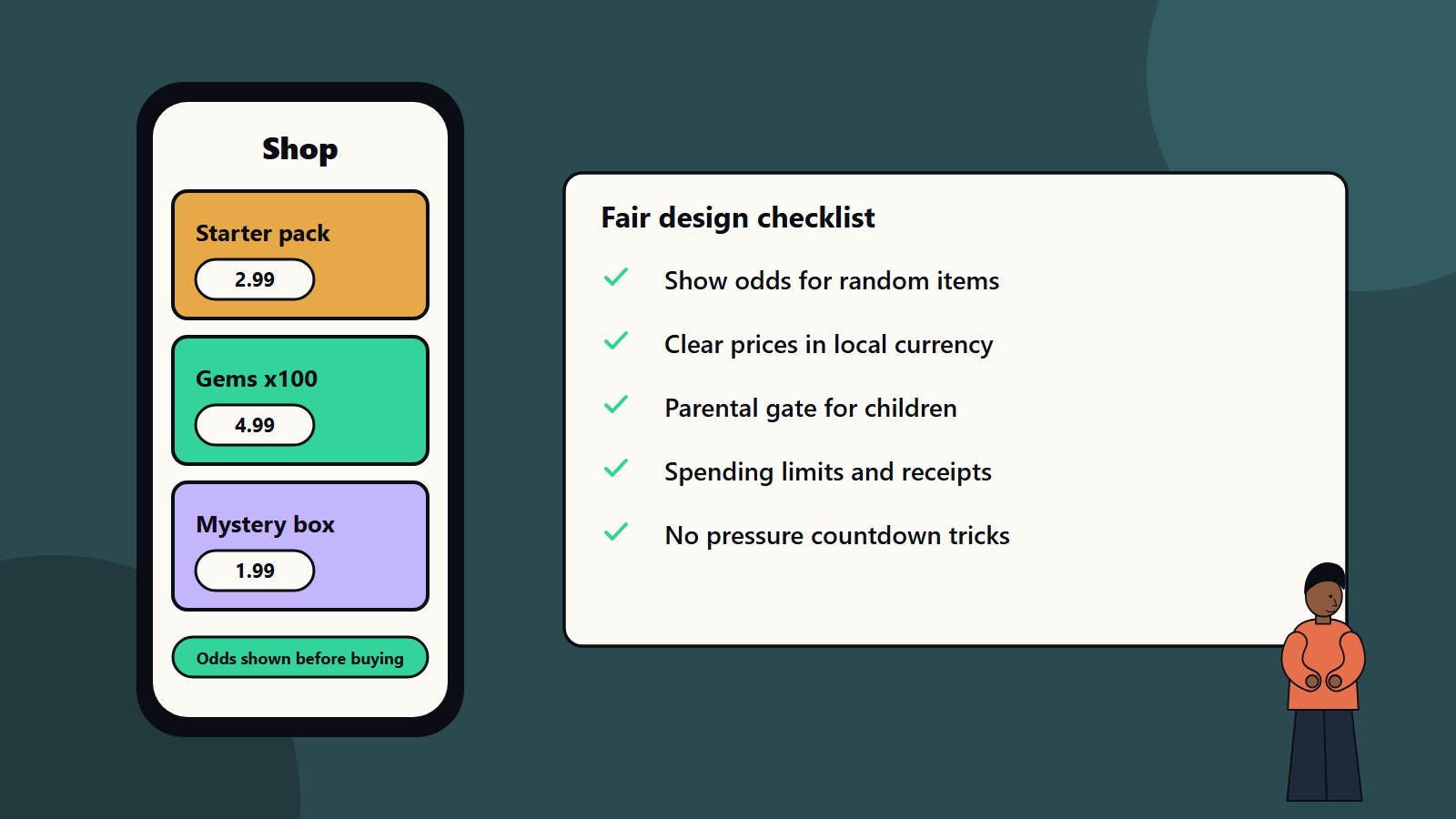
- Show real-money prices clearly, in local currency, wherever purchases appear.
- Avoid hiding costs behind several layers of virtual currency. If you use one, show conversions.
- Disclose odds for random items before purchase, and make them easy to find.
- Confirm purchases clearly, and provide receipts.
- Offer simple ways to restore purchases and manage subscriptions.
Give real value for free
- Let players enjoy the core game without paying. Free progress should feel meaningful.
- Avoid hard walls where only payment can continue, unless the model is clearly explained.
- Make paid items worth their price, and avoid selling advantages that wreck competitive fairness in multiplayer modes.
Respect players
- Avoid manipulative tricks: fake countdowns, repeated pop-ups after losses, confusing buttons or guilt-based messages.
- Limit prompts. Frequent interruptions drive churn.
- Make ads skippable where appropriate, and ensure rewarded ads deliver what they promise.
- Do not target vulnerable players with intensive spending prompts.
- Offer spending controls and reminders, and make it easy to disable purchases.
Protect children
- Use parental gates for purchases and external links in children’s games.
- Collect minimal data, and avoid behavioural advertising for children.
- Choose ad networks that support child-directed settings, and check what they do.
- Follow age ratings and content rules.
- Test the experience as a child and as a parent.
Be accessible
Make purchasing and ad interactions usable with assistive features. Our guide to game accessibility lists options.
Design the economy
- Currencies and sinks: define what players earn and spend, and keep inflation in check.
- Pacing and progression: match difficulty and rewards to a healthy curve, so players feel steady progress.
- Price points: test a ladder from small to large, with local pricing where the store supports it.
- Offers and events: timed events can add excitement. Use them sparingly and honestly.
- Balance: use data and play tests to avoid pay-to-win in competitive games.
- Live operations: plan content updates that keep purchases and ads relevant. Our guide to the game development pipeline covers live operations.
Measure what matters
Track:
- Retention: share of players returning after day one, day seven and day thirty. Without retention, monetisation has little to work with.
- Engagement: session length and frequency.
- Conversion: share of players who pay, and the time to first purchase.
- Average revenue per user and per paying user.
- Lifetime value against acquisition cost.
- Ad metrics: impressions per player, fill rates and rewarded ad completion.
- Subscription metrics: churn and renewal.
- Player sentiment: reviews, support tickets and surveys, with special attention to complaints about spending.
- Refunds and chargebacks.
Our guide to game analytics explains how to set up and use these measures. Test changes with controlled experiments, and judge them on retention and satisfaction as well as revenue.
Technical considerations
- Use the store’s billing libraries, and validate receipts on a server.
- Protect against fraud and tampering, and keep keys out of the client.
- Handle interrupted purchases and offline states.
- Integrate ad software carefully: check size, performance, privacy and consent. Many ad libraries collect data, so declare it accurately on store privacy forms.
- Obtain consent where required for tracking and personalised ads.
- Keep the game responsive, since slow ad loading hurts experience.
- Test purchases and ads on many devices. Our guide to game testing and QA covers what to include.
Choosing a model
Ask:
- Who is the audience, and what do they expect to pay?
- How long will players stay, and how often will they play?
- Does the genre suit ads, purchases or subscriptions?
- Do you have content to sell that players actually want?
- What are the rules in your target stores and countries?
- Can you support live operations over the long term?
- How will you reach players, and at what cost?
Prototype the economy early, test with real players and be prepared to change it.
Common mistakes
- Designing the game, then adding monetisation as an afterthought.
- Too many ads too early.
- Hiding prices or odds.
- Ignoring store policy changes.
- Collecting more data than needed.
- Balancing for spenders and neglecting everyone else.
- Measuring revenue without retention.
- Copying another game’s economy without understanding its audience.
How SoftSapien supports mobile game teams
SoftSapien’s teams design game economies, build purchase and ad integrations, run analytics and test for store compliance across iOS and Android. See our game development and mobile app development services.
To talk through your model, visit the contact page to chat with our team, send a message or schedule a free consultation call.
Frequently asked questions
What are the main mobile game monetisation models?
Premium, advertising, in-app purchases, subscriptions and passes, and hybrids that combine them.
What do app stores require?
Digital goods generally use the store's purchase system, purchased currencies may not expire and loot boxes must disclose odds before purchase. Children's apps need parental gates and limited data collection.
What is fair monetisation design?
Clear prices and odds, real value for free players, no manipulative pressure, spending controls and care for children.
Which measures matter most?
Retention, engagement, conversion, average revenue per user, lifetime value against acquisition cost, ad metrics, subscription churn, sentiment and refunds.
Can SoftSapien design our game economy?
Yes, with store compliance checks. Contact SoftSapien through the contact page to chat with our team, send a message or schedule a free consultation call.