Short on time? Game analytics turns player behaviour into decisions. Define questions first, track a small set of events, then study retention, funnels, progression and spending. Run careful experiments for live tuning, respect privacy law and player trust, and avoid steering design only by numbers.
A game launches, and players arrive. Some stay for months, and many leave in the first minutes. Without data, a team argues about why. With data, it can see where players quit, which level stalls them and what changed after the last update.
This guide explains the core ideas of game analytics for producers, designers and founders. It suits a small mobile studio and a large publisher running live services on PC and console.
Key takeaways
- Start with questions, then design the events and dashboards that answer them.
- Core measures are retention, funnels, progression, session patterns, engagement and monetisation.
- Cohorts compare groups fairly, such as players who installed in the same week.
- Live tuning uses controlled experiments and careful reading of results.
- Privacy law, platform rules and player trust set limits on what you collect.
Start with questions
Useful questions are specific:
- Where do new players quit in the first session?
- Which level has the lowest completion rate?
- Do players who finish the tutorial return the next day?
- Which features do paying players use?
- Did last week’s balance patch make the game easier?
Each question tells you what to track. Without them, teams collect mountains of events nobody reads.
Core measures
Retention
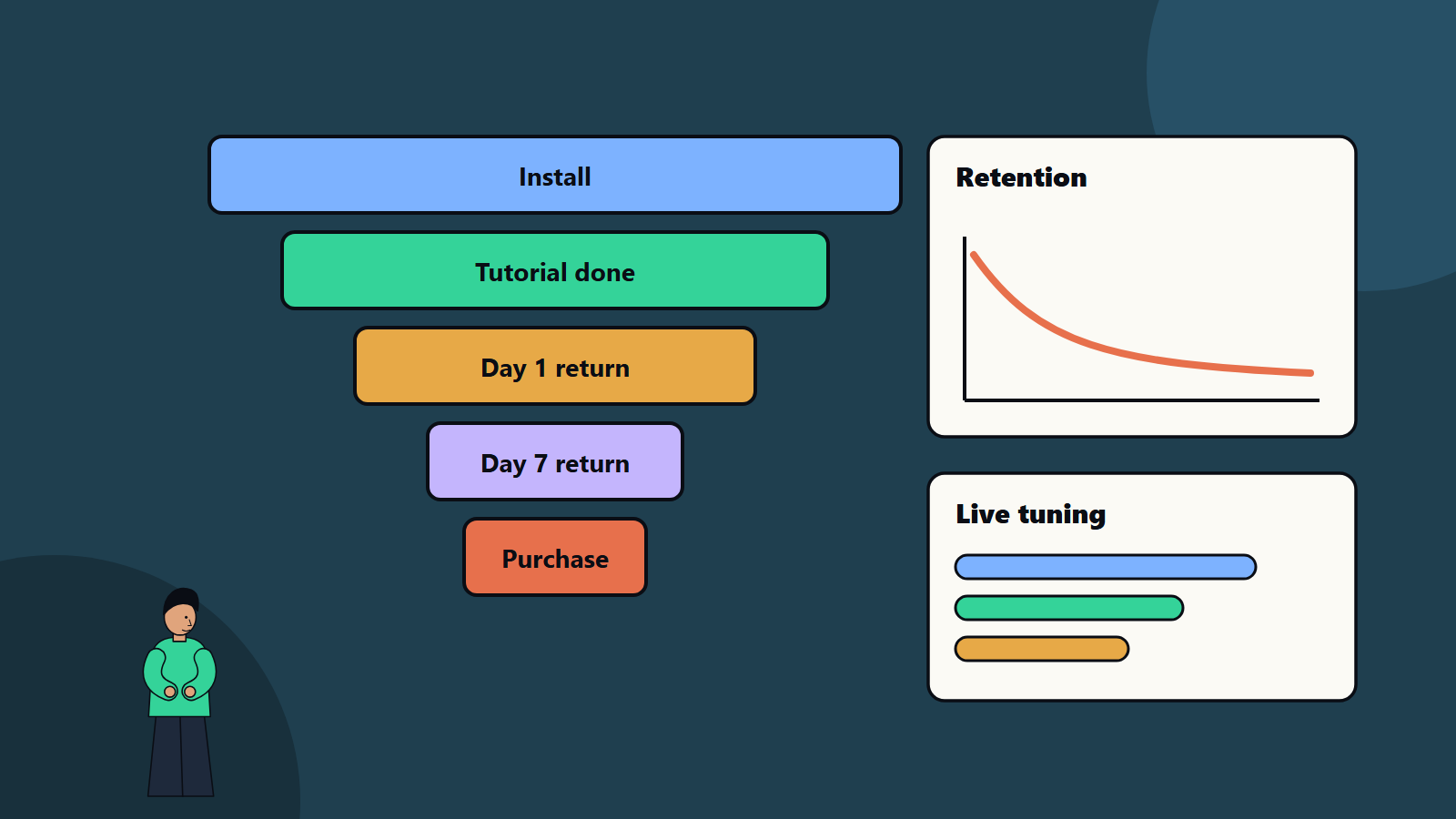
The share of players who return after a set time. Day 1, day 7 and day 30 retention are common checkpoints, measured from the install or first play date. Compare cohorts, since a single blended average hides trends. Benchmarks vary by genre and platform, so compare against your own history before external figures.
Funnels
A funnel shows how many players pass through each step of a journey: install, first launch, tutorial complete, first level, first return, first purchase. The biggest drop points to the next fix. Our guide to conversion rate optimisation explains funnel thinking for web products, and the same logic applies.
Progression and difficulty
Track level attempts, completion, time per level and failure counts. A level with many retries and then drop-offs is probably too hard or unclear. Compare with your level design intent.
Sessions and engagement
Session length, sessions per day, time between sessions and feature use show how the game fits into players’ lives. Longer is not always better, since the right length depends on the design.
Monetisation
For games with purchases or ads: conversion to paying, average revenue per paying player, purchase timing, what players buy and ad engagement. Read these next to retention, since aggressive monetisation can harm it. See mobile game monetisation.
Technical health
Crash rates, load times, frame rate and network quality by device and region. Many players leave because of technical problems, which analytics can reveal. See PC game optimisation.
Design the events
- Name events clearly, with a naming convention and a data dictionary.
- Track meaningful actions: level start, level end with result, purchase, tutorial step, settings change.
- Add context as properties: level, difficulty, device, version, country, session id.
- Keep it lean: hundreds of events create noise and cost.
- Version your schema, and test events in each build.
- Identify players carefully with pseudonymous ids, and decide how to handle players across devices.
Choose between a packaged analytics service and your own pipeline. Packaged tools are quick to start, and your own pipeline offers control and depth. See our guides to data pipeline reliability and dashboards that work.
Cohorts and segments
- Cohorts: group players by start date, platform, country or acquisition source, and compare them over time.
- Segments: group by behaviour, such as completed tutorial, spender or high engagement, to find patterns.
- Compare like with like: a cohort acquired through a big promotion may behave differently from organic players.
Live tuning and experiments
Live games adjust difficulty, rewards, prices and content. Tune with care:
- Form a hypothesis: shortening level 3 will raise day 1 retention.
- Define the success measure and guard measures, such as revenue and complaints.
- Randomly split players between control and variant.
- Run long enough to reach enough players and cover weekly cycles, and avoid peeking early.
- Analyse with care: consider sample size and statistical uncertainty.
- Roll out or roll back, and record what you learned.
Use remote configuration, so you can change values without a new release, and monitor changes for side effects. See our guide to evaluating model output with test sets for similar thinking about measurement.
Prediction and personalisation
Teams use models to predict churn, forecast spending or tailor offers. Start with simple methods, check the results and consider fairness: do not exploit vulnerable players. See our guide to demand forecasting and predictive analytics.
Privacy, consent and trust
- Follow privacy laws that apply to your players, which differ by region and have special rules for children.
- Follow platform requirements for data collection and disclosure.
- Collect only what you need, explain it in plain language and offer controls where required.
- Secure the data, restrict access and set retention limits.
- Be honest about experiments and offers. Players notice when they feel manipulated.
Common mistakes
- Tracking everything with no questions.
- Judging by averages when cohorts tell the story.
- Changing several things at once and then guessing the cause.
- Stopping experiments too early.
- Ignoring technical health data.
- Optimising only for short-term revenue.
- Collecting personal data with no clear purpose.
- Leaving analytics out of the QA process. See game testing and QA.
A starting plan
- Write five questions you need answered in the first month.
- Define about twenty events, a naming guide and properties.
- Build one dashboard for retention, the early funnel and technical health.
- Run one small experiment with a clear hypothesis.
- Review weekly with design, production and engineering.
How SoftSapien supports game analytics
SoftSapien’s data engineers and game specialists design event schemas, build pipelines and dashboards, set up experiments and help teams act on the results while respecting privacy rules. See our game development and data analytics services.
To put data behind your game decisions, use the contact page to chat with our team, send a message or schedule a free consultation call.
Frequently asked questions
What should a game track first?
Start from questions, then track about twenty events such as tutorial steps, level start and end, purchases and session start, with context properties.
What is retention?
The share of players who return after a set time, such as day 1, day 7 and day 30, best compared by cohort.
How do we run a live experiment?
Form a hypothesis, define success and guard measures, split players randomly, run long enough and review results with care for sample size.
What privacy rules apply?
Laws differ by region and have special rules for children. Collect only what you need, explain it and follow platform requirements.
Can SoftSapien help with game analytics?
Yes, from event design to dashboards. Contact SoftSapien through the contact page to chat with our team, send a message or schedule a free consultation call.