Short on time? Brand voice guidelines tell everyone how your company sounds. Pick a few traits, show real examples, list words to use and avoid, and cover each channel from website to support replies. Keep the guide short, test it on real writing and update it as you learn. Clear voice builds trust with technical buyers.
Technical buyers read a lot of copy. Most of it sounds the same: full of buzzwords and bold promises. A company with a clear voice stands out because it sounds like real people who know their field.
This guide shows how to write brand voice guidelines for a technical company. It works for a start-up with three people and for a global firm with many writers.
Key takeaways
- Brand voice guidelines describe how you write and speak, so every channel feels like one company.
- Choose three or four traits, and show what each looks like in a real sentence.
- Technical audiences value plain words, precise claims and honest limits.
- Give writers examples, a word list and a quick checklist.
- Test the guide on real drafts, and review it twice a year.
Voice and tone are not the same
Voice is your personality. It stays the same everywhere. Tone is how that voice adjusts to the moment. You speak differently in a product alert than in a launch post, and you are still the same person.
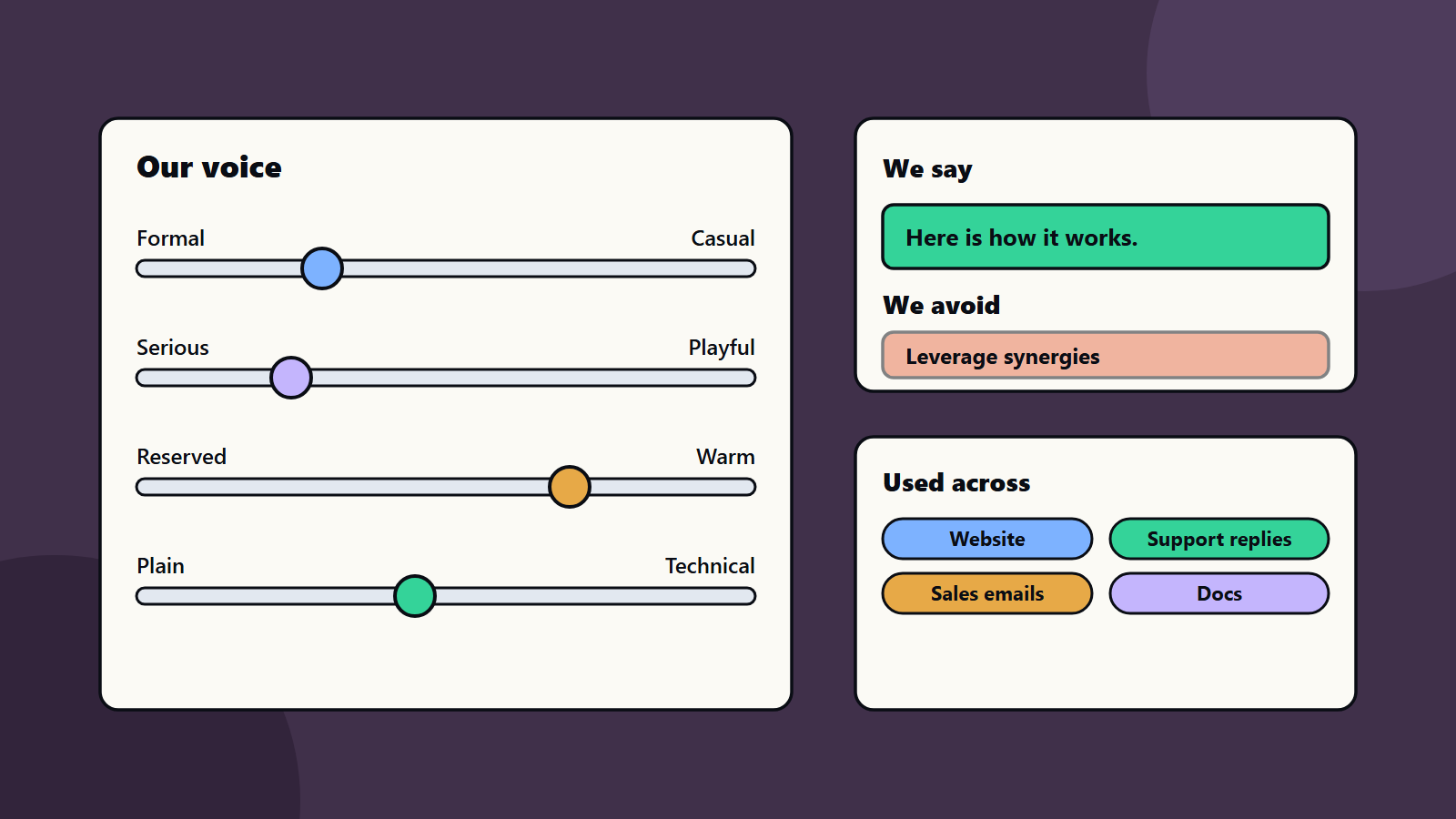
The Nielsen Norman Group describes four dimensions of tone: formal or casual, serious or funny, respectful or irreverent, and matter-of-fact or enthusiastic. These make a handy way to place your own voice on a scale.
Start with your audience and values
Before you write traits, answer three questions:
- Who reads us? Engineers, finance leaders, buyers or home users?
- What do they need from us? Clear answers, proof and respect for their time.
- What do we stand for? Honesty, craft, speed or care?
Our guides to brand positioning for technology companies and the brand strategy workshop help with this step.
Choose three or four traits
Good traits are specific. “Professional” tells a writer little. Try traits like these:
- Plain: short sentences, common words, terms explained.
- Precise: real numbers, named sources, no vague claims.
- Warm: we talk to one person, and we are kind about mistakes.
- Confident: we say what we think, and we admit what we do not know.
For each trait, write three lines: what it means, where its limit is and an example. A confident voice can stay modest.
Show examples
Examples teach faster than rules. Put a before and after side by side.
- Before: “We leverage cutting-edge solutions to unlock value.”
- After: “We help you move your systems to the cloud without downtime.”
Add examples for headlines, emails, support replies, error messages and social posts.
Build a word list
- Use: customer, team, cloud, plan, fix, check.
- Avoid: synergy, best-in-class, revolutionary, world-class, game-changing.
- Spell and style rules: which English you use, how you write dates, numbers and product names.
- Terms to define: jargon you must use, with a short plain meaning.
Keep the list short enough that people will read it.
Cover each channel
Your brand voice guidelines should say how tone shifts by channel:
- Website and product pages: clear, calm and helpful.
- Blog and guides: teaching and generous with detail. See our B2B content strategy.
- Social media: short and human. See B2B social media platforms.
- Support and incident messages: direct, kind and quick. See communications during a technology incident.
- Sales emails: respectful of time, and specific.
- Documentation: exact and consistent.
- Global markets: write for translation. Avoid slang and idioms.
Write for global readers
Many readers use English as a second language. Short sentences and common words help them. Avoid jokes that depend on local culture. Use “we” and “you”. Spell out acronyms once.
Make brand voice guidelines easy to use
- Keep it to a few pages, with a one-page summary.
- Add a checklist: Is it clear? Is it true? Is it useful? Would we say this out loud?
- Host it where writers work, and link it from templates.
- Train new writers, and review samples together.
- Name an owner who answers questions.
Use AI tools with care
Writers now use AI tools for drafts. Give those tools your voice guide and examples, but have a person check facts, tone and claims before anything goes out. See our responsible AI policy guide.
Measure and refine
- Review a sample of published pieces each quarter against the checklist.
- Ask customers and sales teams if the writing feels clear and trustworthy.
- Track engagement and support questions.
- Update examples as products and markets change.
Common mistakes
- Traits that could describe any company.
- A long document that nobody reads.
- No examples.
- Different voices on the website and in support.
- Rules with no owner.
- Copying a famous brand when your own voice is what readers need.
A starting plan
- Collect ten pieces of your best writing and five weak ones.
- Pick three or four traits, and write examples.
- Build the word list and the checklist.
- Test the brand voice guidelines on new drafts for a month.
- Share the guide, train writers and review it every six months.
How SoftSapien supports brand voice
SoftSapien’s strategists and writers help technical companies build brand voice guidelines, train teams and check content for tone and clarity. See our brand strategy and corporate communications services.
To shape your voice, use the contact page to chat with our team, send a message or schedule a free consultation call.
Frequently asked questions
What are brand voice guidelines?
A short guide that describes how your company writes and speaks, with traits, examples, a word list and channel rules, so every message feels like one company.
What is the difference between voice and tone?
Voice is your steady personality. Tone is how it adjusts to the moment, such as a launch post or an incident message.
How many traits should we choose?
Three or four specific traits, each with a meaning and a real example sentence.
How do we keep AI-written drafts on voice?
Give the tools your guide and examples, and have a person check facts, tone and claims before publishing.
Can SoftSapien help write our guidelines?
Yes, with workshops and training. Contact SoftSapien through the contact page to chat with our team, send a message or schedule a free consultation call.