Short on time? Procedural generation uses rules and random numbers to build game content such as levels, items and worlds. It adds variety, replay value and saves authoring time, and it can produce dull, broken or unfair results without control. Use seeds, design constraints, hand-made anchors, validation and heavy testing. Decide what to generate, and keep what must be crafted by people.
Many beloved games never repeat. A new map each run, a fresh set of weapons, a world too large for any team to build by hand. The technique behind them is procedural generation: content made by algorithms from rules and randomness.
This guide explains how it works, where it fits and how to keep it under control, for designers, producers and developers on mobile, PC and console projects. It suits a solo developer building a replayable game and a studio generating large worlds.
Key takeaways
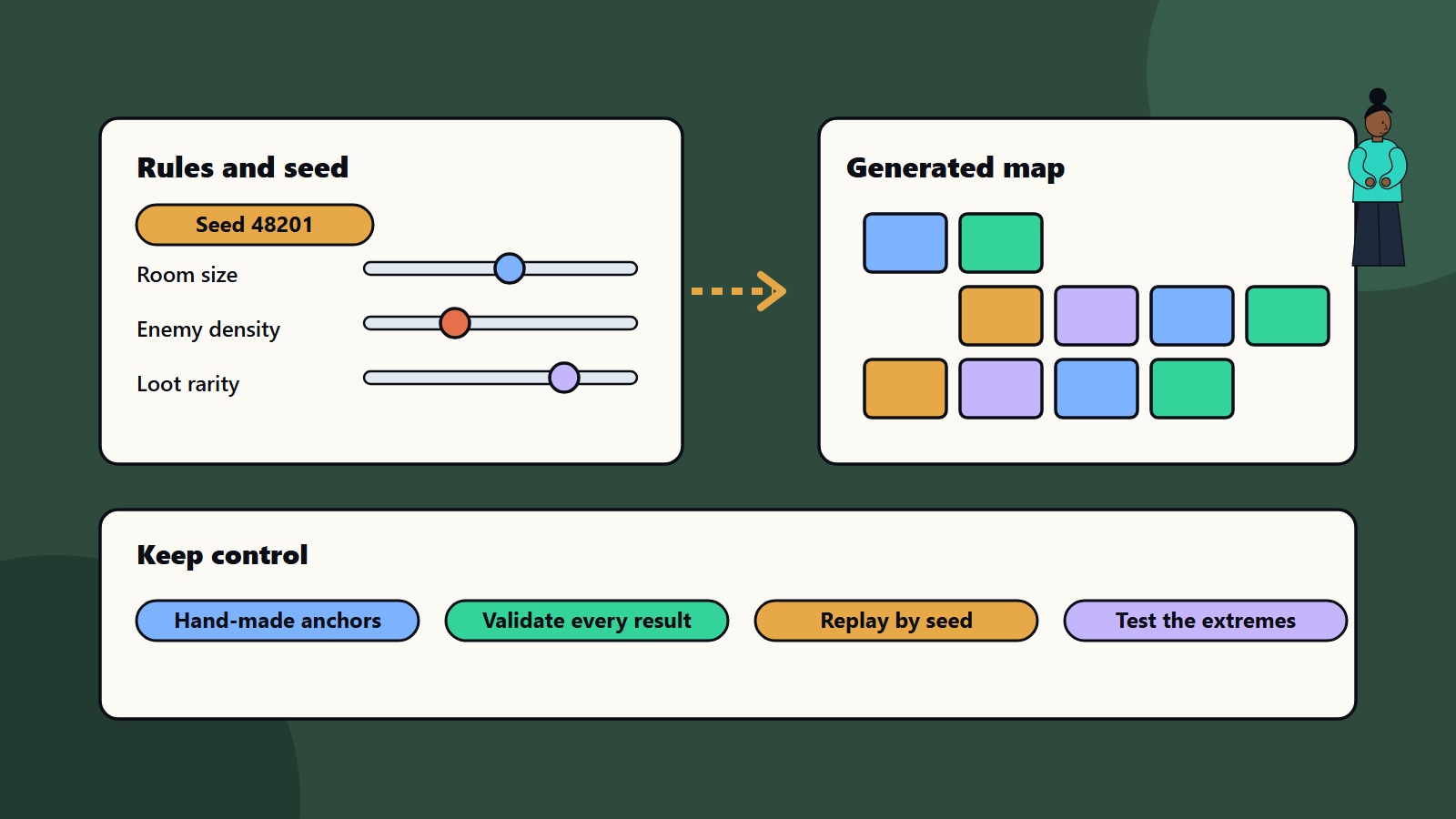
- Procedural generation creates content from rules, parameters and a random seed, so the same seed gives the same result.
- It excels at variety, replayability and scale, and it struggles with story, pacing and polish.
- Control comes from constraints, hand-made pieces, validation and tuning of probabilities.
- Test extremes at scale, since rare combinations create unwinnable or broken results.
- Performance, memory and storage affect when and how you generate.
What can be generated
- Levels and dungeons: rooms, corridors and layouts.
- Terrain and worlds: landscapes, rivers, biomes and vegetation.
- Items and loot: weapons and gear with varied stats.
- Characters and creatures: appearance, names and traits.
- Quests and encounters: combinations of goals, enemies and rewards.
- Textures, audio and music: variations and layers. See game audio.
- Puzzles: with solvability checks.
- Difficulty and pacing: adjusting challenge to the player.
Generation can run during development, as a tool that creates content artists then refine, or at runtime, producing content as the player plays.
Core techniques
Seeds and pseudo-random numbers
A computer’s random numbers are actually produced by a formula from a starting value called a seed. The same seed gives the same sequence, which allows replays, shared worlds, bug reproduction and saving the seed alone for the whole world. Keep generation deterministic across platforms where it matters, as differences in maths or libraries can change results.
Noise functions
Smooth noise, such as Perlin and simplex noise, produces natural-looking variation for terrain heights, clouds and textures. Layers of noise at different scales add detail.
Rule-based and grammar systems
Rules describe how parts connect: a room has doors, a corridor joins rooms and a dungeon has a start, a boss and a key. Grammars expand a high-level plan into detail.
Tiles and modules
Prebuilt pieces are assembled by algorithm. Wave function collapse and similar methods choose pieces that fit their neighbours. Hand-made modules keep quality high.
Space partitioning and graphs
Divide a map into regions, connect them as a graph and then fill them. Graphs make it easier to guarantee that the exit is reachable.
Simulation and evolution
Run a simulation, such as erosion or growth, to produce natural results. Search and optimisation methods can tune content to targets such as difficulty.
Machine learning
Learned models can generate textures, text or level layouts from examples. Check output quality, legal rights to training data and consistency with your art style. See synthetic data uses and limits for related quality checks.
Why use it
- Replay value: each run differs.
- Scale: worlds and content volume beyond hand authoring.
- Efficiency: small teams build more. Download size can shrink when content is generated on the device.
- Surprise: players discover things the designers did not predict.
- Support for live games: fresh content on a schedule. See game analytics.
The limits
- Sameness: thousands of variations can feel alike if the underlying rules are narrow.
- Weak pacing and story: algorithms struggle with dramatic structure, so levels can lack rhythm. See level design principles.
- Unfairness: random combinations can create impossible or trivial situations.
- Bugs at scale: rare failures appear when millions of worlds are generated.
- Hard to polish: it is difficult to perfect something you have never seen.
- Debugging: problems depend on seeds and conditions.
- Performance: generation takes time and memory.
Keep control
Constraints and rules
Define what must always be true: the player can reach the exit, keys appear before locked doors, enemy density stays within a range and rewards match difficulty.
Hand-made anchors
Mix generated and authored content. Fixed set pieces, story moments and landmark locations give structure, while generated filler provides variety.
Validation
After generating, check the result automatically: path exists, no overlapping geometry, performance within budget, puzzle solvable and no impossible spawns. Reject and regenerate if checks fail, or repair the result.
Tunable parameters
Expose controls for designers: room count, density, rarity and difficulty curves. Tune with data and playtests.
Weighted randomness
Not every outcome should be equally likely. Use weights, and consider limits that avoid long streaks of bad luck, since players perceive pure randomness as unfair.
Player-facing fairness
Show enough information for players to make decisions. Offer ways to reroll or retry where it suits the design.
Testing generated content
- Mass generation: create thousands of seeds in an automated run, and check each against the validation rules.
- Statistics: measure distributions of room counts, item values and difficulty, and compare them with targets.
- Extremes: test the smallest, largest and strangest outputs.
- Bots: let automated players try generated levels to find impossible ones.
- Seed logging: record the seed with every bug report so that it can be reproduced.
- Human playtests: people spot boring and unfair results that numbers miss.
- Platform tests: confirm the same seed gives the same result on each platform if consistency matters.
See game testing and QA and our test automation strategy.
Performance and technical design
- Decide whether to generate at build time, at load or during play.
- Generate in chunks on background threads, and stream them in.
- Cache results when the same content repeats.
- Budget memory for generated assets. See PC game optimisation.
- Plan how saves work: store the seed and the player’s changes.
- For multiplayer, share seeds so that all players see the same world, and plan for server authority. See multiplayer netcode.
- Check engine support and tools. See game engines compared.
Common mistakes
- Generating everything, including content that should be crafted.
- No validation, so impossible levels ship.
- Ignoring pacing and difficulty curves.
- Pure randomness with no weights.
- Forgetting to log seeds.
- Testing only a handful of results.
- Platform differences that change results.
- Slow generation during play.
A starting plan
- Choose one content type to generate, such as room layouts or loot.
- Define the rules and what must always be true.
- Build the generator with a seed and validation checks.
- Generate thousands of results, review statistics and fix failures.
- Add hand-made anchors, then playtest and tune.
How SoftSapien supports procedural content
SoftSapien’s game engineers and designers build generators, validation and test tools, tune results with data and integrate them with mobile, PC and console projects. See our game development and QA and testing services.
To add generated content to your game, use the contact page to chat with our team, send a message or schedule a free consultation call.
Frequently asked questions
What is a seed in procedural generation?
A starting value for the pseudo-random number formula. The same seed gives the same result, which allows replays, shared worlds and bug reproduction.
Why can generated levels feel dull or unfair?
Narrow rules create sameness, and pure randomness can produce impossible or trivial situations. Use constraints, weights, validation and hand-made anchors.
How do we test generated content?
Generate thousands of seeds automatically, validate each, check statistics, test extremes, use bots and log seeds with every bug.
Should everything be generated?
No. Generate variety and filler, and keep story moments, set pieces and landmarks crafted by people.
Can SoftSapien help build generators?
Yes, with tools and tests. Contact SoftSapien through the contact page to chat with our team, send a message or schedule a free consultation call.