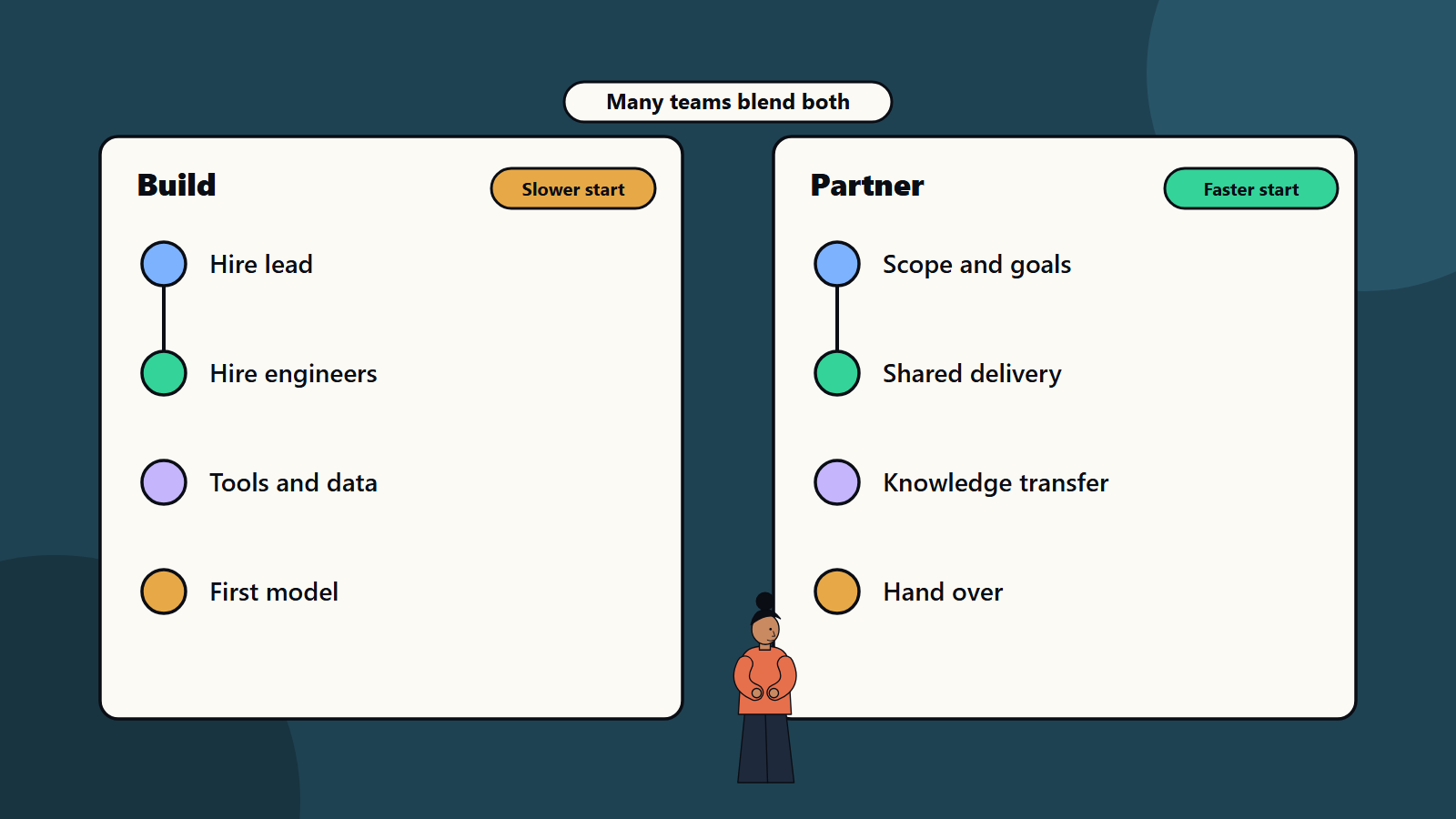
Short on time? Build a data science team when data is central to your product and you can keep it busy with a steady roadmap. Outsource or partner when you need speed, a specific skill or a first project to prove value. Many companies blend both: a partner starts the work, trains the in-house team and hands over. Decide by strategy, cost, risk and the supply of talent.
Few business leaders doubt the value of data science. The harder question is how to get it: hire a team, hire a partner or mix the two. Each path has costs and risks that are easy to underestimate.
This guide helps owners and executives of a small firm and a large enterprise decide, and shows how to run either choice well.
Key takeaways
- Build when data science is a long-term advantage and you have enough steady, valuable work.
- Outsource when you need speed, scarce skills, a short project or proof of value before committing.
- A hybrid approach often works best: partner first, then transfer skills and build gradually.
- Success depends on data access, clear problems, business ownership and a path to production as well as talent.
- Compare total costs, risks and exit options, and write down how knowledge will transfer.
What a data science function needs
Hiring a single data scientist rarely creates impact. Useful work needs a combination of roles:
- Business owner who defines the problem and acts on results.
- Data scientists who explore data and build models.
- Data engineers who build the pipelines and platforms.
- Machine learning engineers who move models into production and keep them running. See MLOps basics.
- Analysts who explain results and build reports.
- Product or project management that connects the work to the business.
- Governance and security support for privacy, fairness and risk.
A small team can cover several roles per person, with a clear view of the gaps.
When building makes sense
- Data and models are central to your products or competitive edge.
- You have a stream of problems that will keep a team busy for years.
- Your data is sensitive and must stay under tight control.
- You can offer a credible career for specialists, with interesting work, tools and growth.
- You have leadership that understands data science and will protect it from becoming a reporting service.
Advantages: deep knowledge of your business, long-term accumulation of skills, close collaboration and control.
Challenges: recruiting is slow and competitive, salaries are high, retention is hard and a new team needs data access, tools and support from day one. A team without a clear mandate often drifts.
When outsourcing or partnering makes sense
- You need results within months, before a long hiring process could finish.
- The need is specific or temporary: a forecasting model, a one-off analysis or a proof of concept.
- You lack the senior skills to set direction.
- You want to test the value before building a permanent team.
- Peaks of demand would leave a permanent team idle at other times.
Advantages: speed, access to varied experience, flexibility and lower fixed cost.
Challenges: the partner must learn your business, knowledge can leave with them, dependency can build and handover can be poor. Sensitive data requires strong contracts and controls.
The hybrid path
Many organisations follow these steps:
- Partner for the first projects, with a clear scope and measurable benefit.
- Embed your people in the work, so they learn the methods and the data.
- Hire a lead early, to own the roadmap and the relationship.
- Transfer code, documentation, models and operating knowledge in stages.
- Keep a partner for peaks and specialist topics.
Make knowledge transfer an explicit deliverable with dates. Our guides to choosing a software development partner and offshore and nearshore engagement models cover partner selection and commercial structures.
Compare the costs honestly
Build costs include salaries and benefits, recruiting fees, time to hire and ramp up, tools and compute, data platform work, management time, training and turnover. Outsourcing costs include fees, the effort to brief and manage the partner, data preparation, integration work and the cost of handover or switching.
Compare over three years, and include the cost of delay, since a model that arrives six months earlier may repay a premium. Use the framework in our technology investment business case guide.
Prerequisites for either path
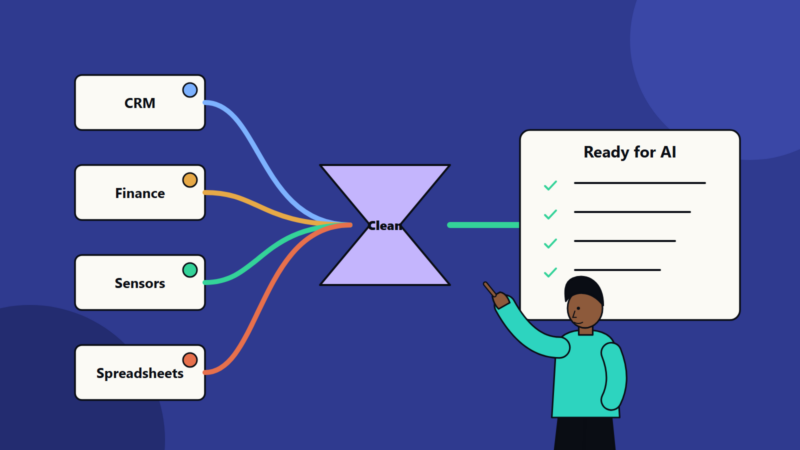
- Accessible, reasonably clean data. See data quality for machine learning and data analytics maturity.
- A clear problem and success measure, agreed with the business.
- A route to production, with engineers and platforms to deploy and monitor models.
- Governance: privacy, security, fairness and documentation. See responsible AI policy.
- Ownership: a named business sponsor.
- A decision about tools and platform: cloud, notebooks and experiment tracking.
Choosing a partner
- Relevant experience in your industry and problem type, with references you can check.
- A method that includes data assessment, baselines, testing and production support.
- Clear ownership of code, models and data in the contract.
- Security practices and certifications, with controls for sensitive data.
- Team stability and named people.
- Willingness to train your team.
- Transparent pricing and exit terms. See vendor management for technology buyers.
Hiring well
- Write role descriptions around problems to solve, with tool lists kept short.
- Test practical skills with realistic tasks.
- Hire a mix of seniority, with at least one person who has shipped models to production.
- Offer growth, mentoring and interesting work.
- Be honest about data quality and constraints.
- Build relationships with universities and communities.
Measure the function
- Models in production, and their business impact.
- Time from idea to deployment.
- Stakeholder satisfaction.
- Reuse of data, features and code.
- Cost per project and per model run.
- Retention and learning in the team.
Common mistakes
- Hiring one data scientist with no data engineering or sponsor.
- Starting with technology and no business problem.
- Expecting a partner to know your business without access and time.
- No plan for production.
- Handover left to the last week.
- Treating the team as a reporting desk.
- Ignoring governance until something goes wrong.
A starting plan
- List three problems with measurable value, and choose one.
- Assess data readiness and the route to production.
- Decide: build, partner or hybrid, using the criteria above.
- Start with a time-boxed project with a clear success measure.
- Plan skills transfer and the next hires from the first month.
How SoftSapien supports data science teams
SoftSapien’s data scientists and engineers deliver projects, embed with client teams, train and mentor your people and help organisations design their operating model and hiring plan. See our data science and AI development services.
To decide how to build your data capability, use the contact page to chat with our team, send a message or schedule a free consultation call.
Frequently asked questions
When should we build a data science team?
When data is central to your products or advantage, you have a steady roadmap of valuable problems and you can offer specialists a credible career.
When does outsourcing make sense?
When you need speed, a scarce skill, a short project or proof of value before committing to permanent hires.
What roles does a data science function need?
A business owner, data scientists, data engineers, machine learning engineers, analysts, project management and governance support.
How do we avoid dependency on a partner?
Embed your people, hire a lead early, own the code and models by contract and make knowledge transfer a dated deliverable.
Can SoftSapien help build our data capability?
Yes, as a partner and trainer. Contact SoftSapien through the contact page to chat with our team, send a message or schedule a free consultation call.