Short on time? Redesigning work around AI agents means rebuilding a process so people and agents each do what they do best, with a named workflow owner, clear handoffs and complete logs. Deloitte advises redesigning processes before automating them, and IBM expects agents to seek human approval at checkpoints. Start with one workflow: map it, split judgement from routine, set the agent’s level of autonomy and measure results.
Most companies first tried AI as an add-on. A chat assistant here, a summary button there. Agents change the question. When software can carry a task through several steps, the process around it needs to change too: who owns the outcome, what the agent may do alone, who checks the result and where the record lives.
This article gives a practical method for redesigning work around AI agents. It draws on 2026 trend views from Deloitte, IBM, Capgemini and Microsoft. It suits a small business with one assistant and a global company changing many processes.
Key takeaways
- Deloitte’s Tech Trends 2026 advises redesigning processes instead of automating existing ones, and tying investment to business problems.
- IBM’s 2026 trends describe agents shifting from personal helpers to coordinated team workflows, and engineering moving to goal-setting with agents seeking human approval at checkpoints.
- Capgemini describes intelligent operations: agents monitor, optimise and orchestrate workflows while humans supervise.
- Every redesigned workflow needs a named owner, defined autonomy levels, handoff rules and a full log.
- Measure outcomes before and after, and keep a way to pause or roll back.
What the big firms are saying
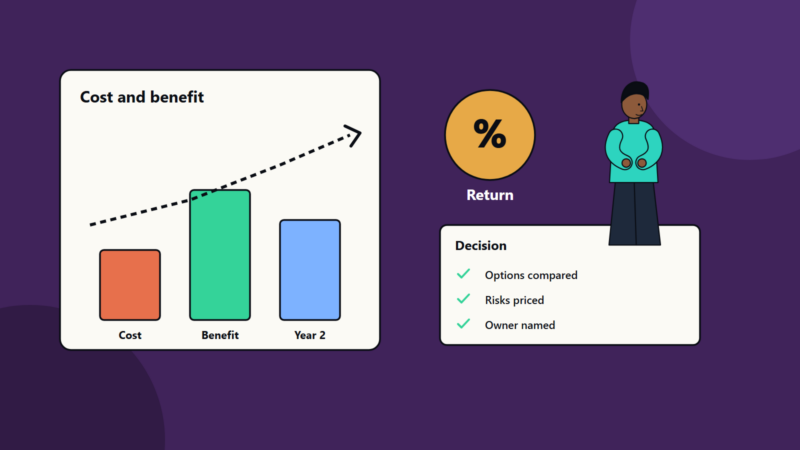
Deloitte’s Tech Trends 2026 includes a chapter called “The agentic reality check”, about preparing for a silicon-based workforce. Its framing is that leaders should redesign processes instead of automating existing ones, tie investments to business problems and move quickly on small pilots.
IBM’s trends for 2026 lists several that bear on workflow design. “Agent teams” describes agents moving from personal helpers to coordinated team workflows that non-developers can build. “AI as teammate” says engineering shifts toward setting goals, with autonomous agents asking for human approval at checkpoints. “Machine automation” describes AI reliably executing complex enterprise workflows end to end.
Capgemini’s 2026 trends include the rise of intelligent ops, where enterprise systems shift from static records toward process-focused operations in which AI agents monitor, optimise and orchestrate workflows with humans supervising.
Microsoft’s AI trends for 2026 begin with human-AI collaboration: AI moving from answering questions to working alongside people and extending their expertise.
The common thread is plain. The gain comes from the redesigned process, with agents inside it, and a bolt-on does not deliver it.
A seven-step method for redesigning work around AI agents
1. Pick one workflow with a clear outcome
Choose a process that is frequent, rule-heavy and measurable, such as invoice exceptions, onboarding, claims triage or incident handling. See AI agent use cases by department.
2. Map the real process
Walk through it with the people who do it. Note each step, the data used, the systems touched, the delays and the rework. Include the exceptions, since they hold most of the effort.
3. Separate judgement from routine
Mark each step as:
- Routine: clear rules and data, safe for an agent.
- Assisted: an agent prepares, a person decides.
- Human: needs judgement, empathy, negotiation or accountability.
4. Set autonomy levels
Define what the agent may do by itself and what needs approval. A common ladder:
- Observe and report.
- Suggest.
- Act with approval.
- Act alone within limits, with review of samples.
- Act alone with alerts only.
Start low, and move up only when results justify it. See AI agent governance.
5. Name the workflow owner
One person is accountable for the outcome, the agent’s behaviour and the results. They approve access, review performance and decide when to expand or pause.
6. Design the handoffs
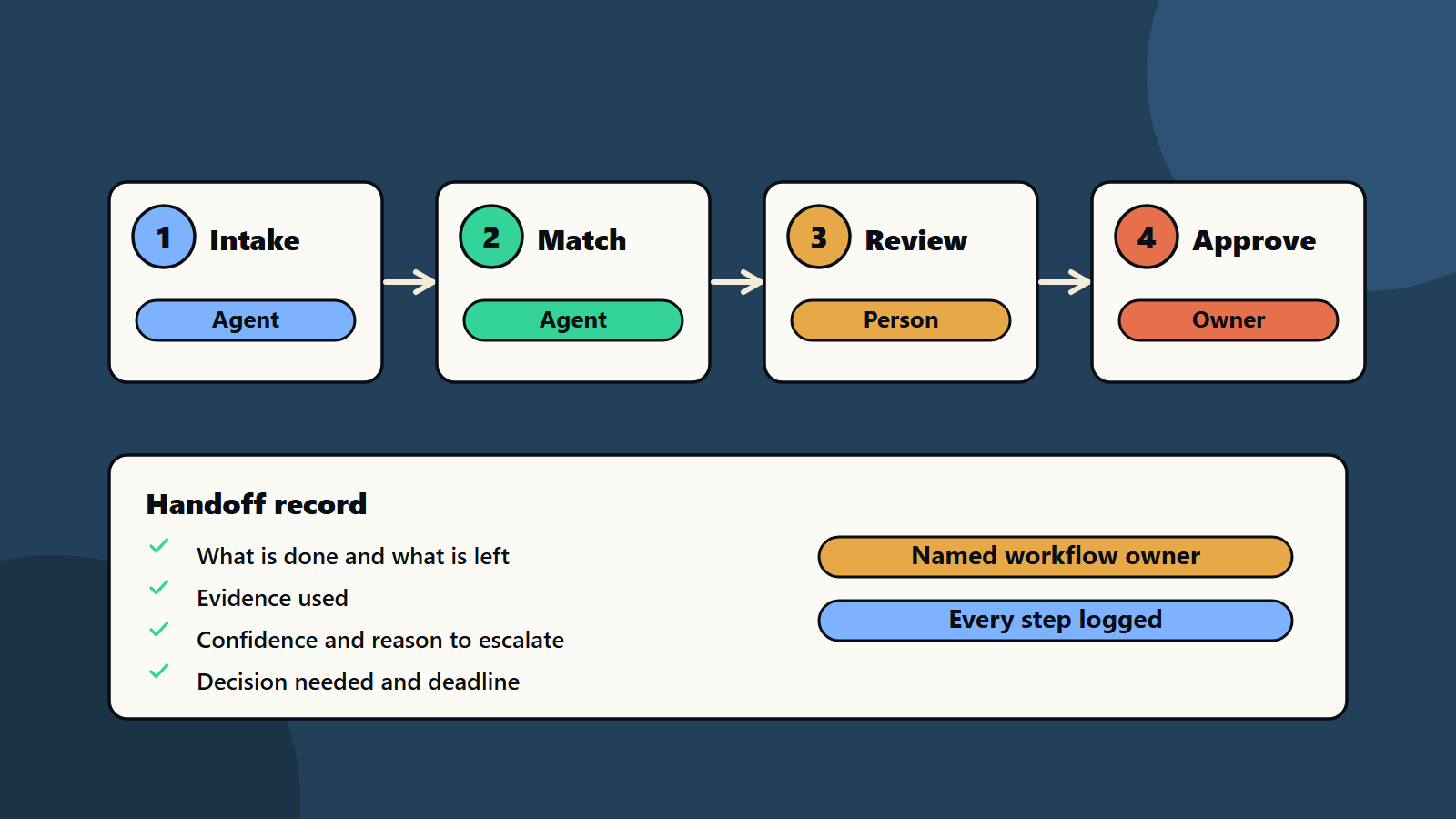
A handoff is where work passes between an agent and a person, or between agents. A good handoff states:
- What has been done and what is left.
- The evidence used.
- The agent’s confidence or reason for escalating.
- What decision is needed, and by when.
Poor handoffs, with missing context, cause most of the friction.
7. Log everything and measure
Record each step, input, tool call and result with a trace id. Track speed, quality, cost and satisfaction against the baseline. See AI ROI.
A handoff record in code
A structured handoff makes the human step fast. This example shows the kind of record an agent might produce when it escalates:
{
  "case_id": "INV-20418",
  "workflow": "invoice-exceptions",
  "agent": "agent-ap-02",
  "status": "needs_human",
  "summary": "Invoice total differs from purchase order by 4.2 percent.",
  "evidence": ["po_7731.pdf", "invoice_20418.pdf", "contract_clause_9"],
  "agent_recommendation": "approve_with_note",
  "confidence": 0.62,
  "decision_needed_by": "2026-12-04T12:00:00Z",
  "owner": "finance-ops"
}
A reviewer sees the issue, the evidence and the recommendation at once, and the same record goes into the audit trail.
A worked example: invoice exceptions
This example is illustrative.
A company processes 4,000 supplier invoices a month. About one in five fails an automatic match and goes to a clerk, who spends around 15 minutes on each.
Before: the clerk gathers documents, checks the purchase order and contract, emails the buyer and waits.
Redesign:
- Owner: the accounts payable manager.
- Routine (agent): retrieve the purchase order, goods receipt and contract clause, compare quantities and prices and classify the exception type.
- Assisted: for price differences under a set limit, the agent drafts a note and a recommendation, and a clerk approves in one click.
- Human: disputes, unusual suppliers and anything above the limit go to the buyer with the full evidence pack.
- Autonomy: level three at the start (act with approval), reviewed monthly.
- Logs: every case record, as above.
- Measures: time per exception, share resolved first time, errors found by sampling and clerk satisfaction.
Result to look for: exceptions resolve faster with fewer back-and-forth emails, the clerks spend their time on real disputes and sampling shows quality at least as good as before. If not, lower the autonomy level and fix the cause.
Roles and skills that change
- Workflow owners become more important. They need process, data and risk skills.
- Reviewers check agent output. They need training on typical errors and on when to escalate.
- Process designers and analysts map and tune workflows.
- Engineers build tools, tests and monitoring.
- Managers coach teams through changed tasks.
Be open about changes to jobs. Involve employees early, and explain what is staying human. See change management in technology programmes.
Metrics that show it works
- Cycle time and cost per case.
- First-time resolution rate.
- Share of cases handled by each autonomy level.
- Escalation rate and reasons.
- Error rate found by sampling.
- Customer and employee satisfaction.
- Cost of the agent system per case. See measuring AI cost.
Small business and enterprise views
- Sole trader or small business: redesign one task at a time, such as quoting or booking, write down who approves what and keep the log in a simple shared sheet.
- Mid-size company: appoint workflow owners, adopt a standard handoff record and review agent results monthly.
- Enterprise: build a workflow catalogue, standard autonomy levels, shared monitoring and a governance board. See AI orchestration and AI agent identity.
Regional and labour notes
Rules on automated decisions, worker consultation and records differ by country. In some places, changes to how work is done need consultation with employee representatives. Check legal duties before you change roles, and keep records of who approved what.
Common mistakes
- Putting an agent on top of a broken process.
- No named owner for the outcome.
- Skipping the exceptions in the process map.
- Starting at full autonomy.
- Handoffs with no context.
- Logging only the final result.
- Ignoring the people whose work changes.
A starting plan
- Pick one workflow, and measure its baseline.
- Map it with the people who do it.
- Mark routine, assisted and human steps.
- Set the autonomy level, owner and handoff record.
- Pilot for six weeks, review, then move to the next workflow in your plan for redesigning work around AI agents.
How SoftSapien supports workflow redesign
SoftSapien’s consultants and engineers map workflows, design autonomy levels and handoffs, build and test the agents and set up logging, monitoring and training for the teams involved. See our business advisory consulting and AI development services.
To redesign a process around agents, use the contact page to chat with our team, send a message or schedule a free consultation call.
Frequently asked questions
What does it mean to redesign work around AI agents?
Rebuilding a process so agents and people each do the parts they do best, with a named owner, clear handoffs and complete logs, instead of adding AI to the old steps.
Who should own an agent workflow?
One named person who is accountable for the outcome, the agent behaviour and the results, and who approves access and decides when to expand or pause.
How much autonomy should an agent have?
Start with observe or suggest, move to act with approval and allow independent action only within limits and after sampled review shows good results.
What should a handoff record contain?
What is done and what is left, the evidence used, the agent confidence or reason to escalate and the decision needed with a deadline.
Can SoftSapien help redesign our workflows?
Yes, from mapping to build and training. Contact SoftSapien through the contact page to chat with our team, send a message or schedule a free consultation call.