Short on time? A sovereign cloud is a cloud setup where you keep control over where data lives, who can access it and which laws apply. Capgemini says hybrid, private, multi-cloud and sovereign designs are becoming core to scaling AI, and IBM lists AI sovereignty among its 2026 trends. Choose by workload: classify your data, set control needs, then place each workload on the cloud type that fits.
For a decade the cloud story was simple: move to one big public provider. AI has changed it. Models need large amounts of data, special hardware and strict controls, and many firms now ask where their data sits and who can reach it.
The result is what Capgemini calls “Cloud 3.0”. This article explains it in plain terms and shows how to plan sovereign cloud and hybrid choices for AI. It suits a small business with a few cloud services and an enterprise with regulated workloads.
Key takeaways
- Capgemini’s 2026 trends describe “Cloud 3.0: all flavors of cloud”, with hybrid, private, multi-cloud and sovereign designs as core systems for AI and agent workflows.
- IBM’s 2026 trends list AI sovereignty and resilience: governing AI systems, data and systems independently is becoming a top business priority.
- Capgemini also describes tech sovereignty as selective control of key layers and diversified suppliers, which stops short of full independence.
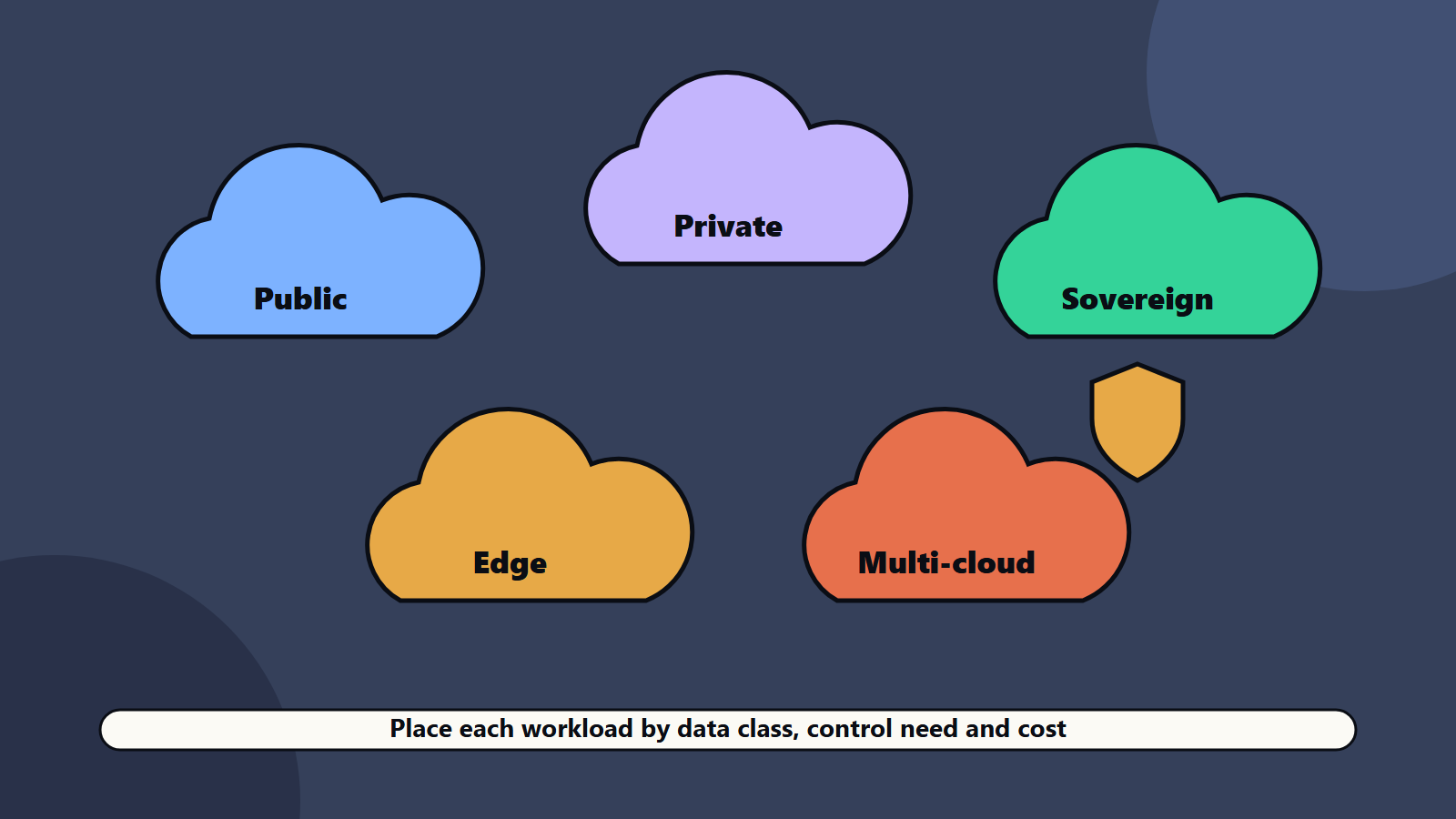
- Place each workload by data class, control need, performance and cost.
- Keep an exit route for every provider you rely on.
What the big firms are saying
Capgemini’s 2026 tech trends include “Cloud 3.0: all flavors of cloud”. It says hybrid, private, multi-cloud and sovereign designs are becoming core systems for scaling AI and agentic workloads. Another trend, “the borderless paradox of tech sovereignty”, says firms pursue resilience through selective control of key technology layers and diversified suppliers, short of full independence.
IBM’s trends for 2026 lists “AI sovereignty and resilience” and says governing AI systems, data and systems independently is becoming a top priority for businesses.
Deloitte’s Tech Trends 2026 has a chapter called “The AI systems reckoning”, about optimising compute strategy in the age of inference economics. Microsoft’s AI trends for 2026 adds efficient AI systems, with densely packed, dynamically routed, linked datacenters that reduce waste and cost.
Together they say the same thing. Where AI runs now matters as much as what it does.
Sovereign cloud and its neighbours in plain words
- Public cloud: shared systems from a large provider. Fast to start and rich in services.
- Private cloud: systems dedicated to one organisation, in its own or a hosted data centre. More control, more to run.
- Hybrid cloud: a mix of public and private, connected. See hybrid cloud design.
- Multi-cloud: more than one public provider. See multi-cloud strategy.
- Sovereign cloud: a design or service that aims to keep data, operations and legal control within a chosen country or region, often with local operation, local teams and strong controls on foreign access. Definitions vary by provider and by law, so read the terms.
Sovereignty is a spectrum with many steps between its ends. Capgemini’s wording is a useful reminder: control selected layers, and use several suppliers.
Why AI raises the stakes
- Data is the fuel. Training, fine-tuning and retrieval use sensitive documents, customer records and code.
- Models see everything you give them. Prompts and context may include personal or confidential data.
- Hardware is scarce. Graphics processors and power limit where you can run workloads. See GPU systems for AI.
- Rules are tightening. Data protection, sector rules and AI laws affect where and how you process data.
- Resilience matters. If one provider fails or changes terms, an AI feature can stop.
A placement method
1. Classify the data
Sort data into classes, such as public, internal, confidential, regulated personal data and national security or critical data. Rules differ by class.
2. Define control needs
For each class, answer:
- Where must data be stored and processed?
- Who may administer the platform and under which country’s law?
- What encryption and key control is required?
- What audit evidence do regulators expect?
- How fast must it recover?
3. Map workloads to cloud types
- Low-risk, bursty work: public cloud.
- Sensitive data with strict residency rules: sovereign or private cloud, or a public region with extra controls.
- Latency-bound or factory-floor work: edge or on-premises. See edge computing.
- Large model training or heavy inference: wherever hardware is available at acceptable cost, with data controls.
4. Design the controls
- Customer-managed encryption keys held outside the provider where required.
- Strong identity and least privilege. See zero trust security.
- Private networking and logging.
- Data minimisation for prompts and context.
5. Plan the exit
For each critical provider, record how you would move away. See cloud exit strategy.
6. Count the cost
Compare compute, storage, data transfer, licences, people and compliance work. See cloud cost optimisation and measuring AI cost.
A worked example: a regional insurer
This example is illustrative.
An insurer wants an AI assistant for claims teams and a model that scores fraud risk.
- Data classes: claims documents with personal and health data (regulated); policy rules (internal); public product information (public).
- Claims assistant: runs in a sovereign or private environment in the home country, with keys held by the insurer. Documents are retrieved from an index in the same environment.
- Fraud model training: uses de-identified data in a controlled public cloud region with approved hardware, under strict access rules.
- Public chatbot: answers questions from public content only, on public cloud.
- Exit and resilience: a documented plan to move the assistant to another provider, tested once a year. A second region for recovery.
- Governance: a register of AI systems, data used and providers, reviewed quarterly.
The insurer uses three cloud types for one AI programme, each chosen by the data it touches.
Small business and enterprise views
- Sole trader or small business: use a reputable public provider with a region you choose, turn on encryption and access controls, and avoid sending customer data to tools you have not checked. See cloud for small business.
- Mid-size company: classify data, pick regions on purpose and add private connectivity for sensitive systems.
- Enterprise or regulated firm: build a multi-cloud and sovereign design with common identity, policy and logging, plus exit plans and supplier risk reviews.
Regional and legal notes
Data protection and sector rules differ widely. Some countries and industries set data location or operator requirements, and new AI rules add duties. In the European Union, for example, the Commission’s page on the AI Act sets obligations by risk level, and cloud and data rules continue to evolve. Check the rules that apply to you with legal advice. See data residency and sovereignty.
Common mistakes
- Treating “sovereign” as a single product you can buy.
- Choosing by brand when data class should decide.
- Forgetting that prompts and logs are data too.
- Locking all AI work into one provider.
- Ignoring exit plans and supplier concentration.
- Overbuilding private systems for low-risk work.
A starting plan
- Inventory AI workloads and the data each one uses.
- Classify data and write control needs.
- Map each workload to a cloud type.
- Pilot one sovereign cloud workload with keys, logging and an exit test.
- Review the sovereign cloud map every six months.
How SoftSapien supports sovereign and hybrid cloud
SoftSapien’s cloud and security consultants classify data, design hybrid, multi-cloud and sovereign designs for AI, build landing zones and controls and plan migrations and exits. See our cloud and datacenter solutions and multi-cloud solutions services.
To plan where your AI should run, use the contact page to chat with our team, send a message or schedule a free consultation call.
Frequently asked questions
What is a sovereign cloud?
A design or service that aims to keep data, operations and legal control within a chosen jurisdiction. Definitions vary by provider and law, so read the terms.
What is Cloud 3.0?
Capgemini term for all flavours of cloud, with hybrid, private, multi-cloud and sovereign architectures becoming core infrastructure for scaling AI.
How do we decide where an AI workload runs?
Classify the data, define control needs, then map each workload to public, private, sovereign or edge placement and design controls and an exit plan.
Do we need several clouds?
Not always. Rank workloads, and use more than one only where data rules, performance or resilience justify the cost.
Can SoftSapien help plan our cloud?
Yes, from classification to migration. Contact SoftSapien through the contact page to chat with our team, send a message or schedule a free consultation call.