Short on time? A composable enterprise builds its systems from replaceable business capabilities, such as orders, payments, customer profiles and search, connected through clear interfaces, so parts can be changed without rebuilding everything. It increases flexibility and speed, and it needs strong architecture, governance and integration discipline. Move one capability at a time, starting where change is most frequent and painful.
Business needs change faster than large, tightly coupled systems can. A new sales channel, a pricing model, a regulation or an acquisition each calls for a change in one part of the technology estate, and each change risks breaking others. Teams spend months on work that should take weeks.
Composability is an architecture and operating approach designed to fix this. The enterprise is assembled from modular capabilities that can be added, swapped or reconfigured. The idea draws on service-oriented design, APIs, microservices and packaged business capabilities, and has been promoted by analysts and vendors under names such as composable business and MACH architecture. This guide explains the principles in practical terms, with realistic cautions. It suits a retailer, a bank, a manufacturer or a public body weighing a long-term platform strategy.
Key takeaways
- Composable means modular capabilities with clear contracts, which can be replaced or recombined without disturbing the rest.
- It supports faster change, best-of-breed choices and reduced lock-in, in return for greater integration and governance effort.
- Start from business capabilities and let technology fashions wait.
- APIs, events and shared data standards hold it together.
- Adopt gradually, applying the approach where change is frequent and value is clear.
What it means
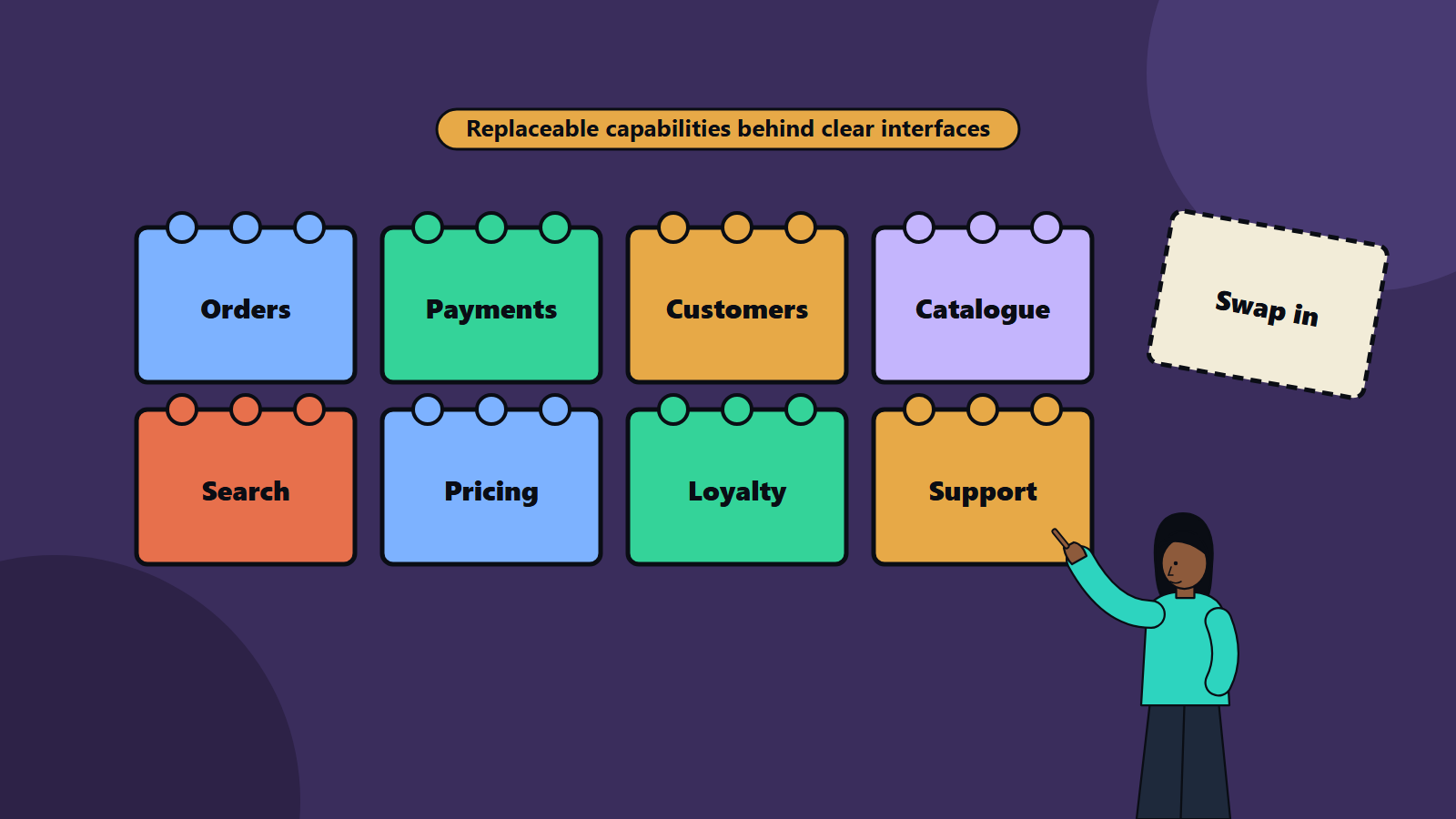
A composable enterprise treats its business as a set of capabilities, each delivering a distinct function: manage customers, price products, fulfil orders, process payments, approve credit, handle returns. Each capability is implemented as a replaceable component, built in-house, bought or provided as a service, and exposed through well-defined interfaces. Business processes are then assembled by combining capabilities.
Four ideas recur:
- Modularity: components with clear boundaries and responsibilities.
- Autonomy: teams can change one component without waiting for others.
- Orchestration: processes combine components, with flexibility to reconfigure.
- Discovery: capabilities are described and findable so they can be reused.
The approach is not new in spirit. What has changed is the maturity of cloud platforms, APIs, event streaming and SaaS ecosystems that make it practical at scale.
Why organisations pursue it
- Speed of change: swap or update one part, such as a checkout or a pricing engine, without a full-system release.
- Choice: use the best product for each capability, and replace it as markets evolve.
- Reduced lock-in: clear interfaces make it easier to move away from a vendor.
- Reuse: one capability serves many channels, such as web, mobile, stores and partners.
- Scalability: scale only the capabilities that need it.
- Experimentation: test new offers and journeys on top of stable capabilities.
- Mergers and divestments: plug in or detach business units more easily.
- Resilience: failures can be contained within components.
The building blocks
Business capability model
Map the organisation by what it does, independent of current systems. A capability map shows domains such as customer, product, order, finance and supply chain, with capabilities beneath them. Use it to decide boundaries and ownership.
Domain-driven boundaries
Group related functions and data within clear domains, each with its own vocabulary and owner. Boundaries that follow the business make components stable. Poorly chosen boundaries cause constant cross-team changes.
APIs and events
Components interact through published contracts. Synchronous APIs suit requests that need an answer now. Events let many components react to changes without tight coupling. Our guides to API-first strategy and enterprise software integration patterns explain how to design and choose.
Packaged business capabilities and SaaS
Buy standard capabilities where differentiation is low, and build where it is high. Compare choices with our guide to custom software versus SaaS.
Headless and decoupled components
Separate presentation from back-end logic, so one capability can serve many front ends. Content, commerce and customer data platforms often follow this pattern.
Composition and orchestration layer
A layer that assembles capabilities into journeys and processes: workflow engines, integration platforms, backend-for-frontend services and low-code tools.
Shared platform services
Common services such as identity, observability, security, data platform and deployment pipelines, so teams do not rebuild the basics. See our guide to platform engineering.
Data foundation
Data flows between components, so agree standard definitions, master data ownership and access methods. A modular front without a coherent data approach produces confusion. Our guide to AI data integration covers connecting and preparing data.
Composable and microservices
They are related and differ in scope. Microservices are a technical style of building applications as small independently deployable services. Composability is a wider approach to the enterprise: capabilities can be microservices, packaged applications, SaaS products or legacy systems wrapped with interfaces. Microservices can be adopted without a composable strategy, and a composable enterprise can use few microservices. Our guide to web application architecture compares structures.
Costs and risks
- Integration complexity: many components mean many connections, versions and failure points.
- Governance burden: without standards, you get sprawl.
- Data fragmentation: inconsistent definitions and duplicated data.
- Vendor proliferation: more contracts, security reviews and relationships to manage. Our guide to vendor management offers a framework.
- Operational overhead: monitoring, support and incident handling across components.
- Skills: architecture, API design, integration and product management capabilities.
- Performance and latency from chatty interactions.
- Over-fragmentation: boundaries too fine, with more coordination than benefit.
- Hype: vendor claims may promise more than the underlying architecture delivers.
- Security surface: more interfaces to protect.
Modularity is a means to an end. The aim is business agility at reasonable cost.
How to adopt gradually
- Define the business reasons: where does slow change hurt most? Examples: customer-facing channels, pricing and promotions, onboarding, partner integration.
- Map capabilities and current systems. Identify which are stable, which change often and which are differentiating.
- Choose a first domain: pick one with clear value, manageable scope and a motivated team.
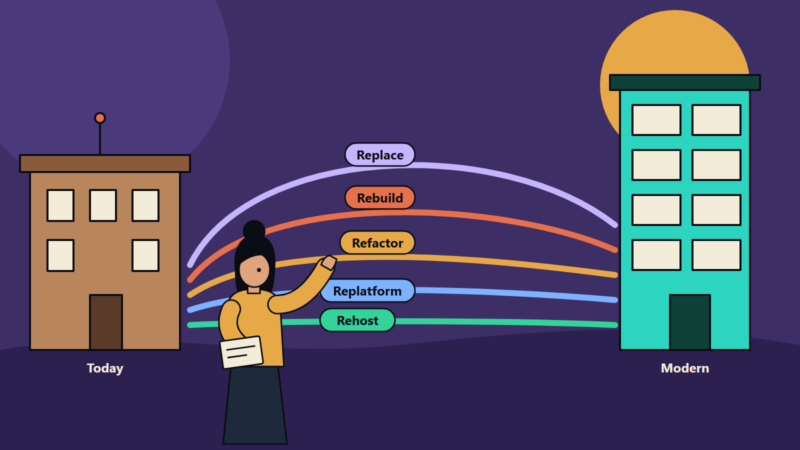
- Wrap before replace: expose existing systems through APIs, so new components can sit beside them. This is the strangler approach described in our guide to legacy application modernization.
- Establish standards early: API design guidelines, event schemas, security and observability baselines.
- Build the platform and tooling: an API gateway, event backbone, catalogue, deployment pipelines and monitoring.
- Deliver in slices: show results every few months, and adapt.
- Create ownership: a product owner and team for each capability, with service levels.
- Measure: lead time for change, release frequency, reuse, incident rates and business outcomes such as time to launch a new offer.
- Review the architecture regularly: merge components that are too fine, split those that are too coarse and retire duplicates.
Governance
- Architecture principles that everyone understands.
- A lightweight review process for new components and interfaces.
- A catalogue of capabilities, APIs, owners and consumers.
- Contract management: versioning, deprecation policies and consumer-driven tests.
- Security and compliance requirements built into the platform.
- Cost transparency per capability.
- Decision rights: who decides on boundaries, standards and exceptions.
Organisation
Composable architecture works best with matching team structures: product-aligned teams that own capabilities end to end, supported by platform teams and architecture guidance. Funding that follows products keeps components maintained. Culture matters: teams must treat their interfaces as products that others rely on.
Signs you are ready, and signs you are not
Ready: frequent change requests that take too long, multiple channels needing the same capabilities, a growing integration burden, leadership support and basic cloud and API skills.
Not yet: unclear business priorities, poor data quality, no investment in platform capability or an organisation that cannot manage cross-team contracts. Fix foundations first.
Common mistakes
- Starting with a technology shopping list before mapping business capabilities.
- Splitting too finely.
- Ignoring data and master data ownership.
- Buying many point solutions with no integration plan.
- No platform team.
- Treating APIs as an afterthought.
- Expecting immediate savings.
- Forgetting run costs and support.
How SoftSapien supports composable architecture
SoftSapien helps organisations map capabilities, design target architectures, build APIs and integration platforms and modernise step by step, combining engineering depth with business advice. See our enterprise software engineering and business transformation services.
To plan your approach, use the contact page to chat with our team, send a message or schedule a free consultation call.
Frequently asked questions
What is a composable enterprise?
An organisation whose systems are assembled from replaceable business capabilities connected through clear interfaces, so parts can change without rebuilding everything.
Is composable the same as microservices?
No. Microservices are a technical style for building applications. Composability is a wider approach, where capabilities may be microservices, packaged applications, SaaS or wrapped legacy systems.
What are the main risks?
Integration complexity, governance burden, data fragmentation, vendor proliferation, operational overhead, skills gaps and over-fragmentation.
How should we start?
Define business reasons, map capabilities, pick one domain with clear value, wrap existing systems with APIs, set standards early and deliver in slices.
Can SoftSapien help design a composable architecture?
Yes, from mapping to delivery. Contact SoftSapien through the contact page to chat with our team, send a message or schedule a free consultation call.