Short on time? Data governance basics are simple: know what data you have, name an owner for each set, agree rules for access, quality and retention, and keep a catalogue people can search. Start with your most important data, write a few clear policies and review them each quarter. Good governance builds trust and makes analytics and AI safer.
Every company holds data about customers, money, products and people. Without rules, the same number means three things in three reports. Private data ends up in the wrong hands. Nobody knows who can fix a mistake.
Data governance is how you prevent this. This guide explains data governance basics in plain terms. It suits a small business with a few spreadsheets and a large firm with many platforms.
Key takeaways
- Data governance basics: owners, definitions, quality rules, access rules and a catalogue.
- Start small with the data that matters most to the business.
- Give each dataset a named owner who can make decisions.
- Write short policies people can follow.
- Governance helps analytics, privacy and AI, and it needs regular review.
What data governance is
Data governance is a set of roles, rules and routines that decide how data is managed. It answers questions like these:
- Who owns this data?
- What does each field mean?
- Who may see or change it?
- How good must it be?
- How long do we keep it?
It is a shared job, and IT is one partner. Business teams know what data means, so they must lead.
Why it matters
- Trust: leaders believe the numbers.
- Privacy and law: you can show how personal data is used.
- Speed: people find data faster.
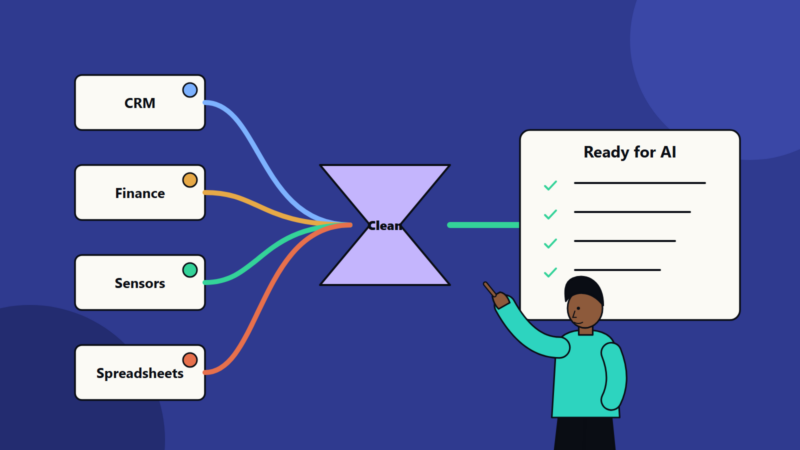
- Better analytics and AI: models need clean, well-described data. See data quality for machine learning.
- Lower risk: fewer leaks and fewer costly errors.
Data governance basics: core roles
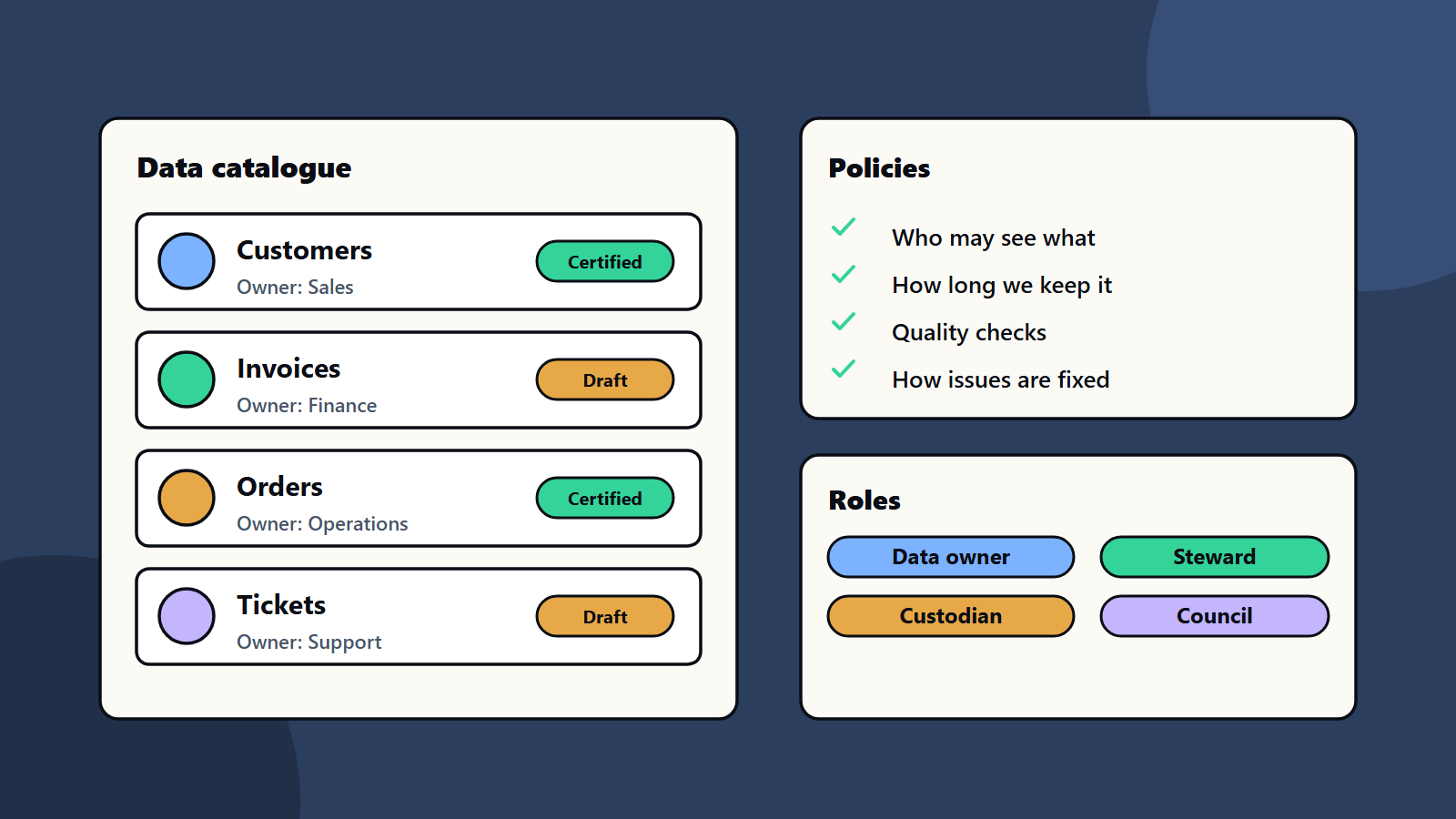
- Data owner: a business leader accountable for a dataset, such as customers or invoices.
- Data steward: a person who looks after quality and definitions day to day.
- Data custodian: the technical team that stores and protects the data.
- Governance council: a small group that settles disputes and approves policies.
In a small firm one person may hold several roles. Write the names down anyway.
The data catalogue
A catalogue is a searchable list of your data. For each dataset it shows:
- A plain description.
- The owner.
- Where it lives.
- Fields and meanings.
- Quality status.
- Who may use it.
- Where it came from and where it goes, which is called lineage.
Begin with a shared document if you must. Move to a catalogue tool as you grow. See our guides to data lakehouse architecture and self-service analytics.
Policies to write first
Keep each policy to a page.
- Access: who may see what, and how access is approved and removed.
- Quality: checks, thresholds and who fixes problems.
- Retention: how long each type of data is kept and how it is deleted.
- Privacy: how personal data is collected, used and protected.
- Sharing: rules for giving data to partners and vendors.
- Definitions: one meaning for key terms, such as active customer and revenue.
The NIST Privacy Framework is a voluntary tool that helps organisations manage privacy risk, and it can inform your privacy policy. Check the laws that apply in each country where you work.
Quality rules
Pick a few checks for your key data: complete, valid, unique, timely and consistent. Run them automatically in your pipelines, and alert the owner when something fails. See data pipeline reliability.
Security and access
Give people the least access they need. Log who views sensitive data. Mask personal details where analysis does not need them. See our small business cybersecurity guide and the notes on data residency and sovereignty.
Roll it out in steps
- Pick scope: choose three to five datasets that matter most.
- Name owners and stewards.
- Describe the data: write the catalogue entries.
- Write the first policies.
- Add quality checks and dashboards.
- Train people and share the rules. See change management.
- Review every quarter and add more data.
Our data analytics maturity guide helps you see where to start.
Measure progress
- Share of key datasets with owners and catalogue entries.
- Data quality scores over time.
- Time to find and get access to data.
- Number of access and privacy issues.
- Policy review dates met.
Common mistakes
- Treating governance as a one-off project.
- Making IT the owner of business data.
- Writing long policies that nobody reads.
- Starting with all data at once.
- No link to real business problems.
- No checks, so rules stay on paper.
A starting plan
- List your top five datasets and their owners.
- Write definitions for ten key terms.
- Set three quality checks.
- Publish a one-page access policy.
- Review data governance basics with leaders each quarter.
How SoftSapien supports data governance
SoftSapien’s data consultants help teams set up data governance basics: roles, catalogues, policies, quality checks and training, across cloud and on-premises systems. See our data analytics and big data services.
To put order into your data, use the contact page to chat with our team, send a message or schedule a free consultation call.
Frequently asked questions
What is data governance?
A set of roles, rules and routines that decide who owns data, what it means, who may use it, how good it must be and how long it is kept.
Who should own data?
A business leader accountable for each dataset, supported by stewards for daily quality and a technical custodian for storage and protection.
What is a data catalogue?
A searchable list of datasets with descriptions, owners, location, fields, quality status, access rules and lineage.
Where should a small business start?
List the top five datasets and owners, define ten key terms, set three quality checks and publish a one-page access policy.
Can SoftSapien help set up governance?
Yes, from roles to tooling. Contact SoftSapien through the contact page to chat with our team, send a message or schedule a free consultation call.