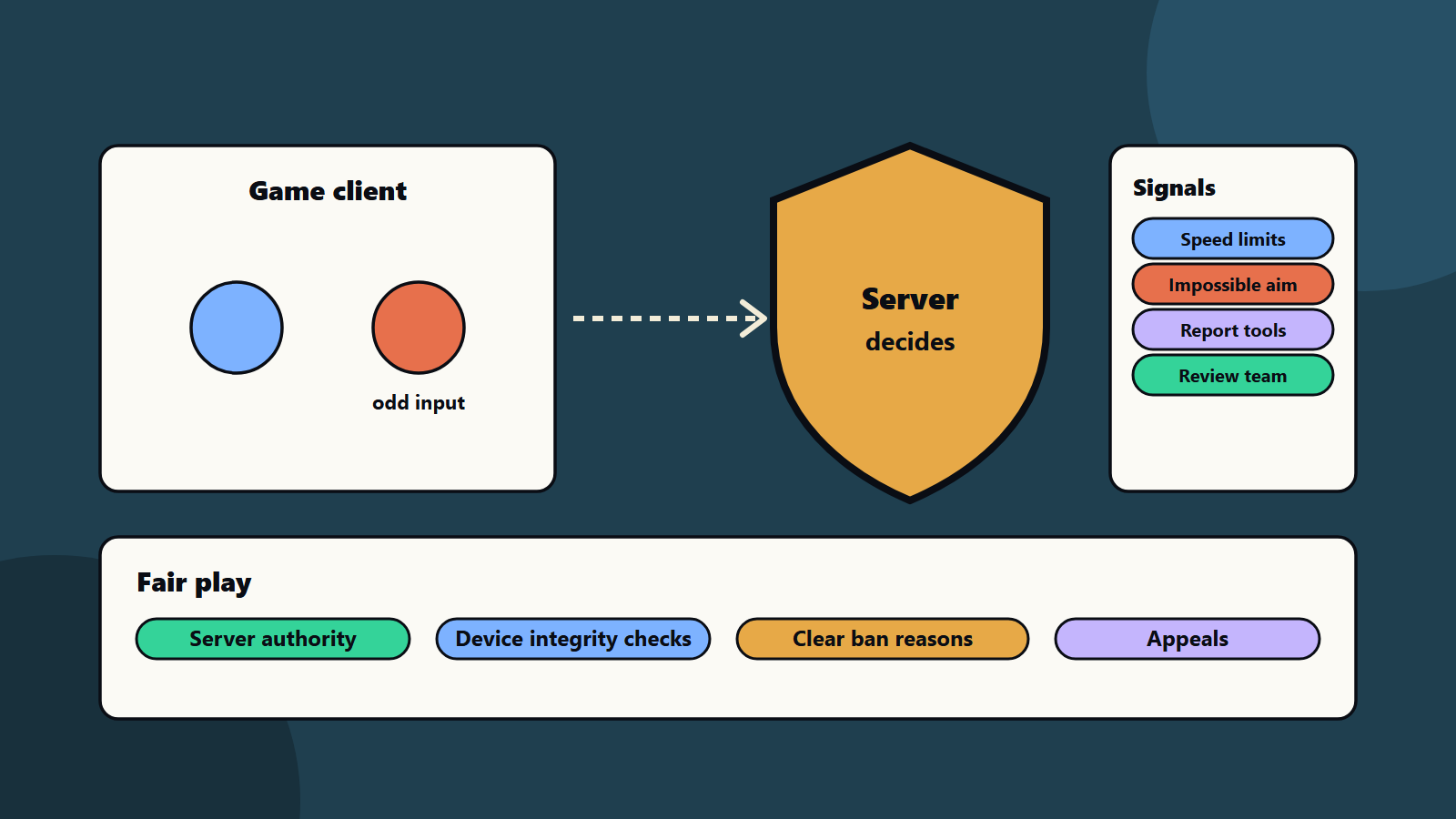
Short on time? Game anti-cheat starts with design: make the server the authority, validate every action and limit what clients can claim. Add detection for impossible behaviour, device and app integrity checks, reporting tools and a fair, explained penalty and appeal process. No system stops every cheater, so aim to make cheating costly, visible and rare.
Players forgive many flaws. They rarely forgive a match ruined by someone who cheats. Cheating drives away honest players, harms reviews and in games with real money in them, can create financial and legal trouble.
This article explains game anti-cheat basics for producers, designers and engineers, on mobile, PC and console. It focuses on defence and fair play. It suits a small team shipping a competitive game and a studio running a large online service.
Key takeaways
- The strongest protection is design: authoritative servers, validation and limited trust in clients.
- Layer defences: server checks, statistical detection, integrity checks, reporting and human review.
- Platform tools such as Play Integrity and Steam’s anti-cheat services help, and they are not complete answers.
- Explain bans clearly, offer appeals and protect innocent players from false positives.
- Treat anti-cheat as live operations, since cheaters adapt.
Start with design
Valve’s Steamworks documentation on anti-cheat gives two best practices that apply everywhere: run authoritative servers, and, in peer-to-peer games, have peers validate each other. It also advises explaining bans clearly in the game and notes that game bans are designed only to manage cheating.
In practice:
- The server decides outcomes. Clients send inputs, such as “move” or “fire”, and the server calculates hits, damage, currency and position. See multiplayer netcode.
- Never trust a number from the client for anything that affects fairness.
- Hide what players should not know. Do not send enemy positions that are out of sight, since cheating software can read them.
- Limit rates and ranges. Cap speed, fire rate, jump height and actions per second on the server.
- Keep secrets off the client: no keys or admin commands in the game build.
- Protect the economy: validate purchases on the server, and make rare items hard to duplicate. See game economy design.
Types of cheating to plan for
- Aim and vision assistance: software that helps aim or shows hidden information.
- Movement and speed manipulation.
- Memory and file tampering: changing values or game files.
- Network abuse: lag switches, packet manipulation and denial of service.
- Account and item fraud: stolen accounts, duplicated items and boosting.
- Collusion: players working together to win unfairly.
- Tampered or unofficial builds on phones and computers.
Each type needs a different mix of defences.
Layers of defence
Server validation
Reject impossible actions at once, and log them. This stops many cheats without any client software.
Statistical and behaviour detection
Analyse data to spot players whose results are far outside the normal range: accuracy, reaction time, win rate or resource gains. Look at patterns over many matches, since single events mislead, and use human review before action. See game analytics.
Client and device integrity
On Android, Google’s Play Integrity API helps you check that requests come from your genuine, unmodified app, installed by Google Play, running on a genuine Android device. Your app asks for an integrity verdict at important moments, and your back-end server decides what to do with it. Other platforms offer their own integrity tools, and dedicated anti-cheat products exist for PC. Read each provider’s current terms, privacy rules and support for your target systems.
The OWASP Mobile Application Security Verification Standard includes a resilience group that covers resistance to reverse engineering and tampering. Treat client protections as speed bumps that raise the cost of cheating, since a determined attacker can bypass them. See our mobile app security checklist.
Reporting and review
Give players an easy way to report suspected cheaters, with a short form and match replay where possible. Triage reports with data, and put a trained team or process behind them.
Account security
Use strong sign-in, such as passkeys, to reduce stolen accounts. See passwordless authentication.
A worked example: a 5 against 5 shooter
This example is illustrative.
A small studio is launching a team shooter on PC and mobile.
- Design: dedicated servers decide hits and movement. Enemy positions are sent only when a player could plausibly see them.
- Server rules: speed, fire rate and recoil limits, with logs of rejected actions.
- Detection: a weekly job flags accounts with extreme accuracy and reaction times for review.
- Integrity: the mobile build requests an integrity verdict before ranked matches, and the server limits ranked play for failed checks while allowing casual play.
- Reporting: a one-tap report during and after matches, with the match saved for review.
- Review and penalties: a small team reviews flagged cases. First confirmed offence: removal from ranked play for a period. Repeat: ban with a clear message and an appeal route.
- Communication: a monthly post on how many accounts were actioned and what players can do.
The team reviews numbers weekly and adjusts thresholds to keep false positives low.
Fairness and trust
- Tell players what you do at a high level, without giving cheaters a manual.
- Explain actions. Say which rule was broken.
- Offer appeals with a human review.
- Avoid collateral damage: do not ban on weak evidence.
- Respect privacy. Collect only what you need for anti-cheat, explain it in your notice and follow laws on data and on children. See game data privacy and children.
- Mind accessibility. Some players use assistive devices and settings that look unusual. Treat them fairly. See game accessibility.
Operate it as a live service
- Monitor detection rates, report volumes and appeal outcomes.
- Update rules and models as cheats change.
- Share findings across design, engineering, support and community teams. See game live operations.
- Test with your own red team before launch. See penetration testing explained.
Small studio and large publisher views
- Small studio: authoritative servers, rate limits, a simple report button, a clear ban policy and platform integrity checks. Skip heavy custom systems at first.
- Mid-size studio: add behavioural detection, a review process and a dashboard.
- Large publisher: run a dedicated trust and safety team, shared tools across titles, partner anti-cheat services and public transparency reports.
Regional and platform notes
Platform rules, consumer law and privacy rules differ across regions, and some regions limit certain kinds of monitoring. Console and store holders have their own rules about security tools. Check each before you ship.
Common mistakes
- Trusting the client.
- Sending hidden information to every player.
- Relying on one anti-cheat product.
- Banning on thin evidence.
- No appeal route.
- Silence about enforcement.
- Treating anti-cheat as a launch task only.
A starting plan
- Review your game for client-trusted values, and move decisions to the server.
- Add rate limits and logs for rejected actions.
- Add reporting and a basic review process.
- Add platform integrity checks for ranked and paid features.
- Review game anti-cheat results monthly, and share a plain summary with players.
How SoftSapien supports game anti-cheat
SoftSapien’s game engineers and security consultants review designs for cheat risks, build server validation and detection, add platform integrity checks and help set up reporting and enforcement for mobile, PC and console titles. See our game development and cybersecurity consulting services.
To protect fair play in your game, use the contact page to chat with our team, send a message or schedule a free consultation call.
Frequently asked questions
What is the best anti-cheat defence?
Design. Make the server the authority, validate every action and do not trust numbers sent by the client.
Do integrity checks stop all cheating?
No. Platform tools such as Play Integrity help confirm a genuine app and device, and they raise the cost of cheating without removing it.
How do we avoid banning innocent players?
Use several signals, human review for serious actions, clear reasons and an appeal route.
Does anti-cheat raise privacy concerns?
Yes. Collect only what you need, explain it in your notice and follow privacy laws and platform rules, including those for children.
Can SoftSapien help protect our game?
Yes, with design reviews and tools. Contact SoftSapien through the contact page to chat with our team, send a message or schedule a free consultation call.