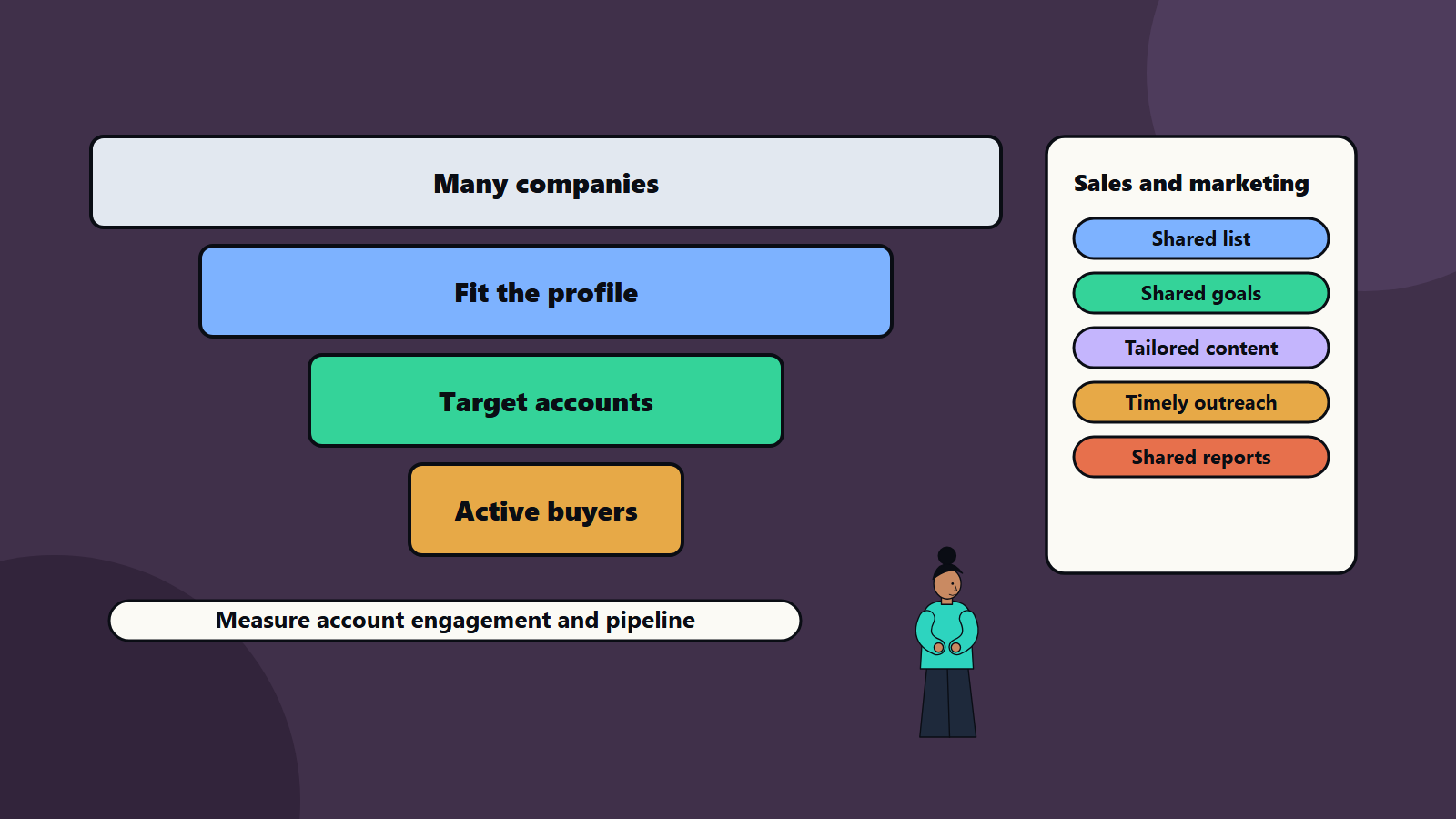
Short on time? Account-based marketing focuses sales and marketing on a short list of target companies with no wide crowd to chase. Pick accounts that fit your best customers, map the buying group, create content for each role, run joined-up outreach and measure account engagement and pipeline. It suits technology services with long sales cycles and high deal values.
Most marketing aims at a large audience and hopes a few people turn into leads. Technology services often sell to a small set of companies, with many people involved in each decision. Casting a wide net wastes effort in that case.
Account-based marketing, often shortened to ABM, flips the model. You choose the accounts first, then build everything around them. This article explains how to run account-based marketing for a B2B technology firm, from a small agency to a global provider.
Key takeaways
- Account-based marketing starts with a chosen list of accounts, and a wide audience comes second.
- Sales and marketing build the list, goals and plan together.
- Map the buying group and give each role useful content.
- Run coordinated outreach across email, ads, events and direct contact.
- Measure account engagement and pipeline, and review the list often.
When ABM fits
ABM works best when:
- Deals are large and sales cycles are long.
- Several people decide together.
- You can name the type of company that gains most from your service.
- The number of target companies is small enough to treat individually.
For small deals sold to many buyers, standard campaigns may suit better. Many firms use both: broad content for awareness and ABM for the key accounts.
Choose the right accounts
- Study your best customers. What do they share: industry, size, systems, region, challenges?
- Write an ideal customer profile.
- Build a long list from your data, sales knowledge and market research.
- Score accounts on fit, need, timing and potential value.
- Pick tiers. A common approach is a few accounts with deep, personal work, a larger group with tailored programmes and a wider group with light, targeted campaigns.
- Agree the list with sales leaders. Shared ownership is what makes ABM work.
Map the buying group
Each account has several roles:
- A sponsor with the budget.
- A technical evaluator.
- Users who will live with the result.
- Finance, legal, security and procurement reviewers.
- Influencers inside and outside the company.
Research each role. What do they worry about? What do they read? Use the company’s public news, reports and job posts. Our guide to content strategy for technical buyers covers questions by role.
Create relevant content
Content should fit the account and the role:
- Executives: outcomes, cost and risk.
- Technical leads: architecture, integration and proof.
- Finance: cost models and return. See technology investment business case.
- Security and legal: compliance and data handling.
Options include tailored guides, short reports, briefings, workshops and case studies. See case studies that win technical buyers. Use real evidence only, and never invent results or quotes.
Run coordinated outreach
Use several channels in step:
- Email and direct messages from sales and marketing together. See B2B email marketing.
- Paid ads shown to people at target accounts. Google’s help pages explain that Customer Match lets advertisers reach people using their own customer data lists, and memberships expire after 540 days. See the Customer Match guidance, and check consent rules for each region you target.
- Social media and communities. See B2B social media platforms.
- Events and webinars, with personal invitations.
- Direct contact from sales, timed to interest signals.
- Website personalisation for visitors from target accounts. See digital experience personalisation.
Plan a sequence for each tier, with dates and owners.
Respect privacy and local rules
Rules on consent, direct marketing and data use differ by country. Check them for every market, use accurate data and honour opt-outs. If you run campaigns in several regions, adapt language, examples and timing. See international SEO and hreflang for language setup.
Align sales and marketing
- Share one account list, one plan and one set of goals.
- Meet weekly to review account activity.
- Agree what counts as a signal of interest, such as repeat visits, content downloads or event attendance, and how sales follows up.
- Give sales content that is ready to send.
- Feed learning back into the plan.
Measure ABM
Traditional lead counts miss the point. Track:
- Coverage: share of target accounts reached, and of key roles reached.
- Engagement: visits, content use, replies and meetings per account.
- Pipeline: opportunities created at target accounts, and their value.
- Velocity: time from first touch to deal stages.
- Win rate and deal size against non-ABM deals.
- Cost: spend per account compared with return.
Set up tracking and a customer relationship system that links activity to accounts. See performance marketing attribution and GA4 setup and governance. <!– expanded –>
What the big platforms say about the tools involved
ABM depends on a few tools and rules from large platforms.
Google’s help pages on Customer Match explain that advertisers can upload a list of their own customer data and target ads to those people across Search, Shopping, Gmail, YouTube and Display when they are signed in to Google. Memberships expire after 540 days unless the list is refreshed. For users in the European Economic Area, consent signals must be passed to Google under its policy. Treat these rules as design inputs and check the current text before each campaign.
Google’s advice on helpful, reliable, people-first content applies to the content you build for accounts too: be original, thorough and clear about who made it and why.
For email outreach, Google’s sender guidelines set standards for authentication, one-click unsubscribe and low spam rates. They matter even for small, personal sequences, because poor sender reputation harms every message. See B2B email marketing for technology firms.
A worked example: a cloud migration service
This example is illustrative.
A services firm sells cloud migration for mid-size manufacturers.
Ideal customer profile: manufacturers with 200 to 2,000 employees, an ageing data centre, a plan to adopt cloud and no large internal cloud team.
Account list: sixty companies from sales knowledge, trade event lists and market research. Marketing and sales review it together and cut it to forty.
Tiers:
- Tier one: five accounts with personal plans.
- Tier two: fifteen accounts with tailored sequences.
- Tier three: twenty accounts with light programmes.
Buying group map for a tier one account:
- Sponsor: chief operating officer, who worries about downtime.
- Technical lead: head of IT, who worries about risk and skills.
- Finance: financial director, who wants a cost view. See data centre versus cloud comparison.
- Security: information security manager.
- Procurement: buyer who will ask for terms and exit rights.
Content for each role:
- A short briefing on downtime-safe migration for the sponsor. See cloud migration checklist.
- A technical walk-through for the head of IT.
- A cost model for finance.
- A security overview, with real certifications only.
- A plain summary of contract terms, including exit.
Sequence over six weeks:
- Week one: a personal note from a senior person, with a useful briefing.
- Week two: ads shown to the target accounts.
- Week three: an invitation to a small roundtable.
- Week four: a follow-up with a relevant case study when one is available and approved.
- Weeks five and six: a call to offer a free review of their plan.
Measures: meetings booked, roles engaged per account, opportunities created and stage progress.
Budget and team
ABM can start small.
- People: a marketing owner, a sales lead, and part-time help from design, data and a subject expert.
- Tools: a customer relationship system, an email platform, an ad platform and analytics. Add account intelligence and orchestration tools as the programme grows.
- Budget: content, events, ads and data. Plan a small pilot, then increase spend on what works.
- Cadence: weekly account reviews, monthly performance reviews and a quarterly list refresh.
Tier playbooks
Tier one: one to one
- Research the account in depth.
- Build a custom plan, with a named sales owner.
- Create content only for them, such as a briefing on their market.
- Use personal outreach and invitations to small events.
Tier two: one to few
- Group accounts by shared needs, such as industry or system.
- Build one set of content per group, with account-specific details added.
- Run sequences across email, ads and social.
Tier three: one to many
- Use targeted ads and content to the account list.
- Watch engagement, and promote accounts that show interest to a higher tier.
Common objections and answers
- “We lose reach.” ABM does not replace broad content. It adds focus where deals are large.
- “It takes too much time.” Start with five accounts, and grow after you see results.
- “Sales will not follow up.” Agree the trigger, the owner and the response time in writing.
- “Our data is poor.” Clean the account list first. It is a small, valuable data set.
- “We cannot measure it.” Measure accounts. See performance marketing attribution.
Local and international accounts
Target accounts may sit in several countries. Write in clear, simple English that translates well. Where you localise, work with native reviewers. Adjust examples, case studies, time zones and currencies. Check the rules for direct marketing and data in each country. See international expansion and localising B2B content.
A ninety-day plan
- Days one to thirty: build the profile, list, tiers and buying group maps. Agree goals with sales. Set up tracking.
- Days thirty-one to sixty: create content for tier one and two. Launch the first sequences and ads.
- Days sixty-one to ninety: review engagement, follow up with sales on every signal, drop weak accounts and add new ones. Report results to leaders.
Common mistakes
- Choosing accounts without sales input.
- A list that is too long to treat well.
- Generic content with a company name added.
- Ignoring the wider buying group.
- No sales follow-up on signals.
- Judging success by lead counts.
- Never refreshing the list.
A starting plan
- Write the ideal customer profile with sales.
- Pick twenty accounts and map their buying groups.
- Create one tailored asset for each role.
- Run a six-week outreach sequence.
- Review account engagement and pipeline, then adjust your account-based marketing plan.
How SoftSapien supports account-based marketing
SoftSapien’s strategists help technology firms design account-based marketing: account selection, content, outreach, tracking and sales alignment. See our performance marketing and digital PR services.
To focus on the accounts that matter, use the contact page to chat with our team, send a message or schedule a free consultation call.
Frequently asked questions
What is account-based marketing?
A model where sales and marketing choose target companies first and build content and outreach around them, instead of chasing a wide audience.
When does ABM fit?
When deals are large, sales cycles are long, several people decide and the number of target companies is small enough to treat individually.
How do we measure ABM?
Track account coverage, engagement, pipeline created, deal velocity, win rate and cost per account, rather than lead counts.
How do we start?
Write the ideal customer profile with sales, pick twenty accounts, map buying groups and run a six-week sequence.
Can SoftSapien help run ABM?
Yes, with strategy and delivery. Contact SoftSapien through the contact page to chat with our team, send a message or schedule a free consultation call.